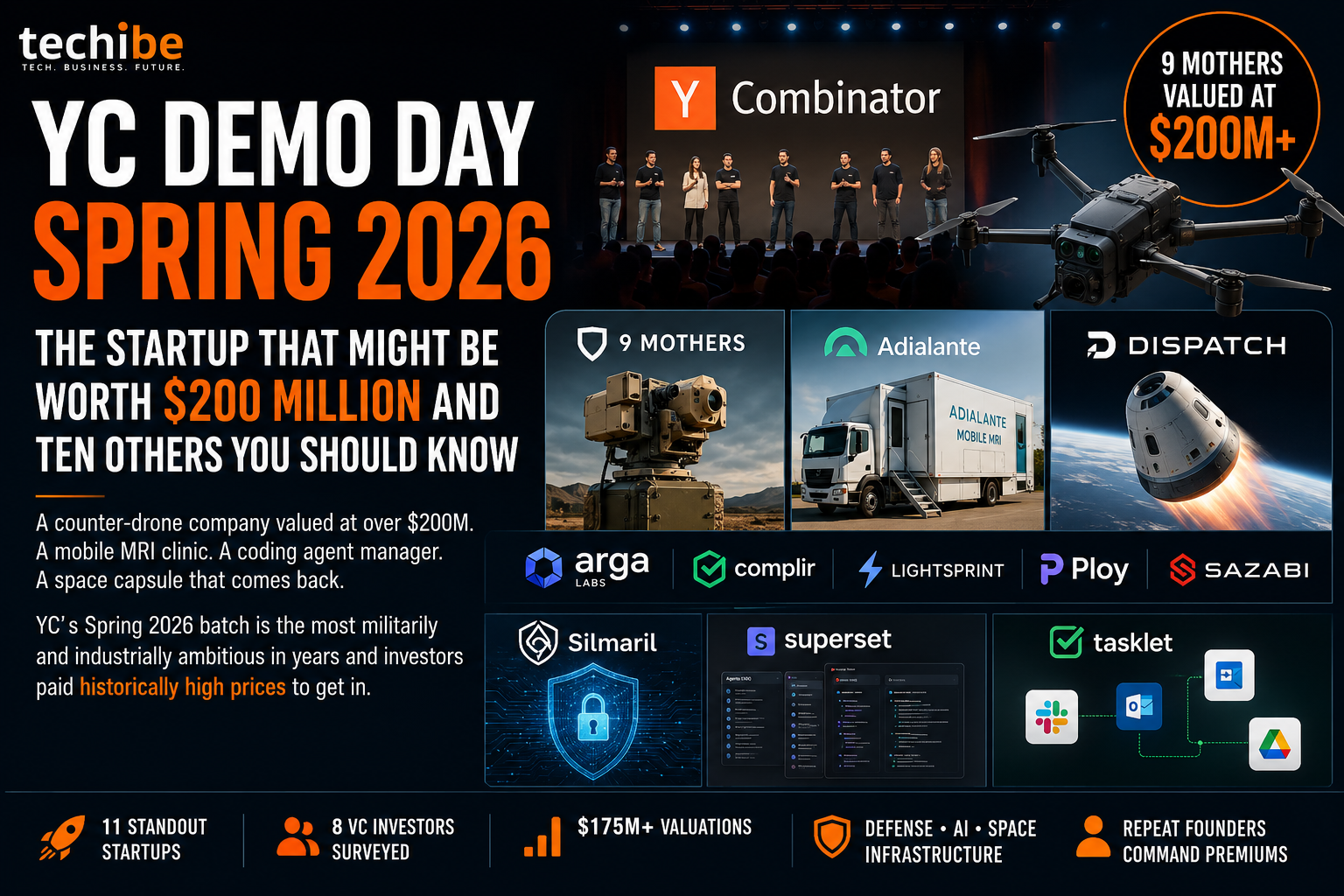
A counter-drone company was founded two years ago. A mobile MRI clinic. A coding agent manager. A space capsule that comes back. YC’s Spring 2026 batch is the most militarily and industrially ambitious in years, and investors paid historically high prices to get in.
On Tuesday, June 18, 2026, Y Combinator announced its Spring 2026 cohort during Demo Day in San Francisco. To find out which companies created the most buzz at Y Combinator’s Summer 2018 Demo Day, TechCrunch polled eight investors to tally votes, vetting only those mentioned by two or more individual VCs. It is simply a compilation of 11 startups that reveals more about the venture capital direction than any trend report.
The headline number first: at least two startups in this batch commanded valuations of $175 million or more. One counter-drone defense startup, 9 Mothers, is reportedly valued at over $200 million, making it among the most valuable companies in YC history at the time of Demo Day.
What is being funded at these prices says something specific. Defense tech. Physical AI. Space infrastructure developer tooling. The Spring 2026 batch is not a consumer app story. It is an infrastructure story, and the money follows accordingly.
What This Batch Tells You About 2026
Three clear patterns run through the 11 standouts VCs flagged. The first is defense and dual-use technology. 9 Mothers builds counter-drone systems. Silmaril builds an AI security infrastructure against prompt injection attacks. The line between defense tech and enterprise security has never been thinner, and investors are not pretending otherwise.
The second pattern is the tooling layer for AI agents. Arga Labs, Superset, Tasklet, Sazabi, and Lightsprint all sit in the same broad category: infrastructure and tooling for a world where software is increasingly written, tested, deployed, and managed by AI agents rather than human engineers. These companies are not betting on AI. They are betting that AI agents have already won and are now building the roads and pipelines those agents need to function.
The third pattern is repeat founders. Bryant Chou, co-founder and former CTO of Webflow, last valued at $4 billion, is behind Ploy. Sherwood Callaway, an a16z scout and former Brex and 11x employee, is behind Sazabi. Investors are paying a premium for people who have built before. In a batch this competitive, provenance matters.
The 11 Standout Startups
1. 9 Mothers The One Everyone Is Talking About
What it builds: AI-powered counter-drone systems. 9 Mothers is the most-discussed company in this batch, and the numbers explain why.
Founded in 2024. Already $1.6 million in booked sales. A single existing contract is expected to expand to $35 million later this year. A projected pipeline of $1 billion in contracts. Valuation reportedly north of $200 million.
The context is impossible to ignore. The Russia-Ukraine conflict demonstrated that small commercial drones have become one of the most effective and lethal tools on the modern battlefield, accounting for roughly 80% of casualties in some analyses. Existing counter-drone solutions are expensive and struggle with low-altitude drone swarms. 9 Mothers claims it has built something more affordable that can track and neutralize drones flying at 60 miles per hour.
Whether a two-year-old startup can deliver on a $1 billion pipeline is a legitimate question. Whether investors are willing to bet on that question at $200 million, evidently, yes.
2. Arga Labs The Testing Bottleneck No One Talks About
What it builds: Digital twin environments for AI agent testing. AI generates code faster than testing environments can handle it. That sentence describes one of the most unglamorous and consequential infrastructure problems in software development right now.
Arga Labs builds digital twins of a company’s software stack, exact replicas that spin up instantly and allow AI agents to test code safely before it hits production. The problem it is solving is real and growing: as AI coding agents proliferate, the test-and-deploy pipeline becomes the constraint.
3. Adialante The Mobile MRI That Could Change Cancer Detection
What it builds: Compact, mobile MRI units for early cancer detection. This one is different from everything else on this list.
The premise: MRI machines cost millions to buy and tens of thousands annually to maintain. As a result, they are reserved for patients who are already symptomatic. Adialante has designed a compact MRI unit that fits in a small truck. Its business model is to bring these machines to clinics and charge $250 per scan, with the explicit goal of transforming MRI from a reactive diagnostic tool into a routine annual screening.
That ambition is enormous. Executing it involves regulatory approval, clinical validation, logistics infrastructure, and healthcare system adoption. But if Adialante can pull it off, the implications for early cancer detection are significant enough that investors are taking it seriously.
4. Complete the Paperwork Problem Behind Every Cross-Border Shipment
What it builds: AI agents for international product compliance. Shipping physical goods across borders is a compliance nightmare that most people outside of logistics and regulatory affairs do not see until it bites them.
Every country has its own labeling requirements, ingredient restrictions, translation standards, and documentation demands. Complir builds AI agents that monitor compliance requirements, track regulatory changes, and generate the documentation and labels a product needs to ship legally into each target market.
The pain point is specific and real. The AI application is straightforward. Investors recognizing both is not surprising.
5. Dispatch The Space Supply Chain Startup
What it builds: Reusable vehicles for returning space-manufactured products to Earth.
Space manufacturing pharmaceuticals, semiconductors, and 3D-printed human tissues produced in microgravity is no longer science fiction. It is a small but growing industry. The missing piece is reliable, cost-effective return logistics.
Most space capsules that re-enter the atmosphere are either destroyed or discarded. Dispatch is designing reusable vehicles that can withstand re-entry, return products to Earth, be refurbished, and go back up. The model is borrowed from what SpaceX did to launch vehicles, applied to return capsules.
Investors are betting that the addressable market for this grows fast enough to justify the capital intensity. Dispatch is the earliest bet in this batch on an infrastructure play that may not mature for several years.
6. Lightsprint Ship Features Without an Engineer
What it builds: A tool that lets non-engineers build and deploy production features. Product managers who have ever waited for engineering bandwidth to implement a change will understand this immediately.
Lightsprint lets a non-technical user describe a change, choose from visual options of how it should look, and have an AI agent build it. An engineer then reviews, approves, and merges the code. The product manager ships the feature without ever touching a code editor.
The question for Lightsprint is not whether product managers want this. They do. The question is whether engineering teams will accept it and whether the AI-generated code is reliable enough that review becomes a rubber stamp rather than a real check.
7. Ploy The Webflow Founder’s Next Bet
What it builds: AI-powered website building and marketing growth automation. Ploy is already funded. A $27 million seed round led by First Round Capital and Y Combinator closed shortly after Demo Day.
The founder matters here. Bryant Chou co-founded Webflow, which became one of the most widely used no-code website builders in the world. Ploy takes website creation further, not just building sites but continuously generating landing pages, writing copy, launching campaigns, and refining content based on inbound growth metrics.
The pitch is the elimination of a large portion of a marketing team’s workload. The founder’s track record makes VCs willing to pay a premium before the product proves itself.
8. Sazabi The Production Monitor Built by a Repeat Founder
What it builds: an AI platform for finding and fixing software production problems
When something breaks in production, someone has to find it, understand why it broke, and fix it. Sazabi automates significant parts of that process.
The tool integrates with Slack, performs log analysis to identify the source of production failures, and lets users request a fix in one click. The repeat-founder premium applies here: Sherwood Callaway’s background at a16z, Scout, Brex, and 11x is the kind of resume that makes investors move fast.
9. Silmaril Securing AI Agents From the Inside
What it builds: AI security infrastructure against prompt injection attacks.
As AI agents handle increasingly sensitive tasks, such as processing emails, accessing databases, and managing workflows, prompt injection attacks become one of the most consequential security vulnerabilities in enterprise software.
Prompt injection means a malicious actor embeds instructions in content that the agent reads, such as an email, a document, or a form that hijacks the agent’s behavior. Silmaril builds infrastructure that probes for these vulnerabilities autonomously and reconfigures its own firewall when it finds a new threat. In a world of autonomous AI agents, this is not a niche security product. It is a foundational one.
10. Superset Managing 100 Coding Agents at Once
What it builds: A platform for running and managing multiple coding agents simultaneously. Cursor, Claude, and other AI coding agents have changed how software gets written. Managing dozens or hundreds of them simultaneously without conflicts, without chaos, has not been solved.
Superset gives developers a single interface to launch up to 100 coding agents at once, each in its own isolated workspace. Any CLI-based agent can run on the platform. It integrates with VS Code, Cursor, and other development environments.
The premise assumes that the number of coding agents any given developer manages will keep growing. That assumption seems increasingly well-founded.
11. Tasklet The Everything Agent
What it builds: A task-performing AI agent that connects to work applications. Tasklet connects to Slack, Outlook, Google Drive, and other work tools via their APIs and executes multi-step tasks in natural language, sort these emails, pull this report, build this interface.
It runs continuously even after a tab is closed. It can write and execute its own code. It builds interfaces on the fly. Some investors have said they are moving away from horizontal AI agent plays, concerned about commoditization.
Tasklet is running against that trend. The bet is that a universal task interface, one place to give instructions across all your tools, is itself a durable product category rather than a feature that gets absorbed into something else. That bet is genuinely uncertain. Which makes it genuinely interesting.
The Number That Defines This Batch
$175 million-plus valuations at Demo Day. That number would have been extraordinary two years ago. Today, it represents the floor for the hottest companies in a YC cohort.
Part of that is the AI premium investors pay for potential in an environment where the potential feels genuinely large. Part of it is the repeat-founder premium. And part of it is defense tech, which attracts a different class of investor with a different risk tolerance and a different timeline.
The Spring 2026 batch is not trying to build the next consumer app. It is building the infrastructure for a world where AI agents work, drones fight, manufacturing happens in orbit, and cancer gets caught before it becomes terminal.
That is either the most ambitious YC cohort in years or a sign of how far valuations have drifted from reality. Probably some of both.
Frequently Asked Questions
What is Y Combinator Demo Day?
Y Combinator Demo Day is a biannual event where YC-backed startups present their companies to investors. The Spring 2026 Demo Day took place on June 18, 2026, in San Francisco, featuring the latest cohort of YC-funded companies.
Which startup had the highest valuation at YC Demo Day Spring 2026?
Another early-stage startup, Nine Mothers, which is focused on counter-drone defense and expected to be valued at over $200 million, was probably at that point the most valuable company ever funded by YC when it participated in Demo Day. Companies in the Spring 2026 batch ended up going public with valuations above $175 million for at least two other such companies.
What is 9 Mothers, and what does it build?
9 Mothers develops counter-drone systems that leverage artificial intelligence to identify, track, and terminate small commercial unmanned aerial vehicles (UAVs), which represent a growing share of battlefield casualties in contemporary warfare. Founded in 2024, the company has secured $1.6 million worth of booked sales with one contract predicted at $35 million and an estimated pipeline of $1 billion.
What themes dominated YC Demo Day Spring 2026?
Three distinct themes emerged: defense and dual-use technology (9 Mothers, Silmaril), tooling and infrastructure for AI agents (Arga Labs, Superset, Tasklet, Sazabi, Lightsprint), and repeat founders commanding premium valuations(Ploy’s Bryant Chou, and Sazabi’s Sherwood Callaway.
Which YC Spring 2026 startup has already announced a funding round?
Just after Demo Day, Ploy, a Webflow co-founder, Bryant Chou’s AI-driven website + marketing automation startup, announced a $27M seed round led by First Round Capital and Y Combinator.
What is prompt injection, and why does Silmaril matter?
A prompt injection refers to a cyber-attack whereby malicious instructions are inserted into content that an AI agent reads (e.g., email, document), causing that agent to act outside its intended design. Silmaril creates a self-defending security framework capable of identifying and immunity from these attacks. Prompt injection, one of the top emerging attack vectors as AI agents take on more enterprise-sensitive tasks.