
The most immediate danger is not a missile. It is a cyberattack or a severed undersea cable. But a new long-range stealth bomber and Pacific island bases could put all of Australia within striking range within the decade.
The Lowy Institute, a Sydney-based non-partisan think tank, released a report on Monday, June 15, 2026, finding that China’s ability to strike Australia militarily will grow markedly over the next decade, with the most immediate threats coming not from long-range missiles but from cyberattacks and the cutting of undersea communications cables. The report was published in Sydney and immediately drew international attention for its blunt assessment of a threat the think tank said most Australians do not fully understand.
One sentence in the report deserves to be read carefully: the Lowy Institute said it was assessing Beijing’s capability, not its intentions.
That distinction matters enormously. Capability and intention are different things. The report is not saying China plans to attack Australia. It is saying China is building the tools to do so and that the gap between “cannot” and “can” is closing faster than public debate has acknowledged.
What China Can Do Right Now
Start with the present, because it is already significant.
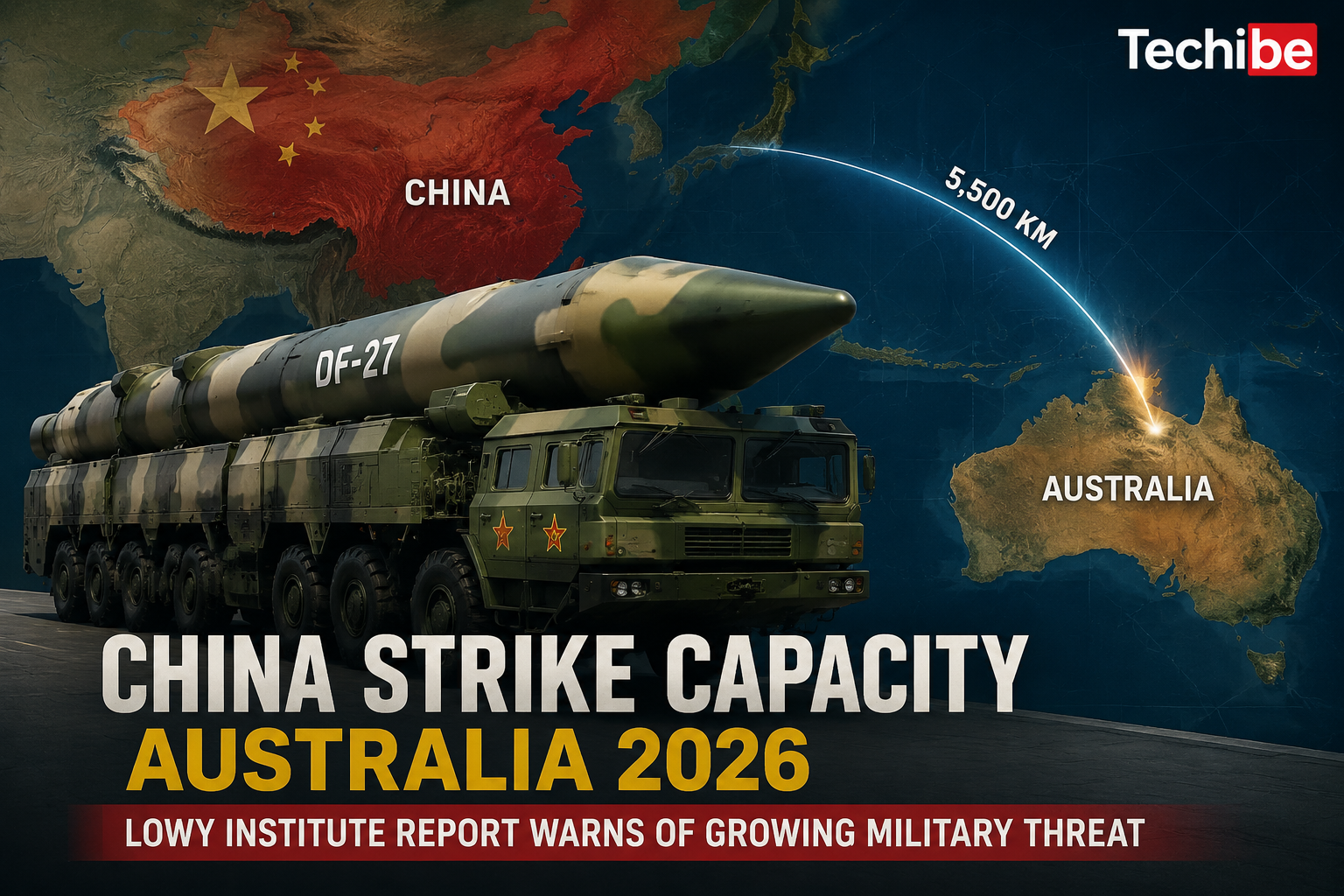
China is currently capable of striking Australia with missiles fired from ships, submarines, and land-based launchers. The weapon the Lowy Institute singles out as the primary existing threat is the DF-27, China’s intermediate-range ballistic missile. According to the US military’s own December 2025 assessment, the DF-27 has a range of 5,000 to 8,000 kilometres. Australia’s northwest coast sits approximately 5,500 kilometres from China’s eastern seaboard.
The math is not comfortable.
The DF-27 can already reach Australian territory from Chinese soil. As missile numbers in service grow, as the report expects, the number of launchers capable of striking Australia at any given moment increases proportionally. A single missile in inventory is a capability. Hundreds of them deployed on mobile launchers is a posture.
What Changes Over the Next Decade
The current threat is serious. The projected threat is substantially worse. The Lowy Institute identified three developments that could dramatically expand China’s strike capacity against Australia within the next ten years.
The first is China’s new long-range stealth bomber, currently under development and not yet in service. Its specifications have not been fully disclosed publicly, but the Lowy Institute assesses that its deployment would represent a qualitative shift in China’s ability to project power at range. A stealth bomber operating from Chinese territory could threaten targets across Australia, not just the northwest coast.
The second is Pacific island-based. China has been actively seeking basing arrangements in Pacific Island nations since at least 2018.
The report is direct about what that would mean:
“Any such base would bring central Australia within bomber combat range and allow attacks to be mounted more frequently.”
The Solomon Islands is the most discussed candidate. In 2022, Solomon Islands signed a security pact with China that alarmed both Australia and the United States. Solomon Islands Prime Minister Matthew Wale, visiting Australia earlier this month, said his country would negotiate a comprehensive strategic treaty with Australia and review the China security pact. Whether that review produces a genuine change in the security architecture of the Pacific is not yet clear.
The third development is the possible deployment of missiles and aircraft to bases closer to Australia on artificial islands in the South China Sea or through arrangements with Pacific partners. The report describes this combination as capable of “quickly and dramatically” increasing the long-term threat.
The Immediate Threat Is Not a Missile
Here is the part of this story that most coverage is underweighting.
The Lowy Institute’s report does not say the most likely near-term Chinese action against Australia is a missile strike. It says the most immediate threats are cyberattacks and the cutting of undersea communications cables.
Those two threat vectors are already in play across the Indo-Pacific. Undersea cable sabotage attributed to state actors in several documented incidents across Europe and Asia over the past two years has emerged as one of the most effective and deniable tools for disrupting a country without triggering the threshold of armed conflict. Australia’s communications with the rest of the world run through a relatively small number of cable landing points. The vulnerability is real and not adequately protected.
Cyberattacks are the other side of the same coin. China’s cyber capabilities targeting critical infrastructure, government networks, and industrial systems have been documented extensively by Australian, American, and British intelligence agencies. The Lowy Institute is not raising a theoretical concern. It is describing an active threat environment that operates well below the threshold of conventional military confrontation.
The missile story gets the headlines. The cable and cyber story is the one that keeps security officials awake.
What the Report Deliberately Did Not Say
The Lowy Institute made a specific choice in framing this report that deserves attention.
It assessed capability. It did not assess intention.
The report said
“The direct military threat posed to Australia was not well understood by the public.”
and then deliberately limited itself to what China can do rather than what China wants to do. That is methodologically sound and also politically careful. Attributing intention to a state actor based on capability assessment is a significant step that intelligence agencies take carefully and think tanks take even more carefully.
The gap between Beijing’s capability and its intentions is where Australian foreign policy has been trying to navigate for years. Australia is China’s largest iron ore supplier. China is Australia’s largest trading partner. The economic relationship is deeply entangled in ways that make the military threat picture genuinely complicated.
The Lowy Institute is not recommending Australia treat China as an adversary. It is recommended that Australia understand what China could do and plan accordingly.
Where Australia Sits in a Shifting Region
The broader context of this report is a region changing faster than most public debate has kept up with.
China’s military build-up is reshaping the Indo-Pacific balance of power, as the Lowy Institute puts it, in ways that affect Australian security regardless of whether China ever fires a weapon at Australian territory. The presence of Chinese military assets closer to Australia in the South China Sea, potentially in the Pacific, changes the strategic calculus for Australian defence planners, for American alliance commitments, and for the smaller nations of the Pacific who are being courted by both Beijing and Canberra simultaneously.
Australia has responded with its own military investment. The AUKUS agreement, the trilateral security pact between Australia, the United Kingdom, and the United States, announced in 2021, is specifically designed to give Australia nuclear-powered submarines capable of operating across the Indo-Pacific. The first AUKUS submarines are not expected to be operational until the mid-2030s.
The Lowy Institute’s report lands in a gap. China’s strike capacity is growing now. Australia’s most significant new capability is a decade away. That gap is the thing the report is really about.
Frequently Asked Questions
What did the Lowy Institute report find about China’s military threat to Australia?
The Lowy Institute, a Sydney-based non-partisan think tank, released a report on June 15, 2026, finding that China’s ability to militarily strike Australia will grow markedly over the next decade. The report identified the DF-27 intermediate-range ballistic missile as the primary current threat, and a new long-range stealth bomber and Pacific island basing as the factors most likely to expand that threat over the next ten years.
Can China already strike Australia with missiles?
Yes. China’s DF-27 intermediate-range ballistic missile, which has a range of 5,000 to 8,000 kilometres according to US military assessments, can already reach Australian territory from Chinese soil. The threat grows as more of these missiles enter service.
What are the most immediate threats to Australia from China?
According to the Lowy Institute report, the most immediate threats are cyberattacks and the cutting of undersea communications cables, not conventional missile strikes. These threat vectors operate below the threshold of armed conflict and are already active in the broader Indo-Pacific region.
What is the significance of the Pacific island bases for China?
The Lowy Institute report states that any Chinese military base in a Pacific Island nation would bring central Australia within bomber combat range. China has been actively seeking basing arrangements in Pacific Island nations since at least 2018. The Solomon Islands, which signed a security pact with China in 2022, is the most closely watched case.
Does the report say China intends to attack Australia?
No. The Lowy Institute explicitly stated it was assessing China’s military capability — not its intentions. The report argues that the direct military threat to Australia is not well understood by the public and that Australia should plan based on what China can do, not assumptions about what it wants to do.
What is AUKUS and how does it relate to the China threat?
AUKUS is a trilateral security agreement between Australia, the United Kingdom, and the United States, announced in 2021. It is designed to provide Australia with nuclear-powered submarines capable of operating across the Indo-Pacific. The first AUKUS submarines are not expected to be operational until the mid-2030s, leaving a capability gap during the period the Lowy Institute identifies as most critical.