
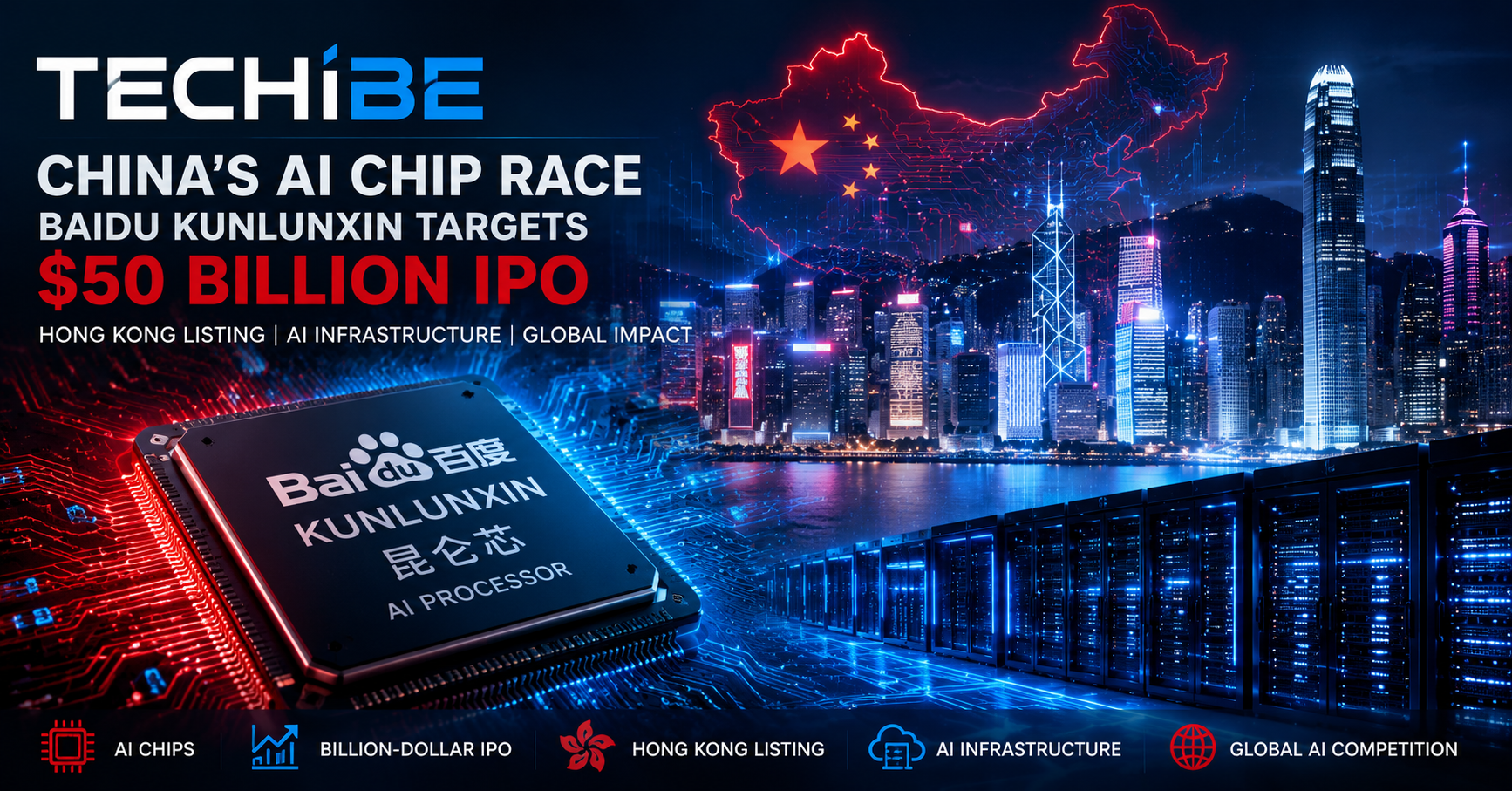
China's AI Chip Race Accelerates as Baidu's Kunlunxin Targets $50 Billion IPO
China's ambition to become a global leader in artificial intelligence is entering a new phase as Baidu's AI chip subsidiary Kunlunxin is reportedly preparing for an initial public offering (IPO) in Hong Kong that could value the company by around $50 billion.
If completed, this initial public offering (IPO) would rank among the largest AI-related IPOs in recent years, signaling growing investor confidence in China’s domestic semiconductor industry. The move also reflects Beijing’s broader strategy to reduce reliance on foreign AI hardware while bolstering local innovation in advanced computing technologies.
With the rising global demand for AI infrastructure, companies developing specialized AI processors are attracting unprecedented levels of investment. Kunlunxin’s initial public offering (IPO) demonstrates that AI chips are becoming one of the most valuable segments of the global technology industry.
Why AI Chips Have Become the Center of the AI Economy
Artificial intelligence depends on much more than software.
Behind every great language model, enterprise AI platform, recommendation engine, and autonomous system are specialized processors capable of handling massive amounts of computation.
These AI chips accelerate machine learning workloads by processing trillions of calculations while improving efficiency compared to traditional processors.
As organizations increasingly deploy complex AI applications, demand for advanced AI processors continues to grow in industries including cloud computing, healthcare, finance, autonomous vehicles, robotics, and manufacturing.
This trend has made AI semiconductors one of the fastest-growing markets in the global technology sector.
Baidu's Long-Term AI Strategy
Baidu has been investing heavily in AI for years, beyond its traditional search business.
The company now develops entry-level models, autonomous driving technology, cloud computing services, and AI infrastructure for enterprise customers.
Kunlunxin represents a key part of this strategy.
Rather than relying entirely on third-party chip suppliers, Baidu has invested in designing AI processors optimized for training and deploying machine learning models across its growing ecosystem.
The reported IPO could provide significant capital to accelerate research, manufacturing partnerships, and international development, while strengthening China’s domestic AI supply chain.
China's AI Chip Industry Is Expanding Rapidly
The global market for AI chips has become one of the most competitive areas of the technology industry.
While companies like Nvidia continue to dominate high-end AI accelerators, Chinese tech companies are investing billions of dollars to build domestic alternatives capable of supporting the country’s rapidly growing AI ecosystem.
Government support, increased research funding, and rising enterprise demand have accelerated innovation in China's semiconductor sector. Companies are developing AI processors for cloud computing, edge AI, autonomous vehicles, smart manufacturing, and enterprise applications, thereby reducing reliance on imported hardware.
Kunlunxin’s initial public offering reflects this broader shift within the industry. Investors increasingly view AI semiconductor companies as long-term infrastructure businesses rather than traditional hardware manufacturers.
Competing in the Global AI Infrastructure Race
The AI revolution is no longer defined solely by chatbots or large language models.
Today’s competition revolves around the infrastructure that powers these technologies, including AI chips, hyperscale data centers, networking equipment, advanced memory, and cloud platforms.
Every major AI company relies on powerful processors to train and deploy increasingly complex machine learning models. With the increasing demand for productive AI, the need for reliable, high-performance AI hardware has become a strategic priority worldwide.
China's investment in companies like Kunlunxin demonstrates the country's determination to bolster its domestic artificial intelligence capabilities, despite ongoing geopolitical tensions and export restrictions affecting advanced semiconductor technologies.
Rather than relying entirely on foreign suppliers, Chinese technology companies are building vertically integrated AI ecosystems that combine hardware, software, and cloud infrastructure.
Why Investors Are Paying Attention
Artificial intelligence has become one of the strongest investment themes in global markets.
Companies active in AI infrastructure have attracted significant capital as investors look beyond software and recognize the long-term value of innovation in semiconductors.
A successful Hong Kong IPO could provide Kunlunxin with significant funding for next-generation chip development, engineering talent, manufacturing partnerships, and the expansion of enterprise solutions.
It would also strengthen Hong Kong’s position as a major financial hub for technology companies seeking access to international investors, while maintaining close ties to China’s rapidly expanding AI economy.
For enterprise customers, increased competition in AI chips could ultimately lead to better performance, greater supply chain diversity, and greater innovation in cloud computing and AI platforms.
What This Means for the Future of AI
The race to master AI is increasingly becoming a race to build the infrastructure behind it.
While software companies continue to develop larger language models and AI-powered applications, semiconductor manufacturers are providing the computational foundations that make these innovations possible.
Industry analysts expect global demand for AI processors to continue to grow throughout the decade as companies accelerate investments in automation, cloud AI services, robotics, autonomous systems, and edge computing.
For China, expanding domestic AI chip production is both an economic opportunity and a strategic priority. Strengthening local semiconductor capabilities could reduce dependence on foreign suppliers while supporting the country’s long-term AI ambitions.
Kunlunxin's IPO shows how AI hardware companies are becoming major players in the global tech ecosystem, rather than operating behind the scenes.
A New Phase in the Global AI Chip Competition
Competition in the AI semiconductor market is expected to intensify in the coming years.
Alongside established leaders such as Nvidia, AMD, Broadcom, Qualcomm, Google, and Amazon, emerging companies are also investing heavily in specialized processors designed specifically for AI training and inference.
Instead of competing solely on raw computing power, the next generation of AI chips will focus on energy efficiency, lower latency, advanced networking capabilities, and optimized performance for enterprise workloads.
This evolution is expected to drive innovation in cloud infrastructure, data centers, enterprise software, and AI-based services worldwide.
For investors, the semiconductor industry is increasingly seen as one of the most important pillars of the AI economy.
Conclusion
Baidu's reported plan to take Kunlunxin public in Hong Kong at a potential valuation of $50 billion shows how valuable AI semiconductor companies have become in today's tech landscape.
As demand for AI increases, investments are shifting from software to infrastructure that powers next-generation AI systems. AI chips are now among the most important strategic assets in the global technology industry.
Whether or not Kunlunxin ultimately achieves its target valuation, the proposed IPO reflects a much broader trend: the global AI competition is increasingly being shaped by companies that build the processors, cloud infrastructure, and computing platforms that enable future innovation.
For businesses, developers, and investors, the AI chip market will continue to be one of the most important sectors to watch over the next decade.
FAQs
1. What is Kunlunxin?
Kunlunxin is Baidu's artificial intelligence chip subsidiary, focused on developing processors optimized for AI training, inference, and enterprise computing.
2. Why is Kunlunxin planning an IPO?
The reported Hong Kong IPO could help the company raise capital for AI chip research, product development, manufacturing partnerships, and global expansion.
3. Why are AI chips so important?
AI chips provide the computing power needed to train and run advanced machine learning models, making them essential for cloud computing, generative AI, and enterprise AI applications.
4. How does this affect the global AI chip market?
Kunlunxin's planned IPO reflects growing competition in AI semiconductors and highlights China's efforts to strengthen its domestic AI infrastructure.
5. Will this challenge Nvidia?
Nvidia remains the global leader in AI accelerators, but increasing investment from companies like Baidu demonstrates that competition in AI chips is expanding rapidly and driving innovation across the industry.