
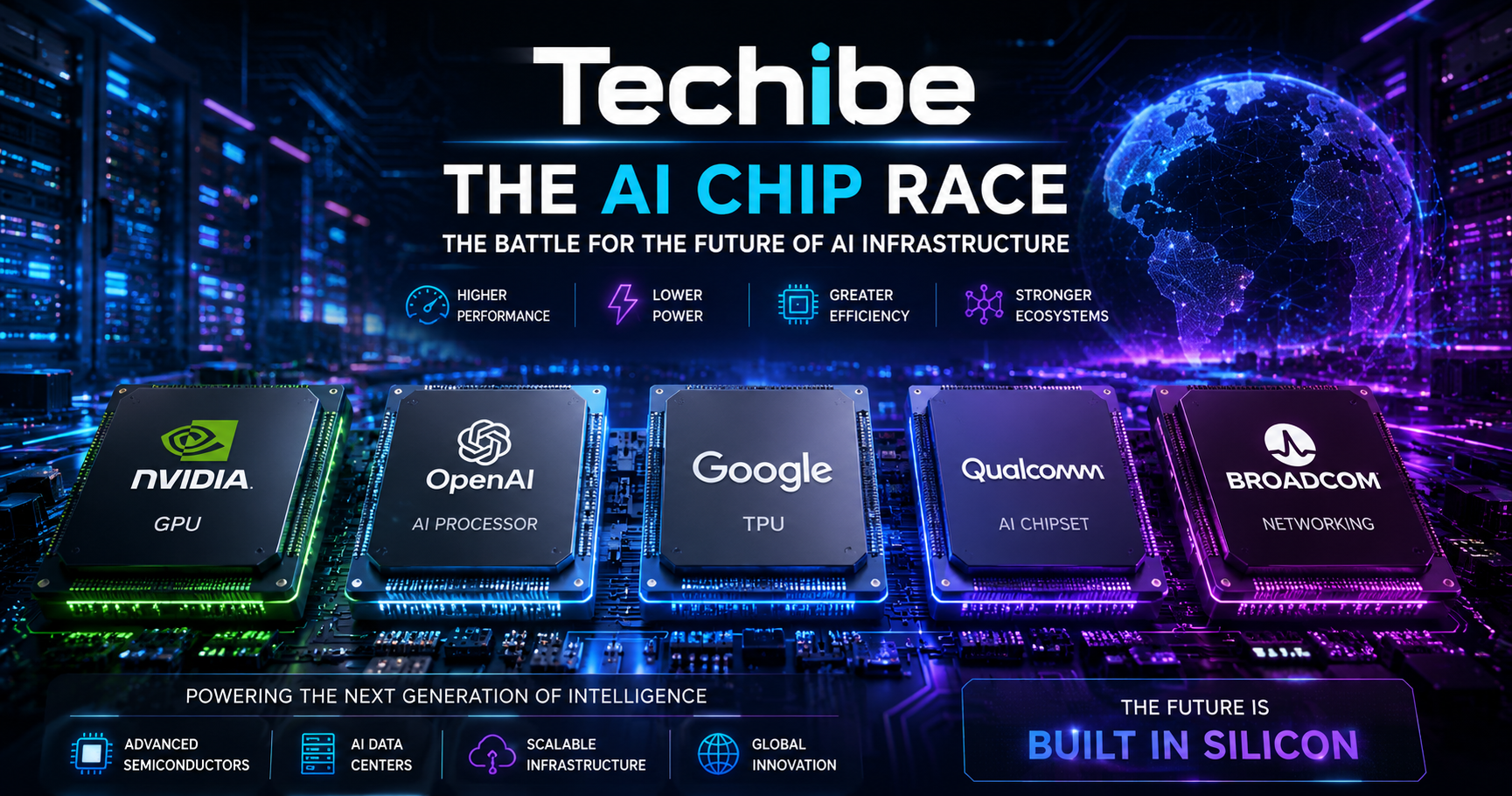
The AI chip race is heating up; why are tech giants looking to replace Nvidia?
AI is no longer limited to developing powerful language models. The real competition has now moved deeper into the technology layer, where big tech companies are investing billions of dollars to design and manufacture dedicated chips.
In recent years Nvidia has become the most important supplier of hardware needed for AI models. The company’s GPUs underpin many well-known services such as ChatGPT Gemini, Claude and hundreds of enterprise AI platforms. But the increasing demand for processing power, the high cost of purchasing GPUs and the limitations of production capacity have led big tech companies to look for a long-term solution.
For this reason companies like OpenAI, Google, Microsoft, Amazon, Meta, and Qualcomm have invested heavily in developing proprietary chips. Their goal is not just to compete with Nvidia, but also to reduce costs, increase data center efficiency and gain more control over AI infrastructure.
Why did Nvidia become the leader in the AI chip market?
Nvidia’s success is the result of years of investment in GPU architecture and the development of the CUDA software platform.
When deep learning models became popular, the company’s processors were the best choice for training neural networks. With the advent of generative AI and the rapid growth of tools like ChatGPT, demand for Nvidia GPUs has skyrocketed.
Today, many of the world’s largest AI models still run on Nvidia hardware, which has led to the company’s market cap being one of the highest in the tech industry.
However, this dependence has also created problems:
Rising prices of AI processors
Shortage of inventory in the market
Long hardware delivery times
High energy consumption
Increasing costs of building and maintaining data centers
These costs are very significant for companies that process millions of AI requests daily.
Why are tech giants pursuing proprietary chip designs?
Building an AI chip is a very complex and expensive process, but its long-term benefits have led large companies to choose this path.
Custom chips can be designed exactly for the needs of the same company and offer better performance than general processors for some tasks.
The most important advantages of these chips include the following:
Reduce the cost of processing AI models
Lower energy consumption
Increase model execution speed
Optimize for specific workloads
Reduce dependency on external suppliers
Increase data center efficiency
These benefits are becoming increasingly important as large language models grow.
OpenAI has also entered the hardware race.
OpenAI has been using Microsoft Azure cloud infrastructure and Nvidia processors to run its models for years.
However, new industry trends show that the company is also expanding its collaboration with semiconductor partners and investing in dedicated hardware.
The goal of these investments is not just to increase processing power; it is also to reduce operating costs, improve responsiveness, and prepare the infrastructure for the next generation of AI models.
This shows that the future of AI does not depend only on developing better models, but also on the quality of the hardware.
How has Google chosen a different path?
Google began developing the Tensor Processing Unit (TPU) years ago, a chip designed specifically for processing AI workloads.
Today, many of Google’s AI services, including Gemini, run on different generations of TPUs.
The main advantage of this approach is that Google has complete control over the software, hardware, and cloud infrastructure. This integration allows the company to manage the performance of its models more efficiently than many competitors.
How have Amazon, Microsoft, Meta, and Qualcomm entered the AI chip race?
The AI chip market is no longer just about Nvidia and Google. Almost every major tech company is developing or expanding its own proprietary projects.
Amazon is trying to reduce the cost of running machine learning models on its AWS cloud service by introducing its Trainium and Inferentia chips. The chips are designed to train and run AI models, offering enterprise customers a more cost-effective option than some traditional processors.
In addition to continuing its partnership with Nvidia, Microsoft has also invested heavily in developing its own accelerators for its Azure infrastructure. This approach helps Microsoft reduce its dependence on a single supplier while maintaining flexibility.
Meta, on the other hand, is developing a new generation of AI chips to improve its content recommendation systems, smart ads, and generative models. With billions of users using Facebook, Instagram, and WhatsApp, increasing hardware efficiency could have a significant impact on the company’s costs and performance.
Meanwhile, Qualcomm is focusing on Edge AI, or on-device AI. The company is trying to bring AI capabilities directly to smartphones, laptops, smart cars, and IoT devices, so that much of the processing can be done without having to be constantly connected to the cloud.
The role of Broadcom and TSMC in the future of artificial intelligence
Although companies like Nvidia and OpenAI get the most media attention, a significant part of the future of AI depends on companies that design and manufacture chips.
Broadcom has become a major partner in custom chip development, and its expertise in semiconductor design and networking equipment plays a key role in data center infrastructure.
On the other hand, TSMC remains the world's largest manufacturer of advanced chips. Many of the processors designed by companies like Nvidia, AMD, Apple, Google, or Qualcomm will be manufactured in its factories.
This shows that the competition in AI chips is not limited to processor design alone; production capacity, manufacturing technology, advanced packaging, and high-speed memories also form an important part of this competition.
What impact will this competition have on businesses?
The development of proprietary chips is not just important for large technology companies. Businesses that use cloud services and AI will also benefit from the results of this competition.
More efficient chips can:
Reduce the cost of using cloud services.
Increase the responsiveness of AI models.
Reduce energy consumption in data centers.
Enable more complex models to be implemented at lower cost.
Make it easier for small and medium-sized companies to develop AI-based products.
As a result, competition among chip manufacturers can lead to greater innovation, lower prices for services, and wider access to AI technologies.
The future of the AI chip market
Experts believe that demand for AI accelerators will continue to grow rapidly in the coming years.
However, many companies are not aiming to eliminate Nvidia entirely. Instead, they are looking to create a hybrid infrastructure that uses powerful GPUs alongside dedicated chips for specific tasks such as inference, recommender systems, and edge AI.
This approach can increase productivity, reduce costs, and accelerate the development of the next generation of AI services.
conclusion
The AI chip race shows that the future of the industry doesn’t just depend on big language models. Hardware has now become one of the most important factors in the success of technology companies.
While Nvidia remains the market leader in AI processors, the investments made by companies like OpenAI, Google, Amazon, Microsoft, Meta, and Qualcomm in developing proprietary chips are a sign that the market is changing.
In the coming years, the winner of this race will likely be the company that can strike the best balance between processing power, energy efficiency, lower cost, and scalability.
OpenAI Delays GPT-5.6 Public Release
FAQs
1. What is the AI Chip Race?
The AI Chip Race refers to the competition among major technology companies to develop proprietary AI processors that improve performance, reduce costs, and lessen dependence on third-party hardware suppliers.
2. Why are companies building custom AI chips?
Custom processors can deliver better energy efficiency, faster inference, lower operating costs, and greater control over AI infrastructure.
3. Is Nvidia losing its leadership?
Not at the moment. Nvidia remains the dominant supplier of AI GPUs, but increasing investment in custom silicon suggests the market is becoming more competitive.
4. Which companies are developing AI chips?
Major players include OpenAI, Google, Microsoft, Amazon, Meta, Qualcomm, Apple, AMD, Broadcom, and Nvidia.
5. How will custom AI chips affect businesses?
Businesses may benefit from lower cloud costs, improved AI performance, better scalability, and more energy-efficient infrastructure.