GitHub, the platform that holds the world’s most critical source code, confirmed on May 20, 2026, that attackers had broken into its internal repositories. The entry point was not a zero-day exploit or a brute-forced password. It was a developer’s trusted tool: a VS Code extension someone downloaded from Microsoft’s own marketplace.
The group behind it is called TeamPCP. They have been running supply chain attacks throughout 2026, each one feeding into the next. This one was their biggest yet.
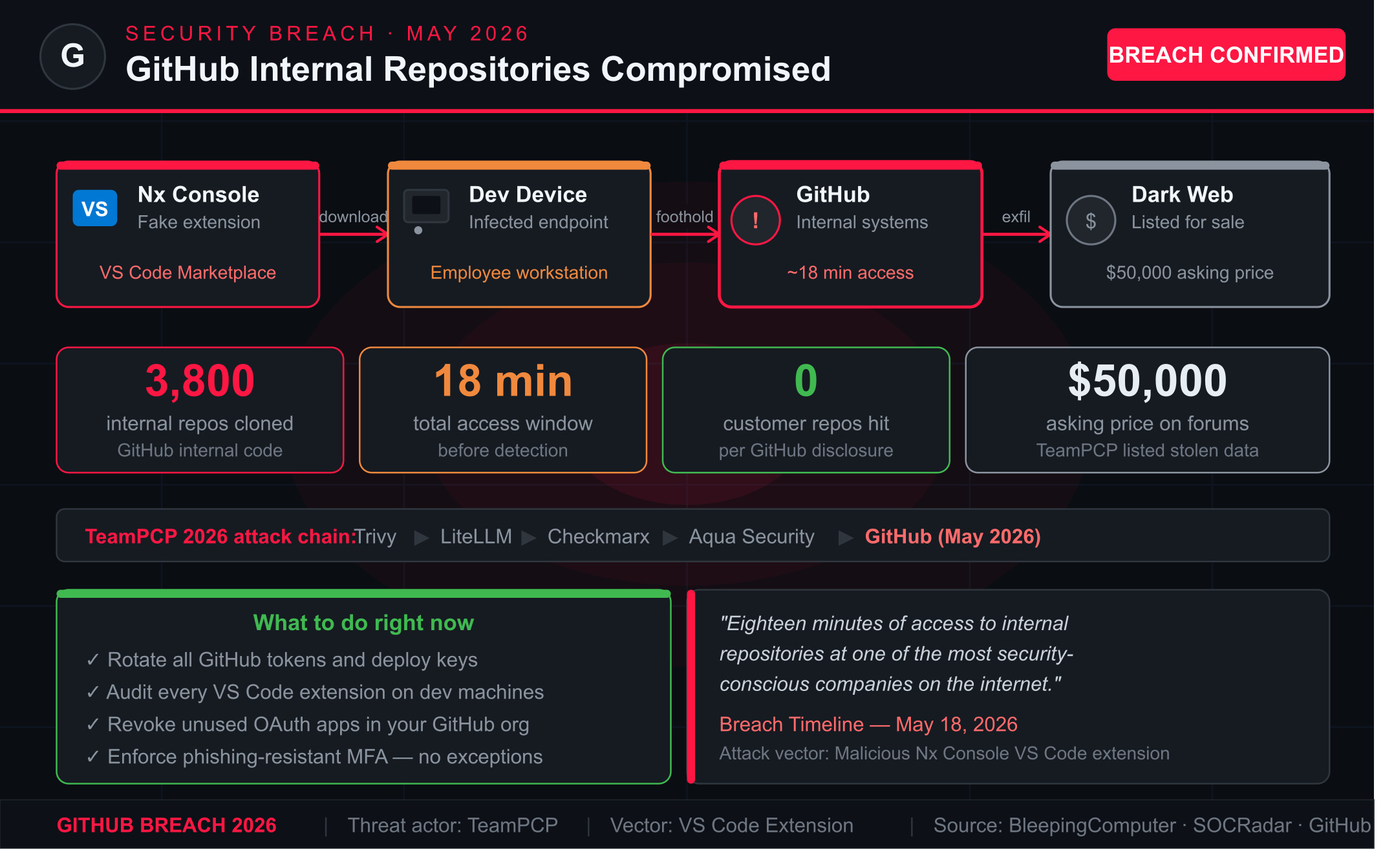
Eighteen minutes. That is how long the attackers had access before GitHub detected and cut them off. In those eighteen minutes, they cloned somewhere between 3,800 and 4,000 internal repositories, compressed archives of GitHub’s own platform code, internal tooling, and configuration files. Shortly after, those materials appeared on underground forums with a $50,000 asking price. The actor posted directory listings as proof. No ransom demand. Just a retirement payday, they said.
GitHub’s own response was measured. The company rotated critical secrets quickly and confirmed that no customer data, no user repositories, no private code hosted on the platform, was directly accessed. But GitHub’s internal source code is a different story.
How Did It Actually Happen?
On May 18, 2026, TeamPCP published a weaponized version of Nx Console to the Visual Studio Marketplace. Nx Console is a legitimate, widely used extension for Angular and monorepo development. The fake version looked identical. A GitHub employee downloaded it.
That single download was enough. The malicious extension gave the attackers a foothold on the employee’s device and, from there, access to GitHub’s internal systems. The architecture of the attack fits a pattern security researchers have been watching all year: attackers do not break through the front door anymore. They walk in through the developer’s toolbox, carrying credentials the organization already trusts.
The breach detection came relatively fast by industry standards. But fast is relative. Eighteen minutes of unrestricted access to internal repositories at one of the most security-conscious companies in the world produced thousands of cloned archives. Detection speed matters. It also has limits.
Who Is TeamPCP?
This group did not appear out of nowhere in May 2026. They have been behind a chain of escalating supply chain attacks all year.
Earlier this year, TeamPCP compromised Trivy Aqua Security’s widely used vulnerability scanner through a GitHub Actions manipulation. That breach cascaded into Aqua Security’s Docker images and the Checkmarx KICS project. From Trivy, the group found their way into LiteLLM, a popular Python package, and infected tens of thousands of devices with their infostealer malware, which they call “TeamPCP Cloud Stealer.” They hit Checkmarx a second time, going after GitHub Actions workflows and OpenVSX extensions to harvest CI/CD secrets.
The GitHub breach is the latest chapter, not a standalone incident.
What Was Actually Exposed?
GitHub has been careful about what it has disclosed, and that is understandable. What is known publicly:
The stolen material includes internal source code and tooling. If the exfiltrated code is authentic and reaches researchers, friendly or otherwise, it could reveal undisclosed vulnerabilities in GitHub’s platform itself. It could expose internal architecture that has not been documented publicly. It could accelerate vulnerability research in ways GitHub cannot fully predict or control.
What was not compromised, according to GitHub’s own disclosures: customer repositories, user data, and private code hosted on the platform.
The exposure window between initial access and detection is still the unknown variable. That window is what will ultimately define how far this goes.
Why Developer Tools Are the New Attack Surface
The axios npm package attack in March 2026 slipped a malicious transitive dependency into one of the world’s most downloaded packages. The Trivy compromise spread through trusted CI/CD pipelines. Now, a VS Code extension on the marketplace has taken down GitHub’s internal repositories.
The pattern is consistent. Attackers are not trying to fight through hardened perimeters anymore. They are targeting the tools developers use every day, extensions, packages, actions, and runners, because those tools already have the credentials and access that attackers need.
A compromised extension on a developer’s workstation can, in the right environment, end up deploying malicious code into a Kubernetes cluster through automation that the organization already trusts completely. The malicious activity happens inside systems already approved to build and ship software. Most security controls were not designed to catch that.
What Should Your Organization Do Right Now?
None of what follows requires new tooling or budget. These are immediate steps.
Rotate your secrets first: Any GitHub tokens, deploy keys, OAuth app credentials, SSH keys, npm credentials, cloud secrets, and Kubernetes service accounts should be treated as elevated risk until you have confirmed they were not exposed. Rotate them now, not after the investigation concludes.
Audit your VS Code extensions: Every developer endpoint, every admin machine. Remove anything that is not actively used, not from a trusted and verified publisher, or that you cannot account for. The Nx Console attack succeeded because it was indistinguishable from the legitimate extension. Review what is installed.
Check your GitHub Actions workflows: Look for unauthorized edits, unexpected commits, unfamiliar OAuth authorizations. Review CI runner logs for unusual outbound traffic, unexpected package downloads, or job execution patterns that do not match normal behavior.
Revoke OAuth apps you do not recognize: Two-thirds of enterprise SaaS environments contain risky OAuth permission scopes, according to Grip Security’s 2026 SaaS + AI Security Report. Go through every GitHub App and third-party OAuth connection in your organization. Revoke anything unused, unknown, or over-scoped.
Enforce phishing-resistant MFA everywhere: Not just for full-time employees — contractors, break-glass admin accounts, anyone with write access to a repository. No exceptions.
Pin GitHub Actions to commit SHA: Not to branch names or tags. Commit SHA. Migrate any long-lived cloud keys in CI pipelines to OIDC-issued short-lived credentials. This closes one of the most common CI/CD attack vectors.
The Bigger Picture
Public SaaS attacks increased 490% year over year, according to Grip Security’s 2026 SaaS + AI Security Report. The average enterprise now runs 3,891 SaaS and AI-connected environments. More than 23,000 SaaS applications operate outside centralized IT visibility in a typical large organization.
The GitHub breach is not an anomaly in that landscape. It is a data point that confirms what security teams have been watching build all year.
Modern breaches do not require breaking through traditional exploits. Attackers inherit trust through compromised identities, developer tokens, CI/CD integrations, and the tools that engineers use without thinking twice. The developer environment is now firmly on the threat model. Supply chain security is not a niche specialty anymore.
The lesson from this breach is not that GitHub failed catastrophically. Their response was reasonable. Customer impact appears contained. The lesson is that no organization is immune when the attack surface includes every tool, extension, and package that developers trust.
Frequently Asked Questions
What happened in the GitHub breach of 2026?
On May 18, 2026, a threat actor group called TeamPCP published a malicious VS Code extension that infected a GitHub employee’s device. The attackers used that foothold to access GitHub’s internal systems and clone approximately 3,800 to 4,000 internal repositories in roughly 18 minutes before detection.
Was customer data compromised in the GitHub breach?
GitHub confirmed that no customer data, including user repositories and private code hosted on the platform, was directly accessed. The breach affected GitHub’s own internal source code, tooling, and configuration files.
Who is responsible for the GitHub breach?
The breach has been attributed to TeamPCP, a threat actor group responsible for a series of escalating supply chain attacks in 2026, including compromises of Trivy, LiteLLM, and Checkmarx.
How did the attackers get into GitHub?
Through a weaponized VS Code extension, a malicious version of the legitimate Nx Console extension was published to the Visual Studio Marketplace. A GitHub employee downloaded it, giving attackers a foothold on the device and ultimately access to internal systems.