Robots have become a major part of our lives, and we didn’t even realize it. They are getting smarter, faster, and more flexible over time. But most of them are too expensive for us to purchase even once. The race to build a human-like robot is getting intense with every passing day. Tesla is working on Optimus, and Google Mind is building Geimini Robotics 1.5. They are releasing their demos, but their price tags and limited access keep them out of our reach. But among all these expensive robots, Unitree is making sure we all have at least one robot at home.
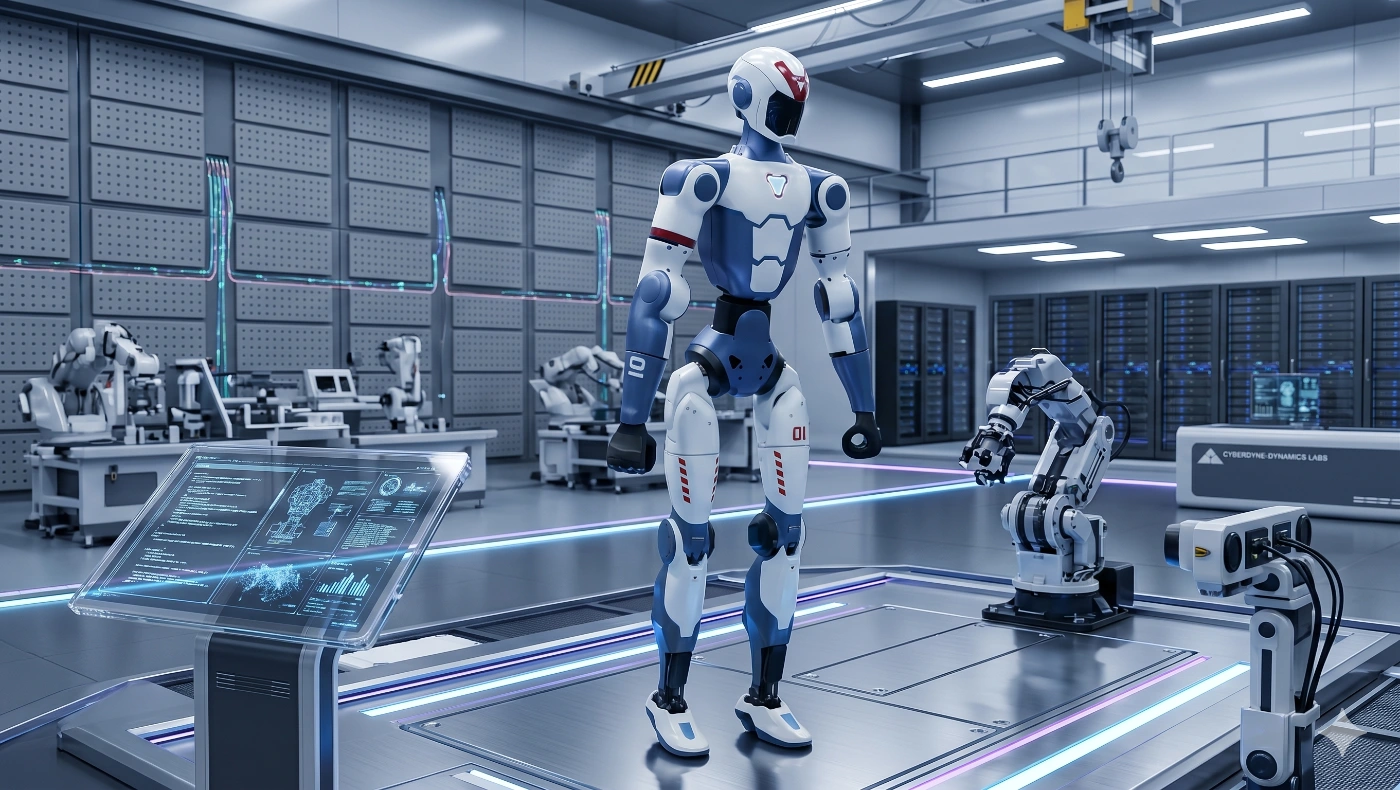
Unitree has recently released a Unitree R1 robot, which is stealing the spotlight. It is a Chinese robotics company, and we all know their dog-like robots. But they have also released robots like G1 and R1. R1 is a compact humanoid robot, and it can perform agile movements like running, flipping, and boxing. But what really makes it special is its price. Its market price is around $5,900, and it is one of the most affordable humanoid robots ever launched. Unitree has surpassed the expected price range of Optimus and Gemini Robotics. The older models of Unitree’s G1 were priced near $16,000, and R1 has set a new bar with $5,900.
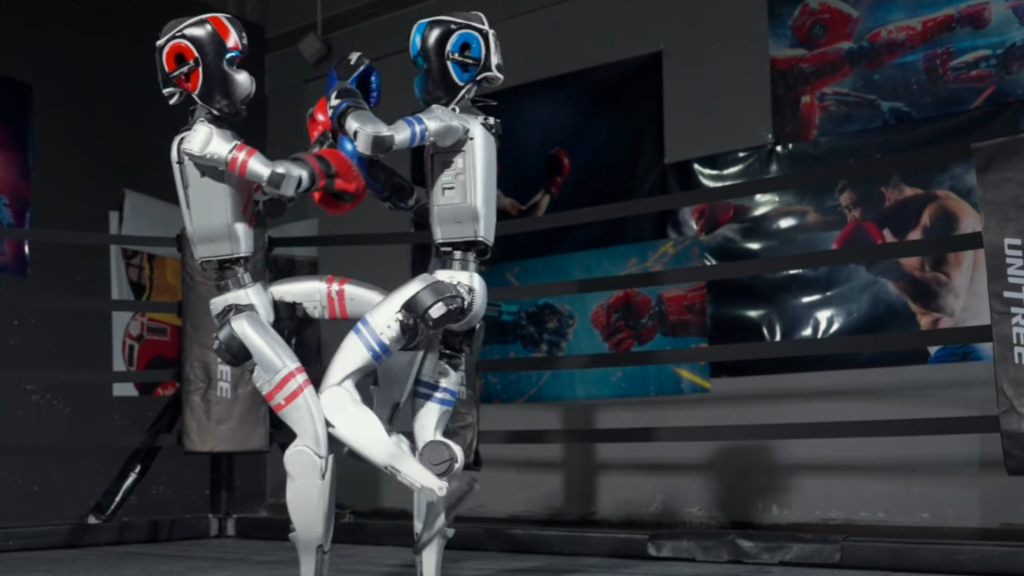
Unitree has marketed it as a “sport-born” bot in their official release video. People are loving the fact that they can purchase one robot. R1 is not limited only to national labs or deep-pocketed firms because researchers and hobbyists will soon get their hands on this robot. But there are also rumors that the released video is AI-generated or that these robots are not worth spending on. Therefore, we have compiled all the information related to R1 to see if it’s a good purchase or not. We’ll explore its features, performance demos, possible uses, and challenges in detail.
Announcement of Unitree’s R1 Robot
Unitree launched the R1 robot at Shanghai’s World AI Conference (WAIC) on July 25, 2025. They demonstrated a live robot to an audience of tech professionals, media, and industry watchers. R1 performed cartwheels and spin kicks during the event to show its movement to the audience. But they were shocked to look at its price. Its videos spread all over the internet, and Unitree also shared an official trailer on YouTube. They highlighted all the specs in the video and shared a statement at the end.
“Movement first, tasks as well. A diversity of moments is the foundation for completing tasks.”
At the launch event, Unitree CEO Wang Xingxing said, “We’re not just making robots; we’re building a future where every home and office could have one.” Many people loved the fact that they could purchase it, but many others said it’s a waste of money. Deedy shared on X,
“This is the first time a humanoid robot is cheaper than a maxed-out MacBook Pro.”Unitree framed the R1 as a developer-friendly and agile humanoid. It is a robot built to be programmable, modular, and accessible to educators, researchers, and enthusiast builders.
“The EDU versions of these Unitree models (though generally more expensive than the baseline models) are pretty interesting.” But people also questioned whether the performance was fully autonomous or heavily teleoperated. Others mocked Unitree that R1 hands are wired and it can only move back and forth.
A person wrote on X:
“Doing backflips is not a skill I need or want. I want something that can help with my chores.”
Public reaction starts changing from excitement to skepticism. They started asking questions like, Can it really walk stably? How long is the battery life? Does the control software allow for real-world tasks, or only demos? Some speculated the launch timing (during WAIC) was strategic to get media attention on AI and robotics. But the most important thing to notice is a small note at the end of the official trailer. Unitree added that the final shipped appearance may be subject to change. It means they will work on this before releasing it to the public.
Unitree Introducing | Unitree R1 Intelligent Companion Price from $5900
Key Features of Unitree R1
Here are the features of the R1 robot that set it apart from G1 and Tesla’s Optimus:
Compact Design and Lightweight Build
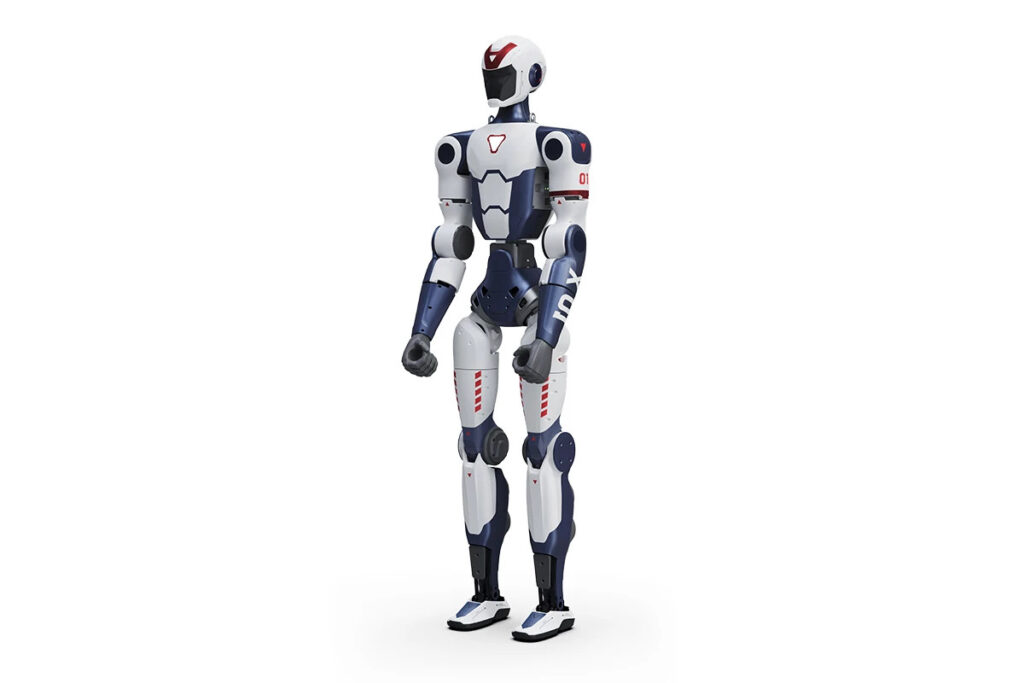
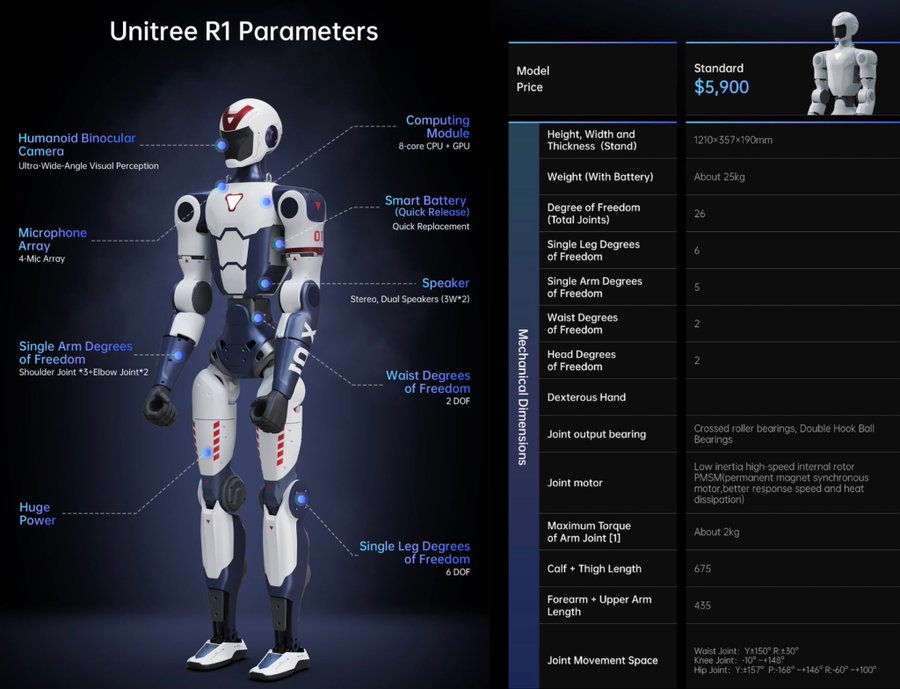
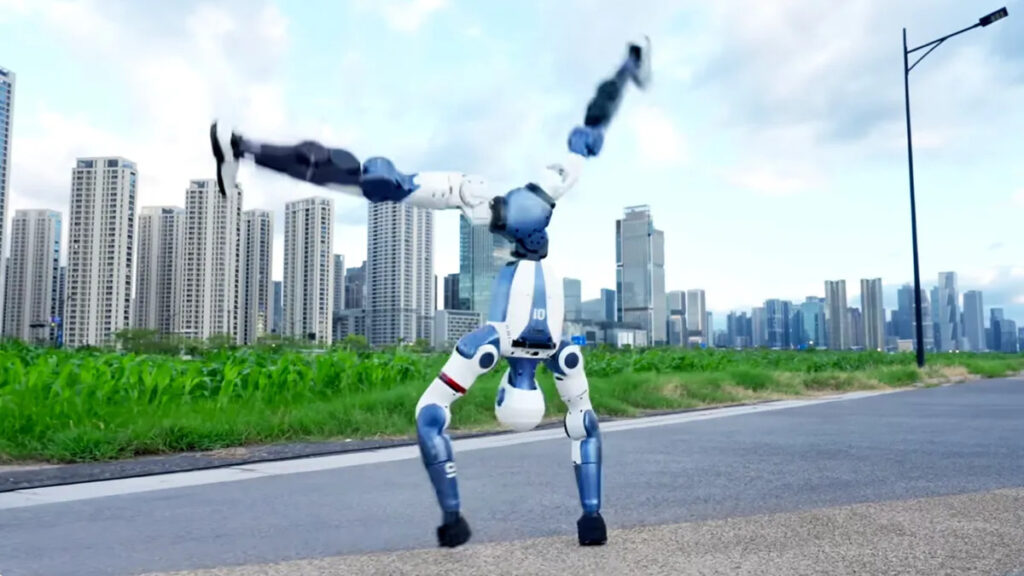
We have seen those bulky robots that take years to move and perform even a single task. But these robots are getting smarter and lighter over time. Unitree R1 is about 1.22 m (4.0 ft) tall, and it is 25 kg (55 lbs) in weight. It is able to carry out flips, quick directional changes, and hops easily due to its lightweight. But how the weight is distributed in the robot also makes a difference. R1’s center of mass is relatively low, which helps it do stunts like handstands without the risk of falling.
There is a significant change in the weight of R1 and G1. G1 used to weigh 35kg with a height of 1.32 m. But R1 cuts roughly 10 kg of weight, and that’s why it’s getting the spotlight. But public reactions are mixed. Many people are praising Unitree for this initiative, but many are mocking its short height. A Reddit user shared in a thread:
“Because of their short height, an average household should have at least two of them.”
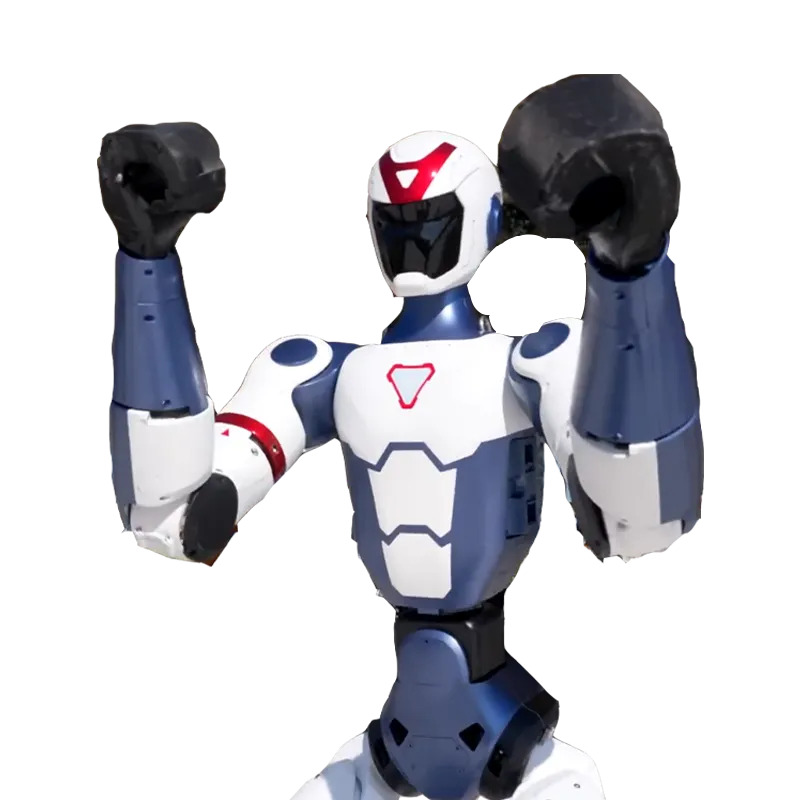
But it’s not all about height and weight, as R1 does not have finger sensors. A person shared on X that “it’s not particularly useful yet. It has a 1-hour battery life, and can’t grip or do meaningful tasks.” Many people mocked that look, R1 has no hands, and others questioned why the hands are in glizzy grabbing mode. But we can expect that Unitree will work on this, as this is just the first model.
Advanced Joint Structure & Degrees of Freedom
We see every other tech company claiming to build a human-like robot, but Unitree actually did it. They gave Unitree R1 human-like motion with a strong joint structure. According to Unitree’s official specs, the R1 has 24 DOF (joints), and many press releases revealed that the number is extended to 26 DOF.
The R1 leg has around six degrees of freedom, and these multiple axes help the robot to maintain balance and perform agile movements. It also has five degrees of freedom in each arm, two degrees of freedom at the waist or torso, and two DOF in the head and neck. It shows that R1 has a better ability to move than G1 with 23 DOF. It stays balanced even when someone kicks it to fall on the ground. Unitree appreciated this feature in their official video, but people are not seeing any benefit. A Reddit user shared,
“Can you make me breakfast? No, but check this out” *does a flip*.”
Victor wrote an X that Backflips are cool, but the real challenge is being useful (cooking, cleaning, helping around the yard). Until then, it is just for show. But this level of agility is surprising for a humanoid of $5,900.
High-Performance Actuators
We all need powerful robots that can lift, run, and work as humans do. We don’t want them to say that they can’t cartwheel or lift groceries. Unitree has focused on this when building the R1 model. It has Permanent Magnet Synchronous Motors (PMSM) that are used in advanced robotics and even electric vehicles. These motors provide smooth torque and allow the robot to control its speed. It also helps R1 to adjust its posture in milliseconds, just like we saw in the demonstration video.
The motors redistribute torque to the legs and arms to maintain the robot even when it’s upside down. The R1’s actuators are smaller, lighter, and quicker compared to the G1’s. G1 used to struggle with balance after movement, but R1 lightweight and PMSM motors allow it to flip easily. Public reactions to its movements are mixed. A person shared on X,
“That’s awesome, the robot can do gymnastics, though it needs to be able to handle objects in ways that work. Can this be done?”
Unitree has not released any statements about the use of R1. So this point is valid as backflip and movement are not the only things that are important. The real challenge will be making those movements useful in everyday tasks.
Battery and Power Efficiency
How long the robot lasts with one charge matters most. We don’t want to charge them after every hour, but Unitree actually failed here. Although they have used a smart lithium battery, R1 lasts only 1 hour under mixed use. People are not quite happy with this battery limit, and one Reddit user even joked about how it will get charged.
“You stick the charging cable in the charging port. And pump the robot full with electricity.”
Another user responded that they have to charge it daily just to see backflips or get a gymnastics coach. Although how long the battery lasts depends heavily on what the robot is doing. But it is still less than G1 (2 hours) and Tesla’s Optimus (8–10 hours).
Sensors and Vision System
Robots can’t just rely on movement because they need eyes and ears to see and respond. The Unitree R1 has a humanoid binocular camera, a 4-microphone array, and optional LiDAR or depth sensors. These help the robot to see in 3D, understand its surroundings, and respond to our voice commands.
Its stereo cameras help it avoid obstacles, recognize objects, and plan its next step safely. The microphones detect audio cues, and optional LiDAR enhances 3D mapping. The R1’s perception system is more advanced compared to the G1, which relies on visual cameras and basic sensors. But people are still concerned about their privacy as they can see and record us. Chiemeri Shared on X,
It still raises a question as to how it stores your interactions. Do the builders have access to the data and information you share with them? Can they remotely access it to record your home or spy on us?
There is a need for strict government regulations and transparency from builders to mitigate these risks.
Customizable Design
We often want to customize those pre-designed robots, but Unitree has made it possible. The R1 robot runs on ROS 2 (Robot Operating System 2), which makes it easier for developers to write and test code. We can also integrate our own sensors, adjust motion parameters, or even design custom behaviors using Python or C++. But the best feature is its SDK and simulation tools. It allows us to test new features in virtual environments before applying them to the robot.
The R1 is best for developers and educators compared to the G1, which was more suited for research labs and industrial testing. We can connect external hardware like LiDAR, depth cameras, and microphones with this R1 robot.
Affordable Humanoid Robot
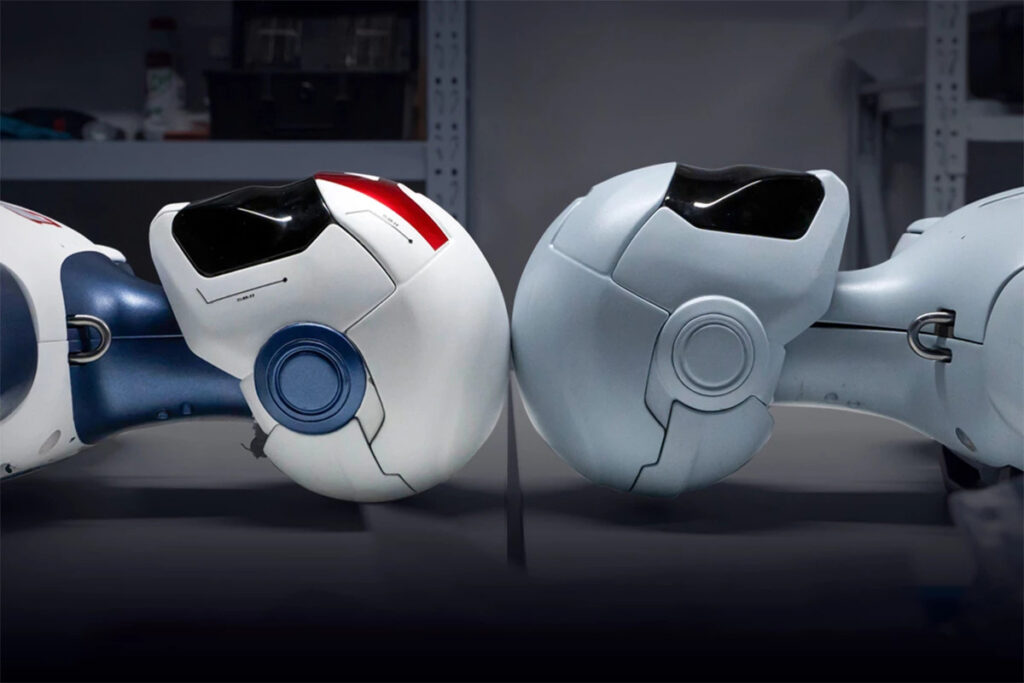
The main reason behind all this hype is the price of R1. It is USD 5,900 or ¥99,000 excluding tax and shipping cost. The R1 is more affordable than Unitree’s older models like the G1 ($16,000) or H1 ($90,000), and big competitors such as Tesla’s Optimus ($20,000) or Boston Dynamics’ Atlas ($200,000+). It actually costs less than a high-end MacBook Pro.
Its launch shows how China is aiming to lead the humanoid robot market, which is worth around $2.4 billion today and could grow to $24 billion by 2032. Time Magazine also called it “The Best inventions of 2025”. But public reactions are getting skeptical with every day. Gordon Shumway shared,
“That can speak to you and do backflips for $5900. My kid can do all of those for free.”
Another person wrote, ” Why would I pay $5900 for something to have someone to talk to and do backflips for me? People called it a pricey toy that does nothing and shared that the Hugging Face bot was a lot better for experimenting and exploring with robots. But this is just the first step towards change. It is hard for US companies to match the same price tag, but it’s not tough for Unitree to produce robots like Optimus. The Unitree R1 is currently available for pre-order and is expected to be delivered in Q1 2026.
Privacy & Ethical Concerns of Unitree R1
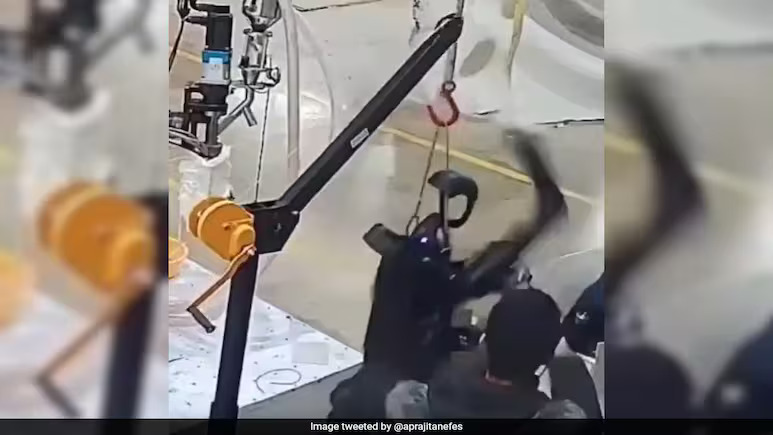
Although Unitree R1 is getting the spotlight due to its low price, many people are concerned due to its previous clash history. A video from a Chinese factory went viral when a Unitree H1 humanoid robot suddenly malfunctioned during testing in May 2025. The footage showed that the robot was violently flailing its arms and legs while two engineers tried to keep control. The video spread quickly across social media, and it sparked a discussion about AI safety and robot control mechanisms.
But this wasn’t the first time Unitree robots made headlines for unusual behavior. Another clip showed a humanoid robot from Unitree attacking people in a crowd during the Spring Festival Gala in Tianjin in February 2025. No one was harmed, but that moment raised questions about testing protocols and reliability in public spaces. Many experts believe such incidents are typically caused by software bugs or sensor malfunctions. But it shows that there is a need for strict safety standards. Some raised concerns about surveillance risks tied to China’s AI ecosystem. Tech analyst Deedy Das on LinkedIn said,
“It’s a platform for developers to build on, not a butler yet.”
UniPwn Exploit in Unitree Robots
Cybersecurity experts Andreas Markis and Kevin Finnisterre disclosed the UniPwn exploit on September 20, 2025. It affects the Unitree Go2, B2 quadrupeds, G1, and H1 humanoids. But the concerning thing is that this flaw allows attackers to gain access wirelessly. It allows a hacked robot to pass the attack to other nearby robots, so one infected unit can spread the problem like a virus.
But the main reason behind all of this is that Unitree used Bluetooth (BLE). Although it makes it easy to connect with Wi-Fi, it uses the same secret keys in every robot. So a hacker can send a specially made Bluetooth/Wi-Fi message to the robot and take over its system easily. But the worst part is that the G1 robot secretly sends data to servers in China every five minutes without notifying the user. As Andreas Makris and Kevin Finnisterre showed, an attacker who gets in can do basic disruptive actions.
“A simple attack might be just to reboot the robot, which we published as a proof of concept. But an attacker could do much more sophisticated things,” he said while speaking to IEEE Spectrum.
Independent researchers have also reported that some Unitree humanoids send data to remote servers. These findings are raising concerns about privacy in public, but Unitree has never ignored them. Unitree posted a statement on LinkedIn:
“We have become aware that some users have discovered security vulnerabilities and network-related issues while using our robots. We immediately began addressing these concerns and have now completed the majority of the fixes. These updates will be rolled out to you in the near future.”
Experts like Víctor Mayoral-Vilches from Alias Robotics and other researchers warned users to be careful. They advised people to connect robots only through secure Wi-Fi and told them to turn off Bluetooth (BLE) to stay safe. They also raised a voice that companies should communicate better and fix such security problems before their robots reach the public. The UniPwn issue shows how small features meant for ease of use can create big security risks. Even though R1 wasn’t directly affected, this issue left a mark on every robot that is going to launch.
Conclusion
The Unitree R1 shows that it’s possible to build affordable robots. It’s one of the most affordable humanoid robots at $5,900 today. But affordability comes with its challenges. There are serious concerns about security vulnerabilities, privacy, and reliability. The recent UniPwn exploit exposed how convenience features can turn into risks if not handled properly. It also showed an important truth that robots will soon be in our homes. Unitree R1 might not be perfect, but it represents progress. It is faster, lighter, smarter, and within the reach of many of us.
FAQs
1. What is the price of the Unitree R1 humanoid robot?
The Unitree R1 starts at $5,900, and it makes it one of the most affordable humanoid robots on the market.
2. How tall and heavy is the Unitree R1?
The R1 is about 1.22 meters (4 feet) tall and weighs around 25 kilograms (55 pounds). It is much lighter than the older Unitree G1, which weighed 35 kilograms.
3. Can the Unitree R1 be customized?
Yes. The R1 supports software and hardware customization.
5. Are there any safety or security concerns with Unitree robots?
Yes. Researchers found a UniPwn vulnerability that affected some Unitree models in September. It allows hackers to gain control through Bluetooth (BLE). Unitree claims to have fixed most issues, but experts suggest that it is better to disable Bluetooth and use secure Wi-Fi connections.
4. How long does the R1 battery last?
The R1 offers about 1 hour of runtime, depending on activity. Idle or moderate use can extend its runtime.,