
Every year, millions of people walk into an Apple Store or open the Apple website, convinced they need an iPad. The marketing is polished. The hardware looks stunning. The price tag stings, but somehow feels justifiable.
Then reality hits.
The iPad is not a bad device. But for a large portion of buyers, it is the wrong device. In 2026, the conversation around tablets has changed significantly. Laptops have gotten thinner, cheaper, and more powerful. Android tablets have matured. iPadOS, despite major improvements, still has limitations that matter in real-world use.
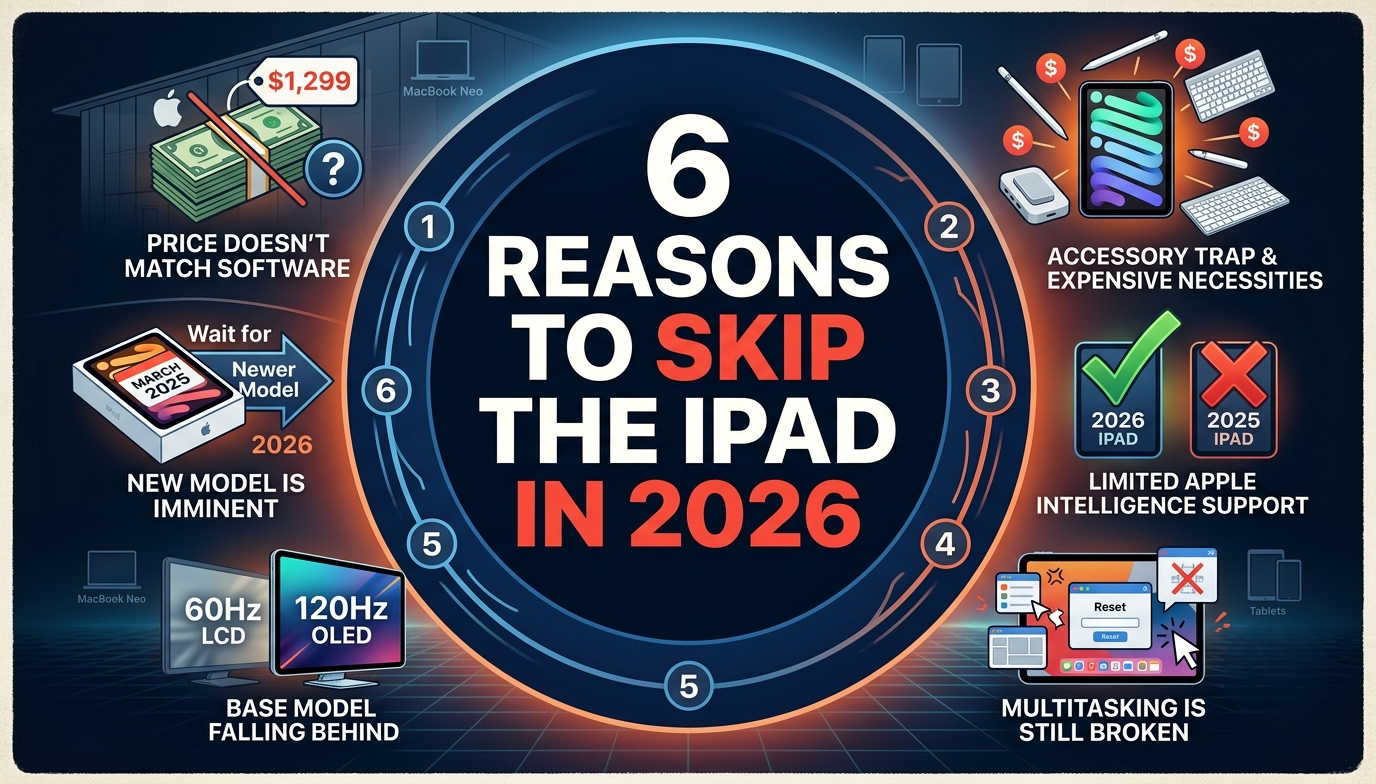
Before spending anywhere from $349 to well over $1,299, here are six honest reasons to pause and reconsider.
1. The Price Does Not Match What the Software Delivers
Apple now offers four distinct iPad models ranging from $349 to over $1,299, each targeting different users with overlapping capabilities. That sounds like a choice. In practice, it creates confusion and pressure to spend more than necessary.
The deeper problem is not hardware. It is software. A device priced like a premium laptop still runs a mobile operating system. iPadOS still cannot fully replace macOS for every workflow. Advanced multitasking, file management, and professional desktop applications remain more limited compared to a traditional laptop.
So buyers end up paying laptop money for tablet software. That gap between price and capability is the iPad’s most persistent problem in 2026.
The comparison gets sharper when looking at alternatives. With the introduction of the MacBook Neo in March 2026, the price gap has narrowed. Starting at $499 for students, it competes directly with mid-range iPads. A full Mac laptop, with full macOS, for $50 more than an iPad Air. That math is difficult to ignore.
2. The Accessory Trap is Real And Expensive
The price tag on an iPad is deceiving.
To use an iPad for any real work, study, or creative project, you need accessories. Need to take notes? Better buy the Apple Pencil. Need to type? Better buy a keyboard case. Need to connect an external display? Better buy a hub. These aren’t arbitrary purchases. They are requirements.
Smart Folios are usually overpriced for the amount of basic protection they offer. Third-party options are usually better and provide the same quality.
Seamless integration with iPadOS is not guaranteed with third-party accessories. The Magic Keyboard and Apple Pencil add hundreds of dollars to the total price. An iPad Air starts at $599 and easily exceeds $900, and that is before apps are even purchased.
Most consumers know this information, but they usually don’t consider it.
3. Apple Intelligence Support is Not Universal
Artificial intelligence is no longer a bonus feature. In 2026, it is quickly becoming the backbone of how Apple devices function, from writing assistance to visual search to notification summaries. The problem is that not every iPad supports it.
The 2025 iPad has an A16 chip inside that does not support Apple Intelligence. It does not have features such as Writing Tools, Image Playground, Clean Up, Live Translation, notification summaries, Smart Reply, Priority Messages in Mail, Visual Intelligence, and several other AI-related tools.
This is a notable limitation for long-term value, especially as future versions of iPadOS are expected to rely increasingly on AI-driven features.
Buying an iPad today without Apple Intelligence support means buying a device that will feel increasingly limited as software evolves. The entry-level iPad at $349 falls into this category. It is a significant blind spot that Apple’s marketing does not highlight loudly enough.
4. iPadOS Multitasking Still Has Real Problems
Apple has made big strides with iPadOS 26. Window Management is better. Stage Manager is now available for all compatible devices. Finally, iPads look like they could be used for productivity. This all looks good on paper, but in practice, the experience is still rough.
Window layouts often reset to show windows in a single layout or in a single window. This issue happens “almost every day or once every two days,” for a user who uses the iPad Pro as their only computer. This is a brand new Pro with the M5 chip, 16GB of Memory, and a 10-core CPU.
There were also complaints about one of the multitasking functions, Slide Over. Apple brought this function back in iPadOS 26.1, but because it doesn’t allow multiple apps to be used at once in Slide Over, the function is much less useful. One user said, “If you look only at Slide Over, the experience has gone backward compared with iPadOS 18.”
These may not be an issue for the casual user, but for people who use the iPad as their main work device, these issues are significant.
5. The Base Model is Already Falling Behind
At $349, many believe the entry-level iPad is the most economical choice. However, significant trade-offs get in the way of the optimal use case.
What users generally dislike about the base iPad more than anything else is what the higher-end models come with. Let’s take the display for example. Once 120Hz scrolling gets accustomed to, 60Hz feels slow, and iPad scrolling may feel a bit inconsistent compared to the smoothness of their most likely higher-end smartphones.
News has reported that all of the iPad models newer than the base model will receive new displays with OLED Technology (higher color quality and contrast) in 2026. The base model will most likely be stuck with the older technology, as it’ll likely be the same display as the last four years, the 11-inch Liquid Retina Display, with 500 nits and 60Hz. At the price of $349 in 2026, it’ll be hard to justify that purchase for an essentially outdated display.
6. A New Model May Be Right Around the Corner
There are so many factors that go into purchasing technology at the right time, and most people don’t realize that the timing of the purchase is very important. Buying during the wrong month or week can mean buying a device at full price that is shortly afterwards discontinued or offered at a discount.
In March 2026, Apple will renew the iPad again, and the existing model will have reached 2 years of age. So, now is not the right time to buy.
The new base iPad that will be released in 2026 will be equipped with either an A18 or A19 chip and, most importantly, with Apple Intelligence support, unlike the current base model. Buying the current base model iPad means paying full price for a model that will be obsolete in a few months, with no upgrade option and a poor resale value.
If you are able to wait a few months, buying the new base iPad at full price now is not worth it. You will get a model with Apple Intelligence, a newer chip, and most likely better support from Apple, for the same or very similar cost.