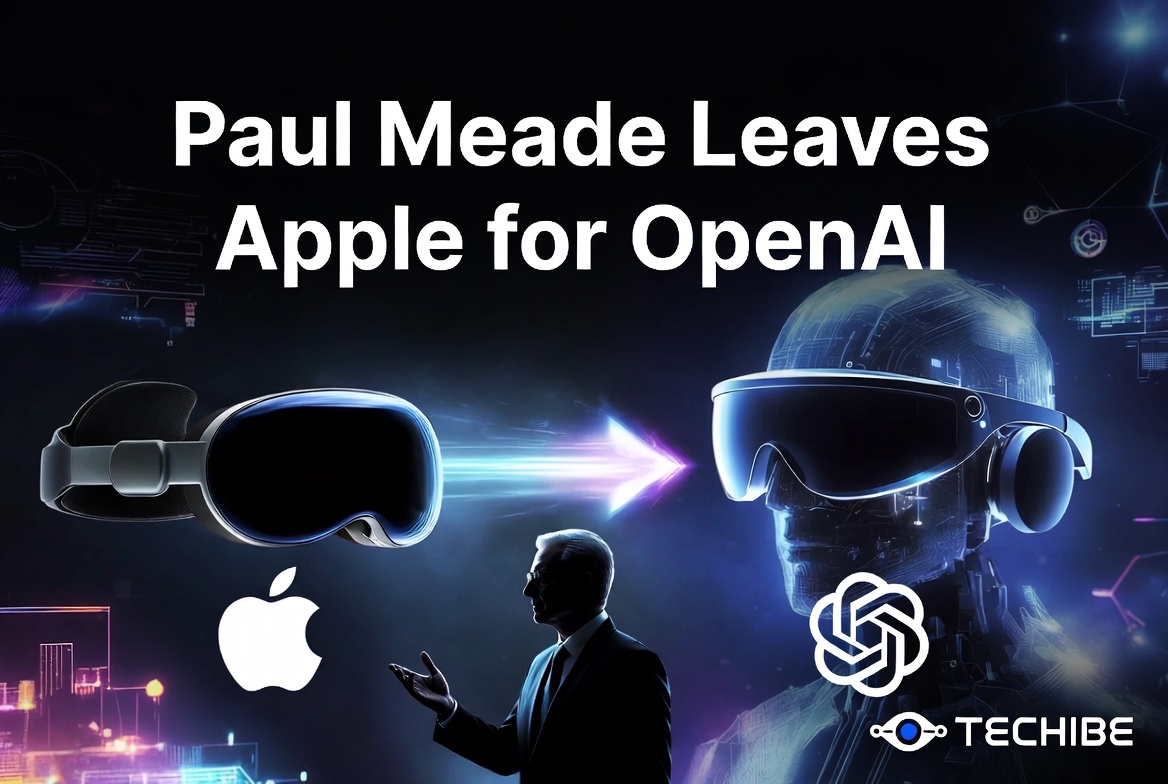
Paul Meade spent seven years constructing the Vision Pro, Apple’s most technically complex product ever made. He starts at OpenAI’s hardware division next week. The timing, the context, and the implications are all worth reading carefully.
Paul Meade, Apple’s vice president of hardware engineering for the Vision Products Group, the executive who spent seven years building the Vision Pro and was leading Apple’s AI smart glasses project, is leaving Apple by next week to join OpenAI’s hardware division, according to Bloomberg’s Mark Gurman. The departure follows Apple’s executive reorganization under incoming CEO John Ternus, which left Meade and several other hardware vice presidents feeling effectively demoted. At OpenAI, Meade will work on a family of AI-powered devices, joining Jony Ive, Tang Tan, and Evans Hankey, all former Apple executives who are already there.
OpenAI is now assembling the most concentrated collection of Apple hardware talent outside of Apple that has ever existed. Whether that translates into a product is the question nobody can yet answer.
Why Paul Meade Is Not Just Another Executive Departure
VP-level departures happen at every major tech company. Most are not worth a detailed article.
This one is different. And not just because of where Meade is going.
Meade brings something different from Jony Ive, Tang Tan, and Evans Hankey: direct experience running the hardware engineering function for Apple’s most technically ambitious product, including what has been described as a display-free smart glasses project meant to rival Meta.
Ive is the designer who created the iPod, iPhone, and iPad. His aesthetic instinct is not in question. But design and hardware engineering are different disciplines. Ive’s team can envision what an AI device should look and feel like. Meade is the person who knows how to build the actual thing, the supply chain, the manufacturing, the tolerances, the compromise between ambition and what is physically possible at a consumer scale.
Meade has been at Apple since 2010 and has been working in the Vision Products Group since 2017. That is nine years inside the most secretive hardware engineering organization in the consumer technology industry. Before Vision Pro, he worked on iPad and iPhone. He did not just manage the Vision Pro project. He was there for the years of fundamental engineering work that preceded it.
OpenAI just hired the person who knows how Apple actually builds things.
The Reorganization That Pushed Him Out
Meade’s departure is not a defection driven by passion for OpenAI’s mission. It is a departure driven by what happened inside Apple.
The reorganization that preceded this exit began in April 2026, when Apple announced that John Ternus, Apple’s longtime head of hardware engineering and Meade’s former boss, would succeed Tim Cook as CEO on September 1, 2026. Johny Srouji, Apple’s chip chief, took over as chief hardware officer and launched a restructuring that merged the hardware engineering and hardware technologies organizations.
Under the new structure, Meade and other hardware vice presidents no longer report directly to Srouji; they report instead to Tom Marieb, the new vice president of hardware engineering, who in turn reports to Srouji.
That is the critical detail. Meade went from reporting to the person who ran all of Apple hardware, John Ternus, to reporting to Tom Marieb, who reports to Johny Srouji. Two layers of hierarchy where there was one. The role did not change on paper. The organizational weight behind it did.
It is rare for an Apple vice president to leave for a competitor, aside from the designers who joined OpenAI. Apple’s retention of senior hardware talent has historically been exceptional. That it is now failing at the VP level and specifically in the hardware engineering function is the signal worth paying attention to.
Meade’s exit is the latest in a pattern of VP-level attrition at Apple that began in October 2025, when Ke Yang, who led Apple Intelligence’s Answers, Knowledge, and Information team, left for Meta. Two months later, Alan Dye, Apple’s vice president of Human Interface Design, followed him to the same company.
Ternus has not been in the CEO seat yet. The reorganization under Srouji has already cost Apple three vice presidents.
What Apple Loses Right Before It Needs Him Most:
Apple is losing the engineer who spent seven years building the Vision Pro’s hardware and was leading the company’s push into AI smart glasses — with a late 2027 launch target bearing down.
The timing of Meade’s departure is particularly painful for Apple because of what he was working on when he left.
Meade was overseeing the development of the AI smart glasses that Apple has in the works to compete with the Meta Ray-Bans, and was also leading the team working on future augmented reality glasses. Apple’s smart glasses are expected late 2027. The Vision Pro was not a hit. Smart glasses are Apple’s best remaining play in spatial computing, the category Apple spent years and billions of dollars establishing as the next frontier.
Fletcher Rothkopf, Meade’s longtime deputy overseeing product design, is expected to assume leadership of Apple’s Vision Products Group.
Rothkopf’s promotion is a reasonable internal response. It is also not Paul Meade. The person Apple is promoting has never run the Vision Products Group. The deadline is 2027. The product has no room for a long learning curve.
Meade’s predecessor, Mike Rockwell, left his role running the organization to take over Siri. Rockwell brought several Vision Pro executives with him to help launch Siri AI this year, splitting the Vision Products Group into separate hardware and software organizations.
The Vision Products Group has now lost two successive leaders in rapid succession, one to an internal reassignment, one to a competitor. The team responsible for Apple’s most ambitious hardware bet is being rebuilt from the middle of a product cycle.
What OpenAI Gains And What It Still Does Not Have
OpenAI has stated publicly that it expects to reveal its first AI-native consumer device before the end of 2026, with commercial availability potentially sliding into 2027. The device is reported to be screenless and audio-first, a wearable or pocketable companion focused on voice interaction rather than a display, with manufacturing expected to be handled by Foxconn.
At OpenAI, Meade will work with former Apple colleagues Jony Ive, Tang Tan, and Evans Hankey, who founded an AI hardware startup that OpenAI acquired last year for $6.5 billion. It’s unclear how the new in-house hardware department will affect OpenAI’s work with Ive’s startup.
That last sentence is the one that deserves more attention than it has received. OpenAI now has two hardware operations: Ive’s io, which remains semi-independent after the acquisition, and Meade’s new in-house hardware unit. Whether those two organizations collaborate, compete, or consolidate is an open question. OpenAI has not explained the relationship.
OpenAI’s hardware expansion is part of a broader talent push. Noam Shazeer, former Gemini co-lead and vice president of engineering at Google DeepMind, recently joined OpenAI. The company also hired Liz Wamai from Netflix as head of recruiting and brought on former White House AI adviser Dean Ball in a strategy role.
Talent is necessary. Supply chain and manufacturing relationships are also necessary. What Meade will actually do at OpenAI alongside the Ive-led design team, and whether accumulating Apple hardware alumni translates into shipping consumer AI devices at Apple-like quality and scale, remains to be seen.
OpenAI can now design and engineer a device. Whether it can manufacture and distribute one is a different category of problem that no amount of Apple hiring resolves.
The Pattern Nobody Should Miss
Step back from the individual moves. Look at the accumulation.
Jony Ive led Apple’s design for 27 years. Now at OpenAI. Tang Tan led Apple’s hardware product design. Now at OpenAI. Evans Hankey led Apple’s industrial design. Now at OpenAI. Paul Meade led Apple’s Vision Pro hardware engineering for seven years. Now at OpenAI.
That is Apple’s design chief, hardware product design lead, industrial design lead, and Vision Pro hardware engineering lead, all at one company, all working on devices that have not yet been named.
With Meade, OpenAI now has the hardware architect who built the most technically complex consumer wearable Apple has ever made, joining the designer who created the iPod, iPhone, and iPad, alongside two senior Apple hardware executives, all under one roof, all working toward devices that do not yet have names or release dates.
The talent concentration is real. The product risk is equally real. Apple’s success was not built by talent alone. It was built by talent, plus manufacturing scale, retail infrastructure, component supply chains developed over decades, and a software ecosystem that made the hardware worth buying. OpenAI has none of those things yet.
The team can build something extraordinary. Getting it to scale is a different problem entirely.
Frequently Asked Questions
Who is Paul Meade?
Paul Meade is a vice president at Apple who led hardware engineering for the Vision Products Group, the division responsible for the Vision Pro headset and Apple’s AI smart glasses project. He joined Apple in 2010 and has been in the Vision Products Group since 2017, spending seven years building Vision Pro’s hardware and most recently overseeing the smart glasses effort.
Where is Paul Meade going?
Paul Meade is joining OpenAI’s hardware unit, according to Bloomberg’s Mark Gurman. He will work on a family of AI-powered devices alongside former Apple executives Jony Ive, Tang Tan, and Evans Hankey, whose AI hardware startup OpenAI acquired in 2025 for $6.5 billion.
Why is Paul Meade leaving Apple?
Meade’s departure follows a reorganization under Apple’s new chief hardware officer, Johny Srouji, who took over the role after John Ternus was named Apple’s next CEO. The restructuring created an additional layer of management hierarchy, leaving Meade and other hardware VPs feeling effectively demoted, reporting to Tom Marieb rather than directly to Srouji.
What happens to Apple’s Vision Products Group?
Fletcher Rothkopf, Meade’s longtime deputy overseeing product design, is expected to assume leadership of Apple’s Vision Products Group. The group is responsible for Vision Pro and Apple’s upcoming AI smart glasses, which have a late 2027 target launch date.
What is OpenAI building in hardware?
OpenAI has said it expects to reveal its first AI-native consumer device before the end of 2026, with commercial availability potentially in 2027. The device is reported to be screenless and audio-first. OpenAI also has an ongoing collaboration with Jony Ive’s io subsidiary, acquired for $6.5 billion, though the relationship between io and Meade’s new in-house hardware unit has not been explained.