
The New Frontline of Cybersecurity Isn’t Where Most People Think
Malicious VS Code extensions are emerging as a serious cybersecurity threat in 2026. Learn how attackers exploit trusted developer tools and how to stay protected.
When it comes to cybersecurity threats, people often think of phishing emails, ransomware attacks or massive data breaches.
Yet, few consider the software that developers work with for hours every day.
In 2026 that perspective changed.
Several security reports have been released about software development tools being compromised, revealing a disturbing reality:
attackers are targeting the software development ecosystem more than ever before. Instead of attacking companies directly they are looking for the easiest entry point and developers have become one of the most valuable targets.
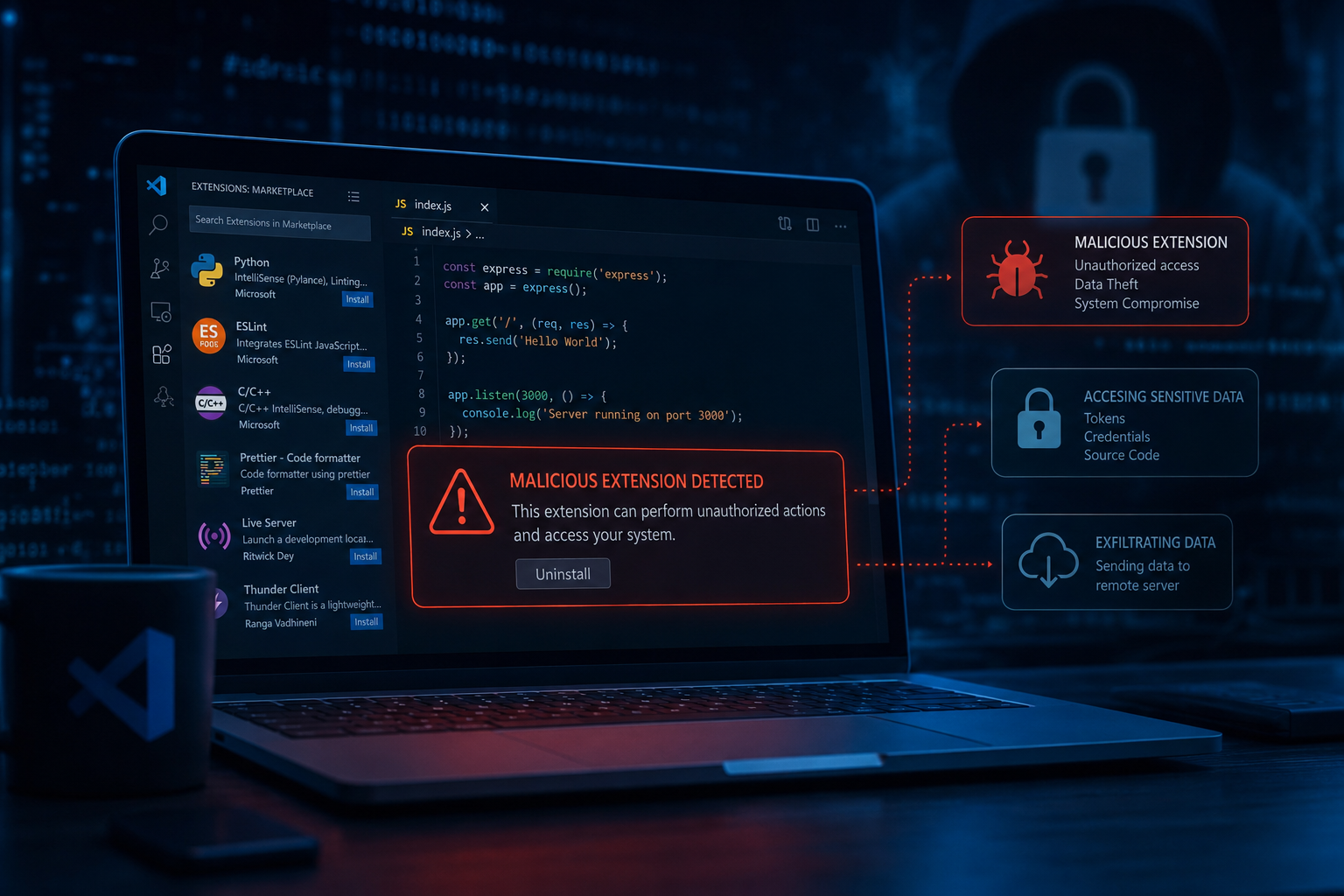
Among these new threats malicious VS Code plugins have become one of the most dangerous.
For organizations that rely on software development the risk is not limited to just infecting a single computer. A malicious plugin can gain access to source code authentication tokens cloud access keys, and even the entire software development process.
Why VS Code Has Become an Attractive Target
Visual Studio Code is one of the most popular and widely used code editors in the world.
Its popularity is largely due to the thousands of plugins that provide developers with features such as artificial intelligence, debugging project management and various development tools.
But the main problem can be summed up in one word:
The problem is simple: trust.
Developers install various plugins to increase their productivity and many of these plugins have extensive access to the development environment and sensitive information. The same flexibility that makes VS Code powerful also creates a perfect opportunity for attackers to exploit it.
Cybercriminals know this well.
instead of bypassing multiple layers of organization security they just need to convince a developer to install a seemingly normal plugin.
A Shift Toward Supply Chain Attacks
In recent years cybersecurity experts have observed a significant rise in software supply chain attacks.
Unlike traditional attacks that directly target end-users these attacks target the tools, libraries, and services used in the software development process.
The reason for the success of this method is simple:
Compromising a single tool can impact thousands or even millions of users.
The infamous SolarWinds incident demonstrated just how destructive such attacks can be. Since then, attackers have expanded their focus to include software package repositories, browser extensions AI tools, and development environments.
VS Code extensions fall squarely into this attack model.
If an extension manages to gain user trust and get installed an attacker could gain access to far more valuable information than through traditional methods.
How Malicious Extensions Work
Today’s malicious add-ons are much smarter than they used to be.
They usually don’t exhibit overt malware behavior and try to look completely normal.
A malicious add-on may:
Harvest authentication tokens
Steal GitHub credentials
Access cloud infrastructure keys
Collect proprietary source code
Monitor developer activity
Download additional payloads after installation
In some cases, malicious code remains inactive for weeks making it harder to detect.
This delay allows attackers to remain in the system for longer without attracting attention.
The Real Problem: Developers Are Trained to Trust Their Tools
Perhaps the most worrying part of this threat is its psychological aspect.
Developers inherently trust their tools.
They install plugins to solve problems, automate tasks, and increase productivity and unlike suspicious files or anonymous emails, they often view these plugins as a natural part of the development environment.
That trust creates a dangerous blind spot.
Many developers spend more time reviewing third-party libraries than evaluating the plugins they have installed on their desktop.
From the attackers’ perspective, this makes the VS Code ecosystem a very valuable target.
Red Flags That Shouldn’t Be Ignored
.
Not all malicious plugins look suspicious from the start, but there are some warning signs.
Newly Published Extensions
Add-ons that have a short history or are from a newly established publisher require further review.
.Excessive Permission Requests
If an extension requests permissions beyond its declared functionality, the reason should be investigated.
Poor Documentation
Reputable projects usually provide complete documentation user guides and developer information.
Unusual Network Activity
Establishing anonymous connections to external servers could be a sign of information gathering or communication with the attackers’ command server.
.Sudden Changes After Updates
If a plugin’s performance changes unexpectedly after an update it should be investigated.
Security experts recommend periodically reviewing installed plugins and removing unnecessary ones.
Why AI Is Making the Problem Worse
The rapid growth of AI-based tools has created new challenges.
Today, attackers can use AI to generate professional documentation, completely natural descriptions and highly credible pages for malicious plugins.
As a result it has become much more difficult to detect fake plugins than in the past.
On the other hand developers are also more dependent on productivity tools than ever before.
The combination of these two factors has created conditions that make it easier for malicious plugins to spread.
This trend doesn’t seem to be stopping anytime soon.
What Organizations Should Do Now
No organization can eliminate all security threats, but it can significantly reduce the level of risk.
Security teams should prioritize the following actions:
Creating Approved Extension Lists
Monitoring Developer Workstations
Implementing Zero Trust Principles
Conducting Regular Security Audits
Educating Developers
The goal of these measures is not to limit productivity but to strike a balance between security and ease of use.
Looking Ahead
Most cybersecurity conversations focus on ransomware or AI-based threats.
But some of today’s most significant threats come from the very tools we trust every day.
The malicious VS Code plugins show that attackers are no longer just looking to infiltrate from the outside; they’re also entering organizations through trusted tools.
For developers and security teams, the message is clear:
The convenience of using a tool should never be a substitute for its review and validation.
As supply chain attacks become more sophisticated organizations that take the security of their development environment seriously today will be better prepared to deal with future threats.
Conclusion
Malicious VS Code add-ons are no longer a hypothetical threat; they are part of the new wave of cybersecurity attacks in 2026.
With attackers increasingly focusing on development environments and trusted tools organizations must rethink how they assess risk in their software ecosystem.
Tighter monitoring stronger security policies and increased developer awareness will play a key role in countering the new generation of supply chain attacks.