NVIDIA CEO unveils Vera Rubin in full production, new AI chips, and autonomous agent tools, marking a turning point in how companies build and use artificial intelligence
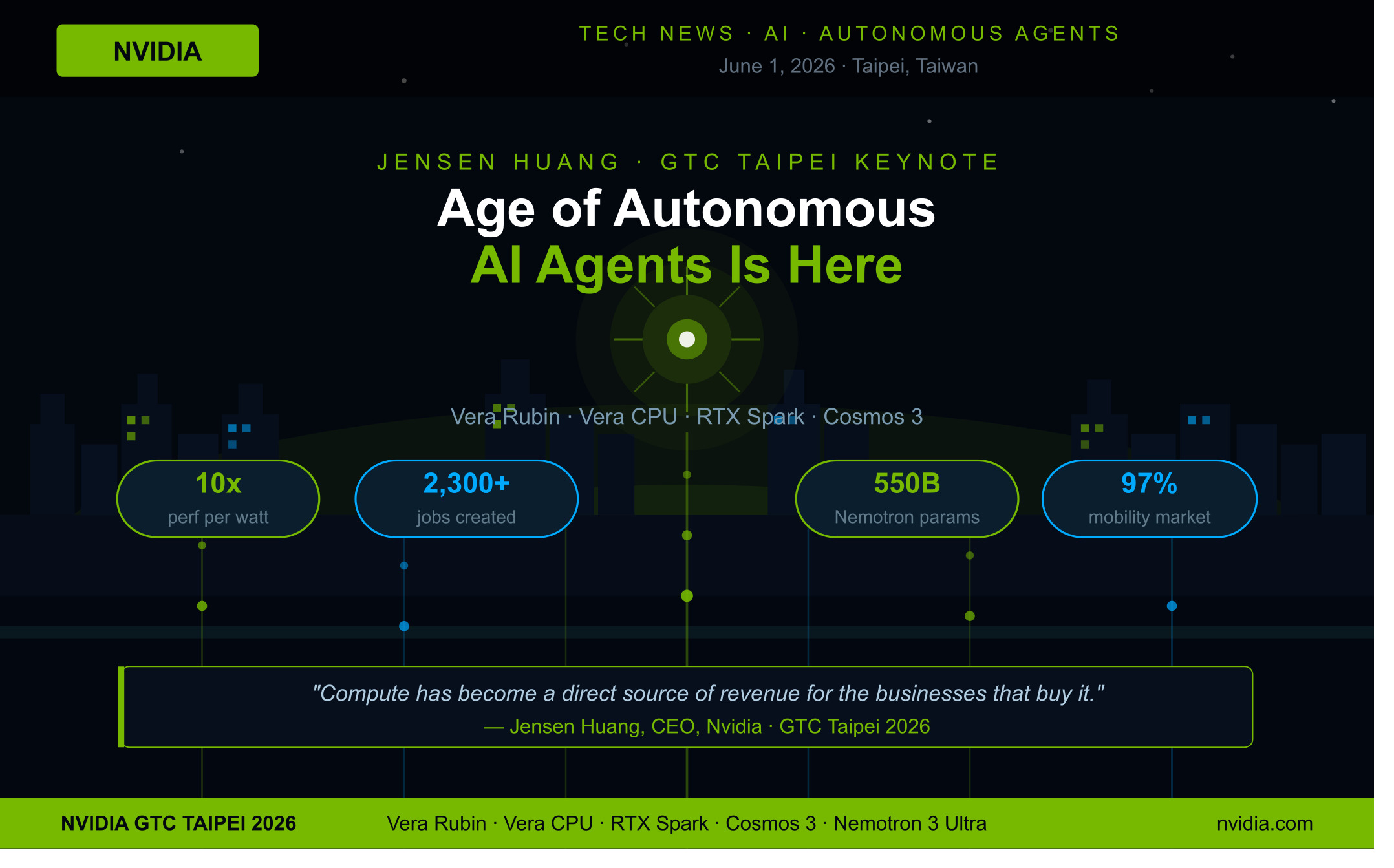
NVIDIA chief executive Jensen Huang stood before a packed audience at the Taipei Music Center on June 1, 2026, and made a declaration that is already reshaping how technology leaders think about the next phase of artificial intelligence. According to Huang, the world has entered the age of autonomous AI agent software systems that observe, reason, plan, and act on their own, with minimal human involvement.
The announcement came during Nvidia’s GTC Taipei keynote, where Huang did not simply introduce new chips. Instead, he used every product reveal to build a single argument: that artificial intelligence has moved beyond generating text and images, and has entered a new stage where it can independently execute complex tasks across businesses, data centers, desktops, and the physical world.
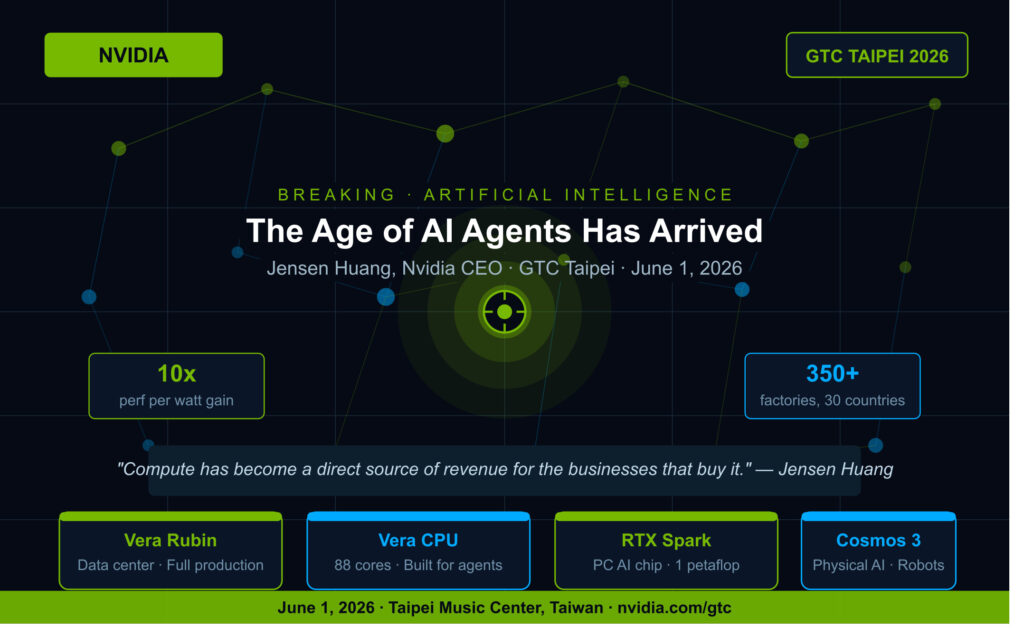
What Is the Age of AI Agents?
The concept of AI agents refers to software programs that go beyond answering questions. These systems take instructions, break them into steps, gather information, make decisions, and complete tasks often without a human directing each move.
Huang pointed to real evidence of this shift. Coding platforms that use AI agents recorded nearly triple the number of developer commits in the first months of 2026 compared to the previous year. In simple terms, AI is no longer just helping workers; it is doing the work.
Huang told attendees at GTC Taipei, arguing that AI infrastructure is now as essential as electricity or the internet.
“Compute has become a direct source of revenue for the businesses that buy it.”
Vera Rubin Enters Full Production
The centerpiece of the GTC Taipei keynote was the confirmation that Vera Rubin Nvidia’s most powerful data center platform, has reached full production.
Vera Rubin is not a single chip. It is a five-rack system that Nvidia treats as one large computer built specifically for agentic AI workloads. Each rack combines 36 Vera CPUs and 72 Rubin GPUs, linked through Nvidia’s sixth-generation NVLink switch. The system also includes ConnectX-9 network cards and BlueField-4 data processing units for traffic management and security.
NVIDIA claims the platform delivers up to ten times higher inference performance per watt compared to its previous generation, and reduces the cost per token by up to ten times. Paired with Groq 3 LPX inference trays, throughput per watt can rise as much as 35 times for the largest trillion-parameter AI models.
Production shipments are scheduled to begin in the fall of 2026. The supply chain behind Vera Rubin spans 150 partners in Taiwan and over 350 factories across 30 countries, roughly double the scale of Nvidia’s previous Grace Blackwell effort.
The Vera CPU: A Processor Built for Agents, Not Humans
Alongside Vera Rubin, Huang introduced the Vera CPU, Nvidia’s first standalone data center processor. The chip carries 88 cores and a custom on-chip fabric designed specifically for the speed and scale that autonomous agents require.
Huang argued that billions of AI agents will run simultaneously and need far lower response times than any human operator demands, creating a processor market that simply did not exist before this moment.
RTX Spark Brings AI Agents to Personal Computers
NVIDIA also moved into a new market on Monday: the personal computer. The company announced RTX Spark, a chip developed with MediaTek that delivers one petaflop of AI performance inside Windows laptops and compact desktops.
RTX Spark pairs a Blackwell RTX graphics processor with 6,144 CUDA cores alongside a 20-core Grace CPU. NVIDIA positioned the chip as the foundation for personal computers that run AI agents locally, without relying on a cloud server for every task.
Partners, including Asus, Dell, Gigabyte, HP, MSI, and Supermicro, are set to begin shipping systems this month. Adobe confirmed it is rebuilding Photoshop and Premiere for RTX Spark, with versions the company says run twice as fast and integrate directly with AI agents.
Cosmos 3 Brings AI Agents Into the Physical World
The agent story extended beyond the data center and the desktop. NVIDIA launched Cosmos 3, an open-world foundation model designed for robots and autonomous vehicles. The system learns from teleoperation, simulation, and re-projected video, allowing robots to understand and reason about their physical surroundings.
NVIDIA also revealed that its Drive Hyperion vehicle platform now serves mobility providers representing approximately 97% of the world’s market. A new open humanoid robot reference design, built on Nvidia’s Jetson Thor module, was made available to robotics research teams worldwide.
What Technology Leaders Should Know
Not all of Nvidia’s claims have been independently verified. Most performance numbers come from the company itself, and Vera Rubin will not ship in volume until autumn, meaning enterprise buyers cannot yet test the cost-per-token figures in real workloads.
Competition is also growing. AMD continues to develop its Instinct accelerators, while Amazon, Google, and Microsoft are each expanding their own custom AI chips to reduce dependence on Nvidia hardware.
Still, the scale and scope of what Huang announced at GTC Taipei signal a clear direction. NVIDIA is no longer positioning itself as a chipmaker alone. It is building the full infrastructure layer, hardware, software, networking, and agent runtimes for a world where AI systems work around the clock, independently, at enterprise scale.
For technology decision makers, the choices made in the next twelve months around AI infrastructure will shape both capability and cost for years ahead.