
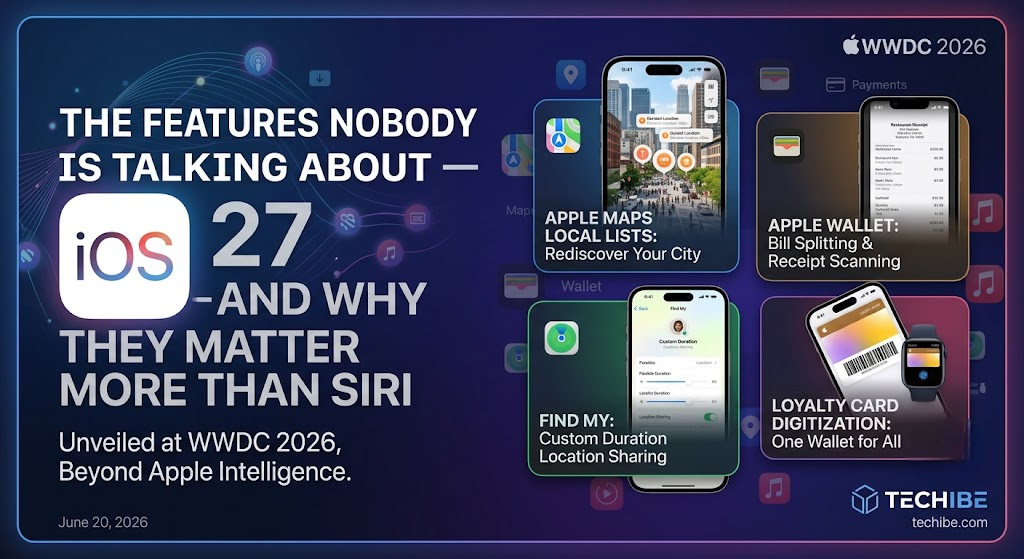
Apple’s AI announcements got all the attention at WWDC. But buried underneath them is an iOS 27 that quietly aims Google Maps, Venmo, and every third-party loyalty card app on your phone.
Apple announced iOS 27 at its annual WWDC dev conference on June 20, 2026, and released the first developer beta, with a public beta to follow next month. The update is set to be made public this fall. Though the main stage keynote was centred around new Siri and Apple Intelligence announcements at WWDC 2023, iOS 27 also brings a host of meaningful changes to Maps, Wallet, Pay, Music, Find My, Podcasts, and Fitness+ that are worth noticing in their own right.
Not all of these features are small. Some are competitive moves dressed up as quality-of-life improvements. Read carefully, and you will see exactly who Apple is coming for.
The Competitive Angle Nobody Is Leading With
Before the feature-by-feature breakdown, step back and look at what iOS 27 is doing strategically.
Apple Maps Local Lists takes direct aim at Google Maps and at the discovery use cases that have been pushing users toward Instagram and TikTok for local recommendations. Wallet’s receipt-scanning and bill-splitting features are a shot at Venmo, Splitwise, and every other app that has built a business on the premise that iPhone users need a third-party tool to split a dinner check. The loyalty card digitisation in Wallet targets every standalone retailer app that survives primarily because it holds a customer’s points balance.
None of these is an accident. iOS 27’s non-AI features are a coordinated attempt to pull high-frequency use cases back into Apple’s own ecosystem. The competition gets less screen time in the keynote. The effect on their businesses could still be significant.
Apple Maps Two Updates, One Clear Target
Flyover gets sharper: Apple’s immersive 3D city views have been refreshed with more detailed visuals and smoother navigation. If you have not used Flyover in a while, the improvement is noticeable. If you never used it, this update probably will not change that.
Local Lists is the one that matters: Apple Maps now lets users discover and save curated recommendations for restaurants, attractions, and local spots by browsing what is trending in their area. That is a feature that currently drives people to open Google Maps, Instagram, or TikTok before they ever open Apple Maps.
Apple is not going to replace TikTok as a discovery platform. But if Local Lists captures even a fraction of the “where should we eat tonight” queries that currently go to Google, that is a significant shift in daily app usage patterns. For a company that sells phones, every minute a user spends inside a native Apple app instead of a Google app matters.
Find My Location Sharing Grows Up
Find My is getting controls it should have had years ago.
Starting this fall, you can share your location for a specific, custom duration, a few minutes, several hours, a specific number of days, or until a precise date and time. You can also temporarily pause location sharing with individual contacts until the end of the day.
Apple’s stated example of keeping a surprise birthday party secret is deliberately mundane. The real use cases are more varied and often more sensitive. Sharing your location with a date you just met. Letting a family member track a trip without permanent access. Giving a contractor access during a home visit.
These are the scenarios people currently manage with awkward workarounds or by just leaving location sharing on permanently. The new controls fix that without requiring any third-party app.
Apple Wallet: The Most Ambitious Feature Set in iOS 27
Wallet is the biggest story in iOS 27, which is not an AI feature. Three distinct additions, each targeting a different competitor.
Receipt scanning and bill splitting: Point your iPhone camera at a receipt. Wallet identifies individual items, calculates each person’s share, including taxes and tips, and facilitates payment through Messages or Apple Cash. This is powered by Apple Intelligence.
Venmo’s core use case for group meals is splitting a bill after the fact. Apple just built that functionality into the camera and payment system that iPhone users already have. Venmo still has a social feed and a network effect. But for users who only opened Venmo to split dinner, that reason just got weaker.
Loyalty card digitisation: Scan a barcode or point your camera at a physical membership card, and it saves directly to Wallet. The cards also sync to Apple Watch for fast retrieval at checkout.
The list of companies that built standalone apps primarily to house loyalty cards is long: Starbucks, Target, Sephora, airlines, and hotel chains. Some of those apps will survive because they offer more than a points balance. Others exist primarily as a loyalty card that occasionally sends push notifications. For that second category, this feature is a meaningful threat.
Hotel key upgrades: Guests at participating hotels can now access trip details, activity schedules, and real-time service updates through Wallet alongside their room key. This deepens Apple’s integration with the travel industry that began with digital hotel keys and is now extending toward the full hospitality experience.
Apple Pay Smarter Checkout, Merchant Tools
Apple Pay’s checkout experience is being redesigned. Swiping between cards is easier, and you can see rewards balances, debit balances, and pay-later options at a glance. Later this year, users will be able to add funds directly to eligible debit cards through Wallet or during checkout.
For merchants, a new “Tap to Share” feature lets customers share loyalty accounts, shipping addresses, and contact details with a single tap. The practical effect is that merchants can collect customer data more seamlessly through Apple Pay than through a separate form, which is either a convenience or a data collection mechanism, depending on your perspective.
Apple Music Languages and Living Rooms
Lyrics Translation expands to seven additional language pairings, including English translations for French, German, Italian, Korean, Spanish, and Japanese. Lyrics Pronunciation, the phonetic display for singing along in unfamiliar languages, comes to five new language pairings.
AutoMix, which smooths transitions between songs, expands from iPhone to Apple TV and HomePod. And Apple TV 4K users get Hi-Res Lossless Audio for Apple Music subscribers with compatible sound systems.
The Music updates are incremental in the context of the full iOS 27 release. But for the specific users, they target language learners, international listeners, and audiophiles with Apple TV setups, each one is genuinely useful.
Apple Podcasts Video Comes to Mac and Apple TV
Podcast listeners have been watching the industry shift toward video-first formats for two years. Apple is catching up.
A “search within show” feature lets users search through episodes of a specific podcast rather than across the entire platform a basic function that has been available on most podcast apps for years and was noticeably absent from Apple Podcasts.
More significantly, video podcasts are coming to Mac and Apple TV. YouTube has built a substantial podcast audience partly by being the destination for video podcast content. Apple’s bringing video podcasts to the living room TV is a direct response to that shift.
iCloud Shared Albums Finally, Full Resolution
iCloud Shared Albums is getting full-resolution photo sharing, support for additional file types, emoji reactions, improved activity feeds, and per-album activity views.
The addition that deserves specific attention: people without Apple devices will be able to contribute photos through the web. This removes a friction point that has made iCloud Shared Albums less useful for groups that include Android users, which is most groups in most parts of the world.
Temporary albums for short-term projects and events also arrive in this update, with the specific design consideration that they do not permanently consume iCloud storage.
Fitness+: A Program Apple Has Never Built Before
“Strong Through Menopause” is a three-week Fitness+ program featuring guided Yoga and Strength workouts specifically designed for people navigating perimenopause and menopause. A new “Time to Walk” episode features actor Busy Philipps.
Apple has built Fitness+ content for many populations. This is the first dedicated program for menopause. The health and fitness industry has been criticised for underserving this demographic. Apple’s entering this space, even with a three-week program, is a signal worth noting.
When Does iOS 27 Come Out?
All features are currently available to developers through the Apple Developer Program. A public beta arrives next month. The full public release comes this fall. Apple has not specified a date, but iOS releases typically arrive in September alongside new iPhone hardware.
Frequently Asked Questions
What is iOS 27?
The current version of Apple’s mobile operating system is iOS 27, introduced at WWDC on June 20, 2026. It tells about the updates for Apple Maps, Find My, Wallet, Pay, Music, Podcasts, iCloud Shared Albums, and Fitness+, along with a new Siri and Apple Intelligence guest announcement in the event.
What are the major new features in iOS 27?
Here were the top new non-AI features included in iOS 27: Apple Wallet now supports receipt scanning & bill splitting, local lists added to Apple Maps, time-limited location sharing, flexible find my loyalty card digitisation, Video podcast on Mac/Apple TV, full-resolution photo sharing in iCloud Shared Album
When is the public release date of iOS 27?
A developer beta is available now with the Apple Developer Program. Public beta is coming next month. The final public release should come later this fall for all eligible devices, likely being released alongside new iPhone hardware in September.
Can I use iOS 27 on older iPhones?
Apple has the full compatibility list for IOS 27. In years past, Apple has supported iPhones for roughly five to six years. Apple Intelligence requires additional hardware capabilities. The complete compatibility list will be confirmed in the run-up to the public release.
Apple Maps Local Lists: What is it?
Engadget: Apple announces ‘Local Lists’: Recommendations for restaurants, attractions, and other popular spots in your area (October ongoing). This product is intended to take on the local discovery use cases that today draw users into Google Maps, Instagram, and TikTok.
What’s the deal with this new Wallet bill-splitting?
In iOS 27, you could aim your iPhone camera at a receipt. Apple Wallet, supported by Apple Intelligence, recognises items as individuals, calculates taxable and tipping amounts person-by-person, and allows you to pay through Messages or Apple Cash. No third-party app required.