Cheaper AI Models Are Reshaping Enterprise AI Strategy as Businesses Prioritize Cost Over Performance
The AI market has entered a phase where the strongest is not the best.
With the increasing use of AI in customer service, marketing software development, finance, and internal processes, many companies are focusing on achieving the best model for better economic performance.
Rising initial costs have led to a move towards more affordable models
This trend could indicate a major shift in the use of AI at the enterprise level in the future. Companies are not looking for the most advanced versions, but for faster, less expensive and energy-intensive versions.
Reports say that businesses are now more careful, about using AI.
They use models only for complex tasks.
Routine work is done with AI models.
This is changing how AI providers compete with each other.
Why Businesses Are Choosing Cheaper AI Models
In the early years of AI, powerful companies focused more on choosing the best model. But today, company executives pay as much attention to its initial costs as to its quality.
Running intelligence is expensive. Every time you use it you need computers to make it work and for companies that use it a lot the costs can add up fast. Something that seems cheap at first can end up costing a lot of money over time.
This is changing how companies build intelligence systems.
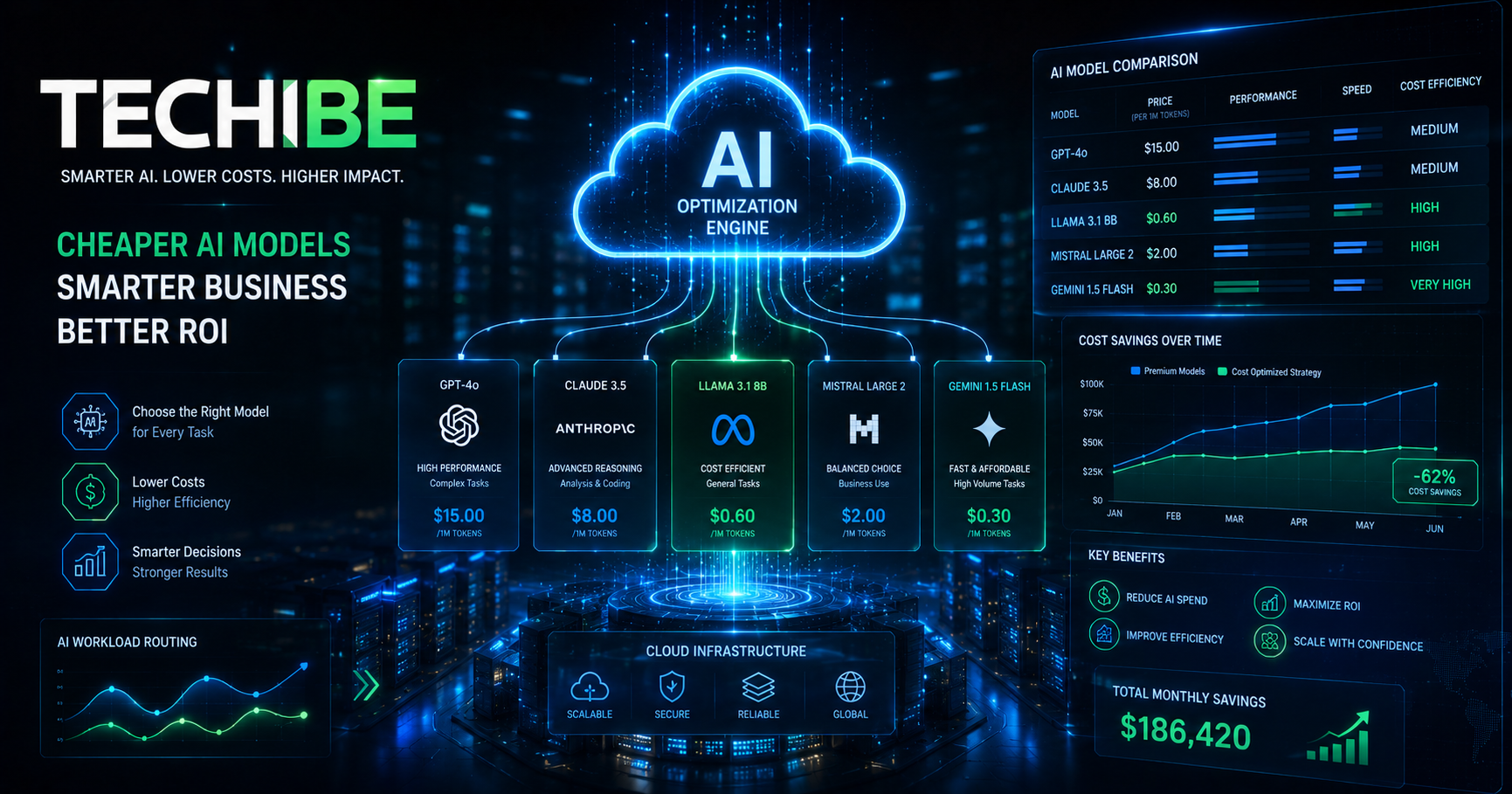
Of using one big artificial intelligence model for everything companies are choosing models that are right for each task. Simple tasks do not need the most expensive artificial intelligence models.
Things like helping customers summarizing documents writing emails, sorting data helping with coding and searching for information often work well with artificial intelligence models.
These models can give you results while saving you money on computers and making things more efficient.
As companies use intelligence more and more they are not just looking at how well it works.
They are trying to find a balance, between what artificial intelligence can do how much it can handle and how much it costs. This is a part of every artificial intelligence plan.
Cost Is Becoming the New Competitive Advantage
The AI industry is gradually moving beyond benchmark comparisons.
As leading AI models continue to push the boundaries of reasoning and multi-faceted capabilities, businesses are increasingly evaluating AI platforms through financial metrics.
For many organizations, a synthetic model that has 95% of the performance of the state-of-the-art system—but costs significantly less—makes a much stronger business case.
As a result, AI providers are beginning to compete not only in terms of intelligence but also in efficiency, pricing, and infrastructure optimization.
How Enterprises Are Optimizing AI Spending
.The growth of enterprise AI is happening fast and it is making organizations think about how they use their computers.They do not just use one model for everything anymore.
A lot of businesses are using models for different things. They pick a model based on how the task is, how fast it needs to be done how safe it needs to be and how much it costs to run.For example a good model might be used for things like looking at legal papers designing software or doing advanced research..
Simpler models can be used for things like helping customers summarizing documents sorting content and doing everyday tasks.Using models, like this helps organizations get more work done and it also saves them a lot of money on AI costs.
When companies use AI for a number of tasks every day picking the right model can save them a lot of money every year even millions of dollars. Enterprise AI is used in places and it is important to use the right model for the task. This way enterprise AI can be used in a way.
AI Pricing Is Becoming a Competitive Battlefield
Currently, companies are not competing on the basis of benchmark scores. Their main advantage is the pricing of their providers.
AI companies are working on better models but they are also making smaller versions that are faster and cheaper.
This is because customers want AI systems that actually help their business, not systems that do well on technical tests.Cloud service providers are helping with this by giving companies options for how to use their services so they can pick the one, for each job without worrying about security or scalability.
As AI providers try to beat each other on price businesses have choices and providers have to make sure they are giving good value for the money they are getting.
Why This Matters for AI Providers
The move to Artificial Intelligence brings both good things and tough problems.
Artificial Intelligence companies that make the best Artificial Intelligence models have to keep spending a lot of money on computer systems, special equipment and research.
At the time big companies that buy Artificial Intelligence want to pay less money they want it to work better and they want to know how much it will cost them to use it.This makes it hard for Artificial Intelligence companies because they have to be good at making things and also keep costs low.Companies that can give people Artificial Intelligence
for less money will probably do very well when more companies start using Artificial Intelligence.
For companies like OpenAI, Anthropic, Google, Microsoft and other Artificial Intelligence leaders doing well in the future might not just be, about making the Artificial Intelligence but also about making Artificial Intelligence that companies can afford to use.
The Future of Enterprise AI Economics
In the next phase, the development of artificial intelligence will not only focus on building smarter models, but the cost of using it will also become more important.
As organizations continue to integrate Artificial Intelligence into their operations controlling the costs of the infrastructure will become as important as improving the performance of the Artificial Intelligence models.
People who study the industry expect companies to increasingly adopt routing systems that automatically select the most suitable Artificial Intelligence model for each request. Of routing every request to the most advanced and expensive Artificial Intelligence model, Artificial Intelligence platforms will dynamically balance the performance, speed and cost of the Artificial Intelligence models.
This change could significantly reduce the costs of Artificial Intelligence for companies while making Artificial Intelligence accessible, to organizations of all sizes.
Than treating Artificial Intelligence as a special service reserved for complex tasks businesses will increasingly integrate cost-effective Artificial Intelligence into customer support, marketing, software engineering, finance, operations and internal knowledge management to make Artificial Intelligence a part of their daily work.
What This Means for the AI Industry
The trend of AI models is getting bigger and this means a big change in how companies
Being successful is not about how high you rank on metrics or how big your model is.
Now companies that make AI products compete in different ways:
* Model quality
* How cost-effective they are
* How fast they. How much time they take to respond
* How energy they use
* How well they work with cloud services
* How secure they are for businesses
It is likely that AI companies in the future will offer models that balance cost and performance.
Conclusion
The invention of artificial intelligence at low prices can be considered one of the most important changes of the new generation.
They no longer think the strongest AI model is always the one. Now they are using AI in a way. They focus on saving money being able to handle work and getting real benefits for their business.
This change will likely affect how AI providers compete with each other. It will also help more businesses start using AI.. It will lead to the creation of special AI models.
These models will be designed for tasks.As AI becomes a part of how businesses work companies that can offer good performance at a lower price will probably lead the way in AI for businesses.
They will set the standard for the generation of AI, in the business world.Businesses are looking for AI models that're cheaper but still work well.The AI models are getting smarter. Are able to do more things.AI is becoming a part of business operations.
Companies are using AI to help them work efficiently.The use of AI is expected to increase in the future.Businesses are adopting AI to stay competitive.The development of AI is changing how businesses operate.
FAQs
1. Why are businesses choosing cheaper AI models?
Organizations are prioritizing lower operating costs, faster response times, and better return on investment as enterprise AI usage continues to scale.
2. Do cheaper AI models perform as well as premium models?
For many routine business tasks—such as document summarization, customer support, and content generation—smaller AI models often deliver sufficient performance at a much lower cost.
3. What is a multi-model AI strategy?
A multi-model strategy uses different AI models for different workloads, selecting the most cost-effective option based on task complexity and business requirements.
4. How does this affect AI providers?
AI companies must now compete on pricing, efficiency, scalability, and enterprise value in addition to model performance.
5. What does this mean for the future of enterprise AI?
AI adoption is expected to accelerate as businesses increasingly deploy specialized, affordable AI models that provide strong performance while reducing long-term operational costs.