
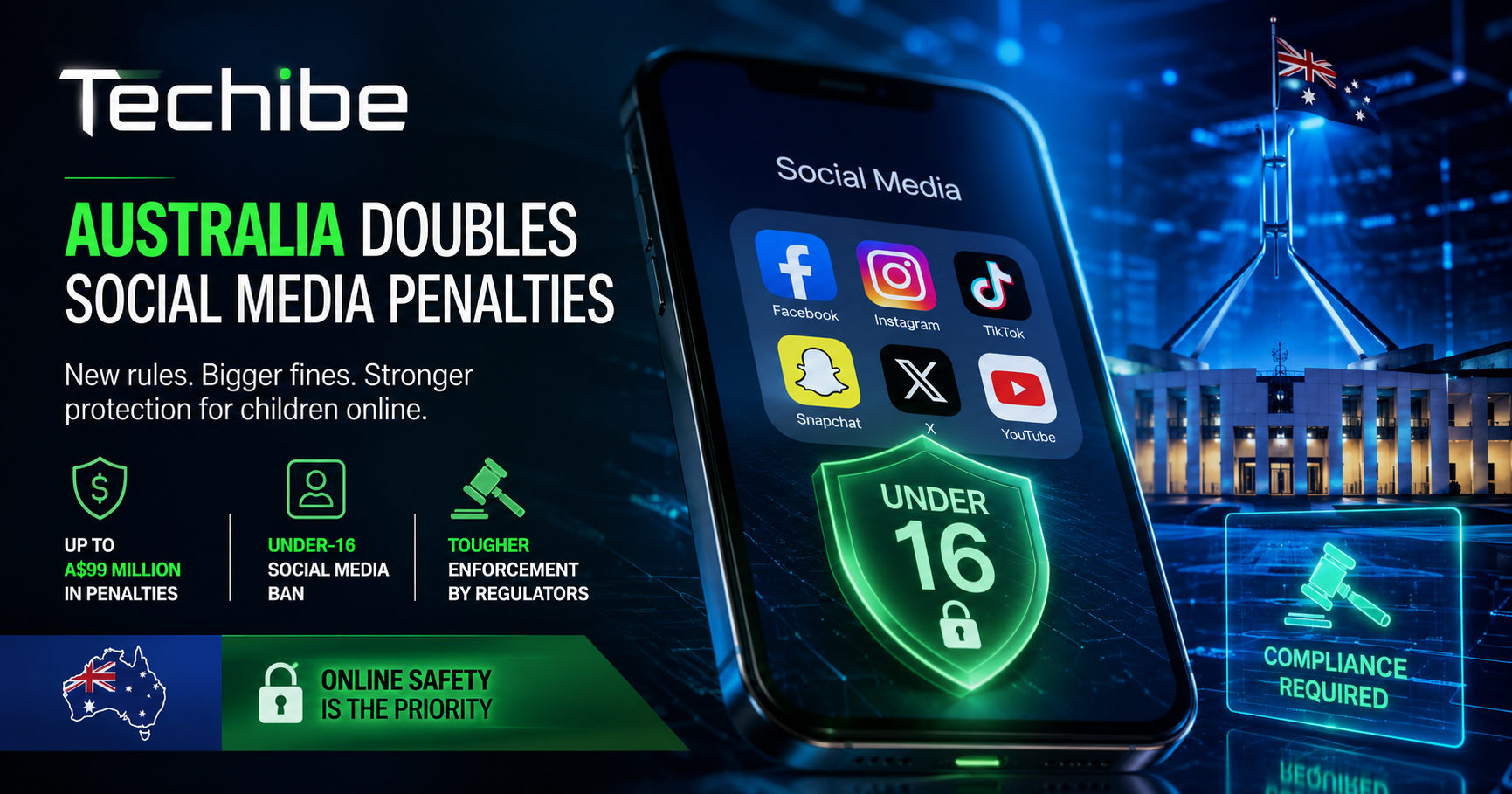
Australia Doubles Social Media Penalties as Big Tech Faces Tougher Child Safety Rules
Australia has taken another step towards regulating social media, with plans to significantly increase fines for companies that fail to enforce a ban on under-16s using social media platforms.
The government’s new plan will increase the maximum fine for widespread violations from A$49.5 million to A$99 million.
The eSafety Commissioner will also be given greater powers to request more evidence from tech companies and scrutinise how they are implementing the rules.
The Australian government has said that despite the law, many children still manage to get around age restrictions by creating fake accounts, using false information or other methods. For this reason, officials believe that technology companies must take greater responsibility in preventing underage users from accessing social networks.
Why is Australia increasing fines?
Australia was one of the first countries to pass a national minimum age for social media use, drawing the attention of many governments.
But authorities say enforcement has not been effective enough.
The review found that some major platforms such as Facebook, Instagram, TikTok, Snapchat and YouTube are still being investigated by regulators to determine whether they are doing enough to prevent users under the age of 16.
The government says the increased fines are aimed at forcing tech companies to invest more in age verification systems, security technologies and child protection tools.
Australia Doubles Social Media Penalties as Big Tech Faces Tougher Child Safety Rules
If approved, social media companies will have to prove that they have effective methods in place to prevent users under 16 from signing up or continuing to use their services.
This will not be limited to simply asking users for their date of birth.
Platforms are expected to use more advanced technologies such as age verification systems, artificial intelligence tools to detect abuse, monitoring suspicious accounts, and parental safety features.
The increased authority of the regulator will also force companies to provide more detailed information on how they are enforcing the rules. If they fail to cooperate or repeat violations, they could face heavier fines.
Big Tech Faces Greater Regulatory Pressure
The proposed changes reflect a broader global trend in technology regulation.
Governments worldwide are exerting increasing pressure on major tech companies to protect younger users from harmful content, excessive screen time, online abuse, and privacy risks. Rather than relying solely on voluntary safety policies, regulators are increasingly introducing enforceable legal obligations backed by significant financial penalties.
For companies operating global social media platforms, Australia’s stricter approach could set a significant precedent should similar laws be adopted in other countries.
How the New Rules Could Affect Social Media Platforms
If passed, the legislation would require social media platforms to demonstrate that they have implemented security systems to prevent users under 16 from creating or maintaining accounts.
This goes beyond simply asking users to enter their date of birth. Lawmakers are increasingly expecting platforms to invest in stronger age-verification technologies, account monitoring, parental safety tools and assessment systems that can detect attempts to circumvent restrictions.
The Australian Electronic Safety Commissioner’s broader provisions also allow regulators to request more detailed compliance information from technology companies. Businesses that fail to cooperate or repeatedly breach the rules could face much higher financial penalties
.For global platforms, compliance could require significant investment in identity verification, AI moderation systems and advanced privacy protections.
The Global Debate Around Age Verification
The Australian bill has reignited a global debate about the balance between protecting children and protecting users' privacy.
Supporters of the law argue that social networks have so far failed to adequately protect children from inappropriate content, online harassment, fraud and social media addiction, and that governments should impose stricter laws.
On the other hand, some experts warn that the mandatory use of authentication systems could create new risks to users' privacy and force companies to collect more personal data.
Why This Matters for the Technology Industry
Australia’s decision could have far-reaching implications.
Governments in Europe, North America and some Asian countries are closely watching the implementation of this law. If the model is successful, it is likely that other countries will adopt similar laws to increase the accountability of social networks.
For big tech companies, this is not just a local law; it is a sign of increasing government oversight in areas such as child protection, privacy, digital security and platform accountability
What This Means for Businesses and the Future of Social Media
Australia’s proposed law highlights a growing shift in how governments view the responsibilities of technology companies. Rather than treating online safety as a voluntary commitment, regulators are increasingly making it a legal obligation backed by significant financial consequences.
For social media platforms, the new rules could require significant investment in age-verification technologies, AI-powered moderation systems, privacy-preserving identity verification and compliance reporting. While these changes may increase operational costs, they could also improve trust between users, parents and regulators.
Tech companies may also need to redesign some platform features to better protect younger audiences. Recommendation algorithms, content discovery systems, messaging functions and advertising tools could all face closer regulatory scrutiny if regulators decide to do so.
For businesses operating globally, Australia’s approach serves as an early indicator of the likely direction of digital regulation. Companies that develop scalable compliance frameworks today may be better prepared as similar rules emerge in other regions.
Conclusion
The Australian government’s decision to double fines for social media companies is a sign that governments are changing their approach to holding tech companies accountable.
Protecting children online has become a hot topic in tech regulation in recent years, with big companies expected to invest more in age verification systems, artificial intelligence tools, content moderation and user safety.
If the law is successfully implemented, it could become a model for other countries and influence the future of social media regulation around the world.
AI Cybersecurity Trends in 2026
Australian Government – Department of Infrastructure, Transport, Regional Development, Communications and the Arts
FAQs
1. Why is Australia increasing social media penalties?
Australia aims to strengthen enforcement of its under-16 social media restrictions by increasing financial penalties for platforms that fail to comply.
2. How much could companies be fined?
Under the proposed legislation, the maximum penalty for systemic breaches would increase from A$49.5 million to A$99 million.
3. Which platforms could be affected?
Major social media companies—including Meta's Facebook and Instagram, TikTok, Snapchat, YouTube, and other platforms operating in Australia—could be subject to the new rules if they fail to meet regulatory requirements.
4. Why is age verification controversial?
Supporters believe it improves child safety, while critics argue it may introduce privacy risks and require users to share more personal information than necessary.
5. Could other countries adopt similar laws?
Yes. Many governments are closely monitoring Australia's approach and may introduce similar regulations if the policy proves effective.
6. What does this mean for Big Tech?
Technology companies are likely to invest more in age verification, AI moderation, compliance systems, and online safety features to reduce regulatory risk.