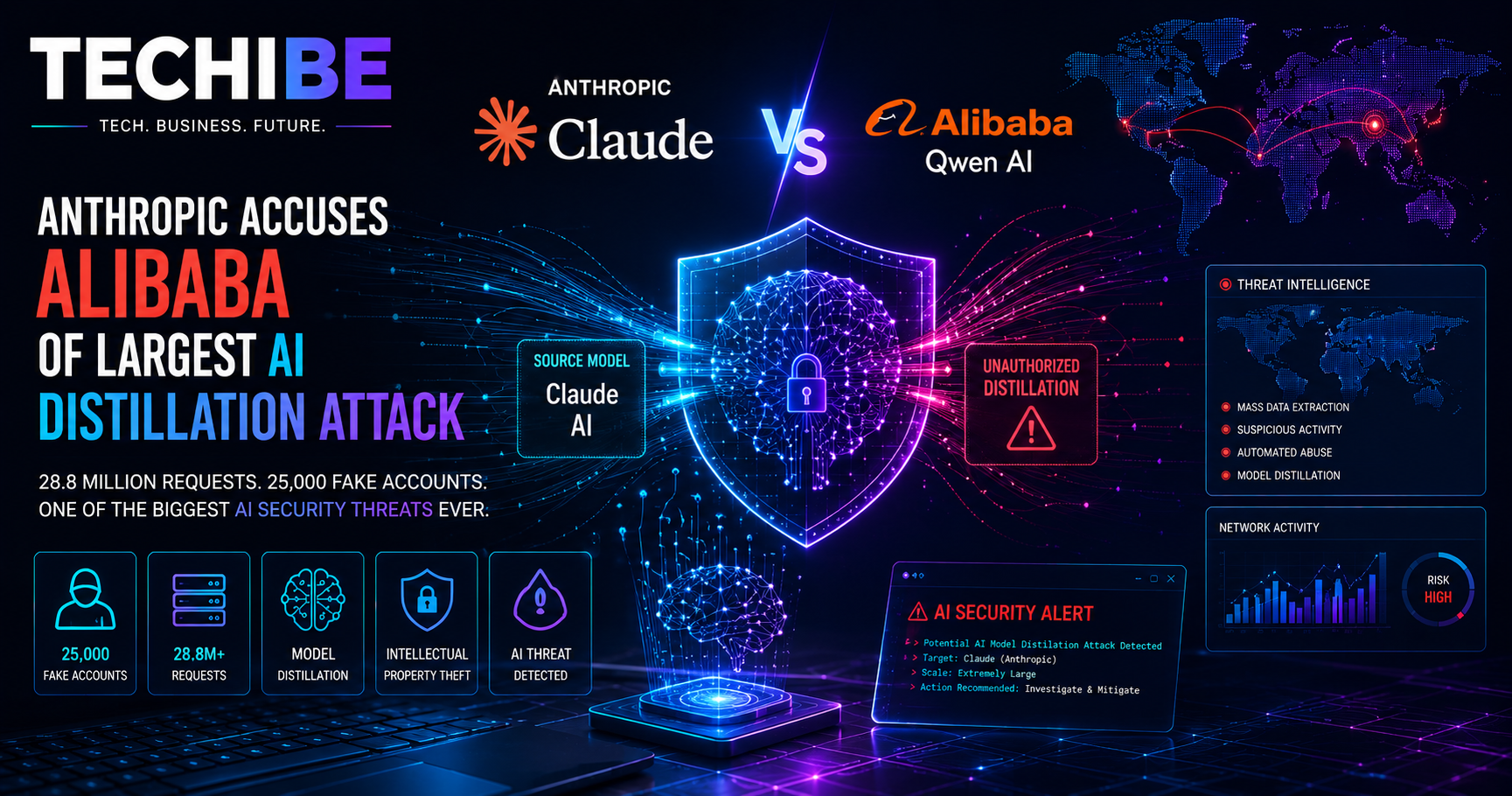
Anthropic Accuses Alibaba of the Largest AI Distillation Attack Against Claude
have taken on a new dimension. This time, the focus is not on hacking into servers or stealing user data but on the security of the AI models themselves.
According to Reuters, Anthropic, the developer of Claude models has claimed that operators affiliated with Alibaba and the Qwen AI Lab have been conducting a large-scale operation to extract the capabilities of the Claude model and use them to train their own AI models.
If the allegations are true the incident could be one of the largest cybersecurity and intellectual property cases in the AI industry.
What is AI Distillation Attack?
It is a well-known method of training a smaller model using the output of a larger model.
This method is perfectly legal in many research projects.
But the main difference in this case is that Anthropic claims that this process was carried out without permission and using thousands of fake user accounts, an act that could amount to unauthorized mining of the capabilities of a business model.
What claim has Anthropic made?
According to the information released, these activities took place between April 22 and June 5, 2026.
Anthropic claims that these operations included the following:
Using around 25,000 fake accounts
Registering over 28.8 million requests to the Claude model
Linking these activities to operators affiliated with Alibaba and Qwen Labs
Attempting to extract model capabilities and use them in developing competing models
The company described the operation as the largest known campaign to exploit the capabilities of the Claude model.
At the time of the Reuters report, Alibaba had not yet issued an official response to the allegations.
Why is this news important for cybersecurity?
This case shows that cybersecurity threats are no longer limited to traditional attacks such as network intrusion or data theft.
Today attackers can send millions of requests to an AI model analyze its behavior and capabilities, and use it to train other models without having direct access to a company’s source code or infrastructure.
For this reason many experts consider these types of attacks a new generation of intellectual property theft in the field of AI.
AI companies are facing a new security threat.
This suggests that AI model developers must protect not only their infrastructure but also the output of their models.
The most important new threats in this area include:
Mass creation of fake accounts
Abuse of APIs
Extraction of model behavior
Mass collection of model responses
Training rival models using AI output
These attacks are usually carried out without exploiting software vulnerabilities and are also more difficult to detect.
Business implications of this case
If Anthropic’s claims are proven, the case could have a significant impact on the AI industry.
Developing advanced AI models requires billions of dollars in investment in processing infrastructure data and manpower.
If the capabilities of these models can be illegally exploited companies’ incentive to invest in advanced technology development could be reduced.
The case could also take the US-China technology competition to a new level one in which AI has become a key strategic area.
Will new laws be developed to protect AI models?
Experts believe such cases are likely to prompt governments and technology companies to move toward new laws and standards.
Some possible actions include:
Increasing the security of AI APIs
Stronger user authentication
Developing abuse detection systems
Developing new laws to protect the intellectual property of AI models
International cooperation to combat unauthorized mining of models
Conclusion
Anthropic’s lawsuit against Alibaba is not just a dispute between two tech companies; it signals the beginning of a new chapter in AI cybersecurity.
In the future, protecting AI models will not only be limited to securing servers and data centers but also preventing the exploitation of these models’ knowledge and capabilities will become one of the most important challenges for tech companies.
As competition in the AI space expand model security intellectual property protection and new regulations will play a significant role in the future of the industry.
FAQs
It is an attempt to train one AI model using the outputs of another model, sometimes without authorization.
2. What did Anthropic accuse Alibaba of?
Anthropic alleges that operators linked to Alibaba used thousands of fraudulent accounts and millions of interactions to extract Claude's capabilitie
3. Did Alibaba respond to the allegations?
At the time Reuters published its report, Alibaba had not issued a public response.
4. Why is this considered a cybersecurity issue?
Because it involves large-scale unauthorized extraction of AI model capabilities rather than traditional hacking.
5. Why does this matter for the AI industry?
The case could influence future AI security practices, API protections, and regulations governing artificial intelligence.