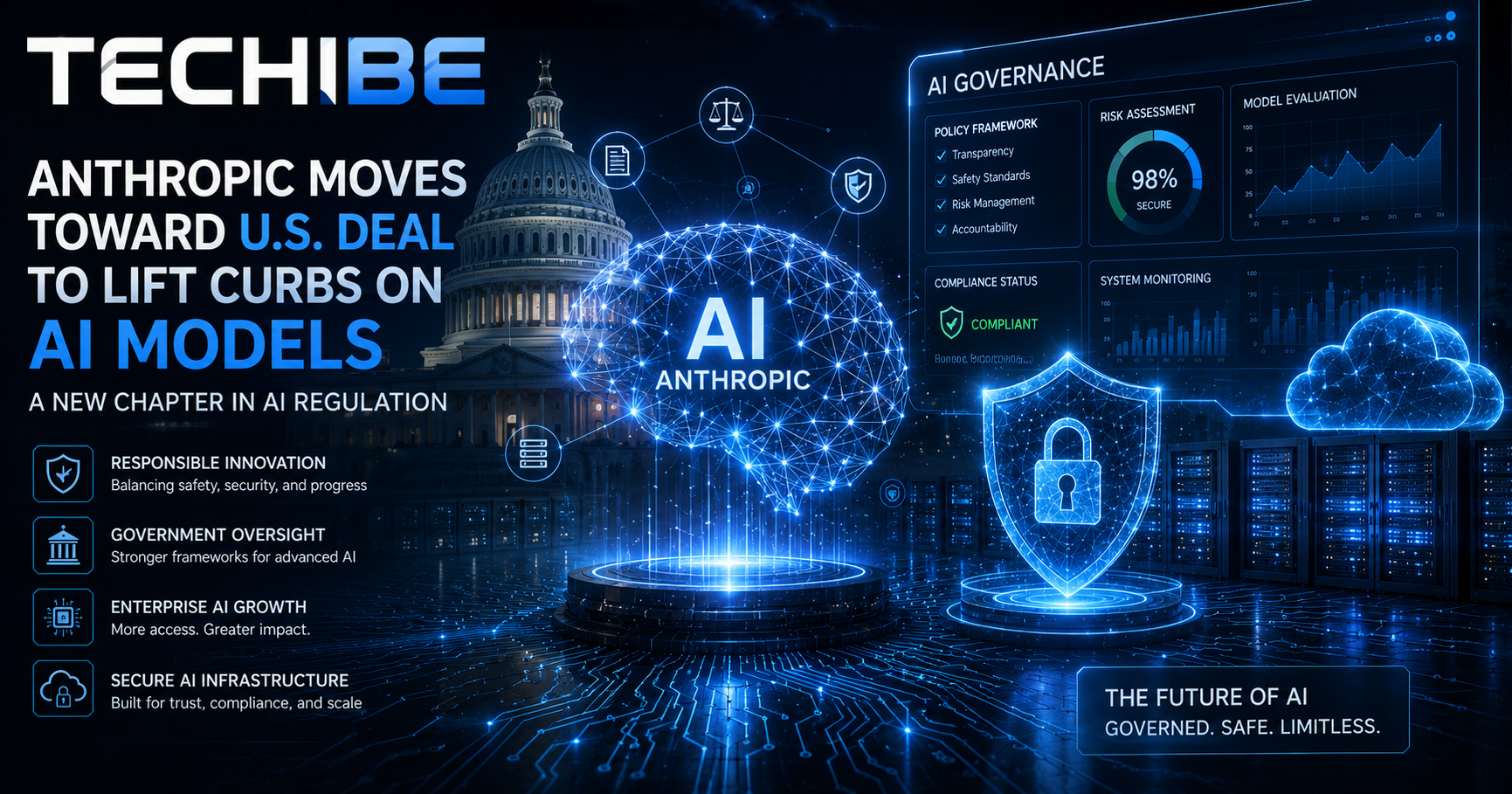
Anthropic Moves Toward U.S. Deal to Ease AI Model Restrictions
Anthropic is reportedly moving closer to an agreement with the U.S. government that could ease restrictions on access to the company’s most advanced AI models. The talks highlight a growing effort to balance national security concerns with the rapid expansion of enterprise AI and commercial innovation.
As governments around the world introduce new rules for powerful AI systems, technology companies are increasingly negotiating directly with regulators to ensure that advanced models remain available to businesses, researchers, and developers under appropriate protections.
The reported talks between Entropic and US officials represent one of the most significant political developments in the field of AI this year, and demonstrate how AI governance is becoming as important as AI innovation itself.
Why AI Model Restrictions Matter
Leading AI models are capable of performing more complex tasks, including software development, scientific research, enterprise automation, cybersecurity analysis, financial modeling, and advanced reasoning.
As these systems rapidly improve, governments have become concerned about their potential misuse for cyberattacks, biological research, disinformation campaigns, or other high-risk activities.
As a result, regulators have imposed various restrictions on who can access the most powerful AI models and under what circumstances.
Technology companies argue that while safety remains essential, excessive restrictions could slow innovation, reduce business competitiveness, and limit the economic benefits that advanced AI can deliver.
Finding the right balance has become one of the defining challenges facing policymakers around the world.
Anthropic's Approach to Responsible AI
Entropic has built its reputation around developing AI systems with a strong emphasis on safety, transparency, and responsible deployment.
The company’s family of cloud AI models has become increasingly popular among companies seeking secure generative AI solutions for customer support, software engineering, legal analytics, document processing, and knowledge management.
Unlike companies that focus solely on model performance, Entropic has consistently emphasized rule-based AI, alignment research, and risk mitigation as core parts of its product strategy.
Reported discussions with U.S. regulators demonstrate the company’s willingness to work alongside policymakers while expanding commercial access to advanced AI capabilities.
Balancing Innovation and National Security
Artificial intelligence is rapidly becoming one of the most important strategic technologies in the world.
Governments are increasingly recognizing that advanced AI models have applications beyond consumer chatbots. They can accelerate scientific discovery, improve healthcare, strengthen cybersecurity, enhance defense capabilities, and transform organizational productivity.
At the same time, policymakers remain concerned that unrestricted access to highly capable AI systems could create new security risks if advanced models are misused.
Reported talks between Entropic and US officials show how regulators are shifting away from sweeping restrictions towards more participatory governance models.
Rather than completely restricting AI development, governments are increasingly exploring frameworks that allow for responsible commercial access while maintaining safeguards for high-risk applications.
What a Potential Agreement Could Mean
If an agreement is reached, it could set an important precedent for how advanced AI companies will interact with regulators.
Rather than viewing AI regulation as an obstacle, companies may increasingly work alongside governments to establish security standards, transparency requirements, and responsible deployment practices.
For enterprise customers, greater regulatory clarity can improve confidence in adopting advanced AI systems for business operations.
Organizations in finance, healthcare, legal services, manufacturing, education, and software development continue to expand their investments in productive AI. A more predictable regulatory environment makes it easier to plan for long-term AI while reducing uncertainty around compliance.
The agreement could also influence future discussions on AI policies in other countries, many of which are already developing their own governance frameworks for leading-edge AI models.
Why Businesses Are Watching Closely
The adoption of enterprise AI is increasing worldwide.
Businesses are increasingly relying on basic models for customer service automation, software development, business intelligence, document analysis, research assistance, and workflow optimization.
However, many organizations are cautious about deploying advanced AI as regulations continue to evolve.
Greater collaboration between AI developers and governments could encourage broader adoption by companies by providing clearer guidance on security, privacy, model access, and compliance.
For Entropy, reaching a regulatory agreement could strengthen customer trust while expanding business opportunities in industries that require advanced AI capabilities and strong governance standards.
The Future of AI Governance
AI regulation is entering a new phase.
Rather than asking whether AI should be regulated, governments are increasingly focusing on how to regulate leading-edge models without slowing innovation or constraining economic growth.
Reported talks between Entropic and the U.S. government suggest that future AI governance will likely be based on collaboration rather than confrontation. Technology companies, policymakers, researchers, and enterprise customers all have a shared interest in ensuring that advanced AI systems are deployed both powerfully and responsibly.
Industry experts expect future regulatory frameworks to emphasize the following:
Risk-based AI oversight
Secure deployment standards
Transparency and accountability
Responsible access controls
Continuous safety testing
Collaboration between governments and AI developers
As AI capabilities continue to evolve, flexible governance models may be more effective than rigid restrictions that struggle to keep pace with technological advancements.
Why This Matters for the AI Industry
The outcome of the entropic debate could extend beyond a single company.
If regulators create a practical framework for granting broader access to advanced AI models while maintaining strong safety protections, other leading AI developers—including OpenAI, Google DeepMind, Microsoft, and future leading model providers—could adopt similar approaches.
This helps create greater coherence across the AI ecosystem and makes it easier for businesses to confidently invest in long-term AI transformation projects.
For companies, clearer rules mean less regulatory uncertainty.
For developers, these rules provide predictable access to advanced models.
For governments, these rules create an opportunity to encourage innovation without compromising public or national security.
Ultimately, the success of AI depends not only on technological advances, but also on governance models that instill trust while enabling responsible innovation.
Conclusion
Entropic is reportedly moving toward a deal with the U.S. government. This represents a significant milestone in the evolution of AI regulation.
Rather than seeing regulation and innovation as opposing forces, both policymakers and AI companies appear to be moving toward a collaborative model that supports the responsible deployment of cutting-edge AI systems.
As governments continue to shape the future of AI, agreements like these may become a blueprint for balancing technological advancement, organizational adoption, and national security.
For businesses, investors, and developers, the message is clear: the future of AI will be determined as much by smarter algorithms as by smarter governance.
FAQs
1. What are AI model restrictions?
AI model restrictions are regulatory or company-imposed controls that limit access to advanced artificial intelligence systems based on safety, security, or compliance concerns.
2. Why is Anthropic negotiating with the U.S. government?
Anthropic is reportedly working toward an agreement that could ease access restrictions while maintaining safeguards for the responsible deployment of advanced AI models.
3. How could this affect businesses?
A clearer regulatory framework could make it easier for enterprises to adopt advanced AI solutions with greater confidence and compliance certainty.
4. Why are governments regulating frontier AI models?
Governments aim to reduce potential risks such as cybersecurity threats, misuse of powerful AI systems, and national security concerns while supporting innovation.
5. Could this influence global AI regulation?
Yes. Any agreement between Anthropic and U.S. regulators could serve as a model for future AI governance frameworks adopted by other countries and technology companies.