
There is a conversation happening in every boardroom, every university lecture hall, and every kitchen table right now. It goes something like this: “Is my job safe?”
It is one of the most honest questions of our generation, and it deserves an honest answer. Not a reassuring one, not a scary one. Just the truth, backed by real data.
This guide walks you through exactly what is happening to the global workforce because of artificial intelligence. What jobs are disappearing? What jobs are growing? Who is most at risk, who is not, and what you can actually do about it.
The Numbers That Actually Matter
Before anything else, let us look at what the research actually says, not the headlines, but the underlying data.
The World Economic Forum’s Future of Jobs Report surveyed more than 1,000 leading employers across 55 economies. Their finding: by 2030, AI and related technologies will create 170 million new roles globally while displacing 92 million. That is a net gain of 78 million jobs. On paper, it sounds like good news.
But here is the part that does not make the headlines: the jobs being destroyed and the jobs being created are not the same. They do not require the same skills. They do not pay the same wages. And they are not in the same locations. A displaced customer service representative in a small town does not automatically become an AI engineer in San Francisco. That gap between who loses and who gains is where the real story lives.
McKinsey’s research adds another dimension. The technology available today, without any future breakthroughs, could theoretically automate approximately 57% of current U.S. work hours. Not 57% of jobs eliminated but across the entire working population, more than half of the hours worked involve tasks that AI could already handle, if fully deployed. The barrier is not capability anymore. It is deployment speed and business decision-making.
Goldman Sachs puts the longer-term displacement figure at 6 to 7% of the U.S. workforce, roughly 11 million workers, with around 300 million full-time positions globally being affected by generative AI in some form.
What “Affected” Actually Means
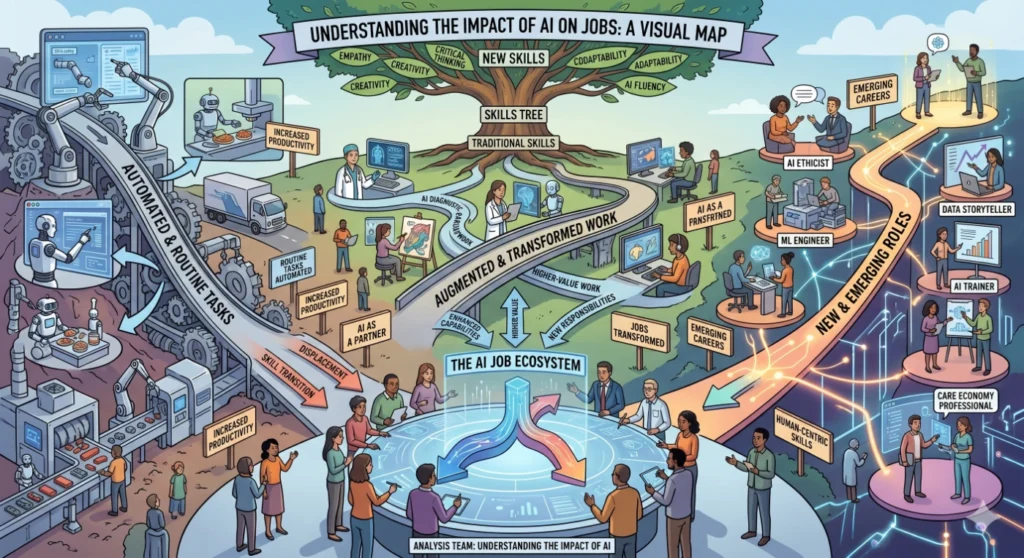
Here is where most coverage of this topic goes wrong. “Affected by AI” does not automatically mean “replaced by AI.”
There is a critical difference between three things:
Displacement: means your job goes away entirely and AI does it instead.
Augmentation: means AI helps you do your job faster, better, or with less effort, and you stay employed, often with higher productivity.
Transformation: means your role changes significantly. Tasks you used to do are automated, but new responsibilities emerge that require human judgment.
The Federal Reserve Bank of Dallas, reviewing wage and employment data through early 2026, found that in jobs with significant AI exposure, wages were not uniformly declining — suggesting that for many workers right now, AI is augmenting rather than replacing their output. That is an important nuance.
The danger is assuming it will stay that way forever.
Which Jobs Are Most at Risk
The Honest List
The jobs facing the most direct pressure share one common characteristic: they involve repeatable, predictable, rule-based tasks, especially digital and text-based ones.
Data entry, customer service scripting, basic legal research, routine coding, and content moderation top the risk list for 2025 and 2026. These are not low-skill jobs. Some of them paid very well for a long time. But the tasks involved are exactly what large language models and AI agents are best at: processing information, following patterns, and generating outputs at scale.
In finance, the numbers are striking. The IMF estimates that 60% of jobs in advanced economies carry high AI exposure, and financial services skew toward the upper end of that range. Wall Street banks are planning to cut approximately 200,000 jobs over the next three to five years, with entry-level and back-office roles hit hardest. As many as 54% of banking jobs carry high potential for AI automation.
The legal profession is facing a similar reckoning. Paralegals face an 80% risk of automation by 2026. Legal researchers face a 65% risk by 2027. Not because AI is a better lawyer, but because the research and documentation work that junior legal staff does can be replicated by AI tools at a fraction of the cost.
In healthcare, medical transcription is already 99% automated. About 40% of medical coding is projected to follow by the end of 2025.
Software engineering, a field that many people moved into specifically because of technological change, is itself now being reshaped. Microsoft CEO Satya Nadella confirmed that 30% of the company’s code is now written by AI. Anthropic CEO Dario Amodei has stated publicly that AI could eliminate roughly 50% of entry-level white-collar positions within five years.
Who Is Least at Risk
The jobs with the lowest AI displacement risk share different characteristics: physical unpredictability, deep emotional intelligence, hands-on technical skill, and contextual human judgment.
Skilled tradespeople, electricians, plumbers, and HVAC technicians work in environments that are messy, variable, and require real-time physical problem-solving that no robot handles well yet. Mental health counselors need genuine human empathy and therapeutic relationships that cannot be replicated. Surgeons operating in complex, non-routine procedures. Senior creative directors make aesthetic judgments shaped by culture, trends, and client psychology.
The WEF’s own data shows that frontline roles, farmworkers, delivery drivers, and construction workers are expected to see the largest absolute job growth by 2030, despite all the noise about automation.
The White-Collar Surprise
Perhaps the most counterintuitive finding from recent research is that educated white-collar workers are facing disruption that blue-collar workers are largely avoiding.
Researchers from the University of Pennsylvania and OpenAI found that workers earning up to $80,000 per year in knowledge-based roles are among the most likely to be affected by workforce automation. This is the opposite of every previous wave of automation in history. The Industrial Revolution replaced physical labor. AI is replacing cognitive labor and it turns out cognitive labor is much easier to automate than anyone expected.
Ford CEO Jim Farley said AI will “replace literally half of all white-collar workers.” Salesforce CEO Marc Benioff claimed AI is already doing up to 50% of his company’s workload. JPMorgan’s Jamie Dimon told the World Economic Forum he expects to hire fewer people over the next several years due to AI.
These are not futurists speculating. These are operating CEOs describing what is happening in their companies right now.
Cornell University research found that companies adopting AI have already reduced junior hiring by about 13%. The structural concern here runs deeper than just the immediate job loss: shrinking entry-level pipelines mean fewer experienced senior workers in the following decade. The career ladder gets pulled up from the bottom.
The Gender Dimension Nobody Talks About
The AI job displacement story has an uneven gender distribution that deserves more attention than it gets.
In the United States, approximately 79% of employed women hold positions categorized as high-risk for automation, compared to 58% of men. This is not a coincidence; it reflects the occupational composition of female employment. Roles like secretarial work, medical administration, legal support, and receptionist work are both predominantly female and among the most AI-exposed.
Globally, 4.7% of women’s jobs face high AI disruption risk compared to 2.4% for men. Any serious discussion of AI’s economic impact has to include this dimension.
What Is Actually Growing
Despite all of the disruption, there is a second half of this story that is equally real.
AI is creating entirely new categories of work. In Q1 2025 alone, there were 35,445 AI-related positions advertised across the United States a 25.2% increase year-over-year. The median annual salary for AI roles reached nearly $157,000.
Data analysis and mathematics roles now account for over 58,000 job openings, with a median pay of $170,000. Data scientists are projected by the U.S. Bureau of Labor Statistics to grow 34% between 2024 and 2034. Computer and Information Research Scientists are projected at 20% growth.
PwC’s 2025 Global AI Jobs Barometer revealed something significant: workers with AI skills are now earning a 56% wage premium over peers doing identical roles without those skills. One year earlier, that premium was 25%. It is accelerating rapidly.
Jobs requiring AI skills are growing 3.5 times faster than all other occupations. McKinsey estimates AI could create between 20 and 50 million new jobs worldwide by 2030. The LinkedIn Economic Graph counted 1.3 million AI-related roles and 600,000+ AI-enabled data center jobs created since 2023 alone.
Cybersecurity is one of the fastest-growing fields of all. As AI tools generate more code, sometimes introducing new bugs and vulnerabilities, the demand for security professionals who can identify and fix those problems is accelerating sharply.
The Skills That Now Matter Most
The WEF identified analytical thinking as the most sought-after skill in 2025, with seven out of ten companies considering it essential. This is interesting because analytical thinking is not about knowing how to use a specific tool. It is about reasoning through problems, something AI assists but does not yet replace.
The broader picture from employer surveys: organizations are not just looking for people who can use AI tools. They are looking for people who understand the limitations of those tools, can catch errors, ask the right questions, and translate AI outputs into real business decisions.
Skills demanding the most attention right now include data literacy, AI prompt engineering, complex problem framing, interpersonal communication, ethical judgment in AI deployment, and domain expertise combined with technical fluency.
About 39% of current skill sets are expected to become outdated or significantly transformed between 2025 and 2030. Seventy-seven percent of employers are planning to reskill or upskill their workforce to work more effectively alongside AI tools. The window to build new skills is not now when the disruption arrives.
The Real-World Company Decisions Happening Now
It is worth naming what is already happening at major companies, because abstract statistics can obscure concrete human impact.
Workday cut 8.5% of its workforce, about 1,750 people, to reallocate resources toward AI investments. Amazon eliminated 14,000 corporate roles, stating that AI enables leaner structures and faster innovation. In the first six months of 2025, 77,999 tech job cuts were directly attributed to AI. That is roughly 491 people losing their jobs to AI every single day, just in the tech sector alone.
Companies rarely announce,
“We are replacing these people with AI.”
The stated reasons are usually restructuring, efficiency, or strategic refocusing. But the underlying driver is increasingly the same: AI can now do work that humans used to do, and it does not need a salary, benefits, or vacation time.
What Workers and Companies Should Actually Do
For Individuals
The most dangerous response to AI disruption is to wait and see. The second most dangerous is to panic and make hasty decisions.
The productive path runs through a few practical principles.
First, understand where your current role sits on the automation risk spectrum. Roles built around processing information, following scripts, or applying standard rules to predictable inputs face more pressure than roles built around unpredictable human interaction, physical variability, or creative synthesis.
Second, build AI fluency regardless of your field. This does not mean becoming a programmer. It means understanding how AI tools work, when they fail, and how to use them to amplify your own output. People who use AI well are currently outperforming those who do not, and the gap is growing.
Third, invest in the skills that compound alongside AI rather than compete with it. Deep domain expertise, knowing your industry at a level no general AI model can match, is genuinely valuable. So is the ability to build trust, communicate complex ideas to non-technical audiences, and make judgment calls in ambiguous situations.
For Organizations
Companies that treat AI as purely a cost-cutting mechanism are making a short-term decision with long-term consequences. Eliminating entry-level pipelines, as many firms are doing, creates a skills gap at the senior level five to ten years from now.
Eighty-five percent of employers identify upskilling as their top workforce strategy in response to AI disruption. The organizations that will navigate this period best are those investing in parallel: deploying AI for efficiency gains while building human capabilities that compound over time.
The Bigger Question
There is a question sitting underneath all of this data that none of the statistics fully answer: what do we want from work?
Throughout history, technology has displaced labor in ways that initially felt catastrophic and eventually created more prosperity than before. The Industrial Revolution. The computerization of offices. Automated manufacturing. Each wave destroyed categories of work and created others.
There is reasonable evidence that AI will follow the same broad arc. The WEF’s net figure of 78 million new jobs by 2030 is not wishful thinking it is a serious research projection based on real employer data.
But every previous technological transition also created periods of genuine hardship for real people, in specific communities, in specific industries, who did not benefit from the eventual prosperity. The macro numbers looked fine. The individual experience often did not.
The honest answer to “will AI take my job?” is: it depends on what your job is, how fast your employer adopts AI, whether your organization invests in transition support, and whether you build the skills that remain valuable as the landscape shifts.
None of those factors is fully outside your control.
Quick Reference: Jobs at Highest and Lowest Risk
Highest displacement risk (2025–2027): Data entry, customer service scripting, basic legal research, routine coding, content moderation, medical transcription, paralegal work, basic financial analysis, and administrative processing roles.
Lowest displacement risk: Skilled trades (electrical, plumbing, HVAC), mental health counseling, surgical medicine, senior creative direction, frontline physical work (construction, agriculture, delivery), complex negotiation, organizational leadership.
Fastest growing new roles: AI/ML Engineers, Data Scientists, Cybersecurity Analysts, AI Solutions Architects, Big Data Specialists, AI Prompt Engineers, Healthcare Technology Specialists, Renewable Energy Technicians.
The Bottom Line
AI is not arriving. It is already here, reshaping hiring decisions, eliminating some roles, creating others, and fundamentally changing what employers value in the people they do hire.
The displacement is real. So is the opportunity. The difference between which side of that equation a person ends up on has less to do with luck than with the decisions made by individuals, organizations, and policymakers in the next few years.
That is not a comforting conclusion, but it is an honest one. And honesty is more useful right now than comfortable.