
Google Cloud Launches AI Models for Scientific Research to Accelerate the Next Wave of Discovery
Artificial intelligence is rapidly expanding beyond chatbots and productivity tools to one of humanity’s most important frontiers—scientific discovery.
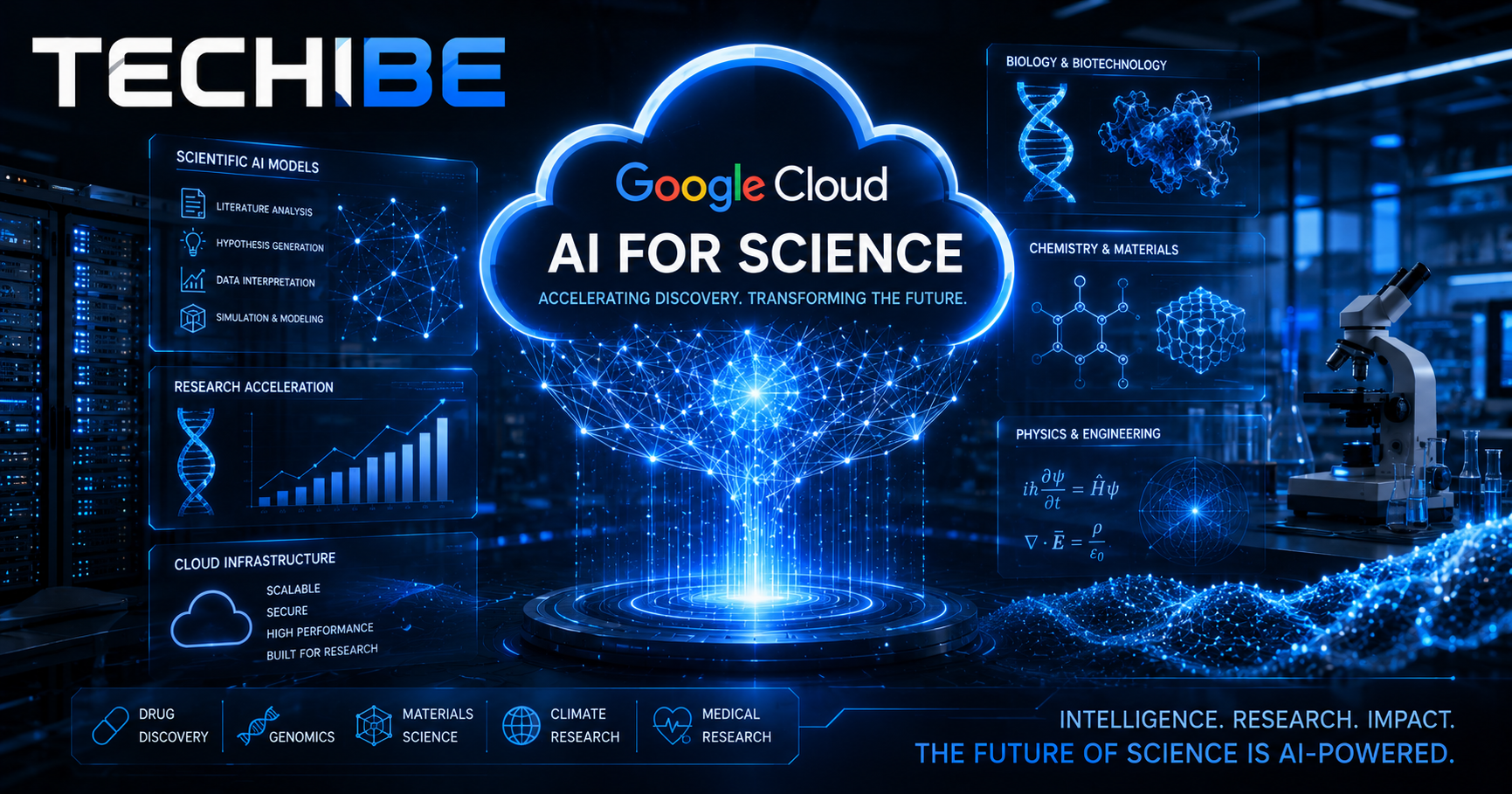
Google Cloud is preparing to offer specialized AI models designed specifically for scientific research, giving researchers access to advanced AI systems that can accelerate work in biology, chemistry, physics, materials science, and other fields. The initiative reflects Google’s broader strategy to transform AI into a platform for solving complex scientific challenges rather than simply automating routine business tasks.
The announcement highlights a major shift in enterprise AI. Rather than relying solely on large, general-purpose language models, organizations are increasingly adopting domain-specific AI models optimized for specialized industries and research disciplines.
For Google Cloud, the expansion into scientific AI strengthens its position in the growing enterprise AI market while creating new opportunities for universities, pharmaceutical companies, research labs, healthcare organizations, and industrial innovators.
Why Scientific AI Is Becoming a Major Technology Trend
Modern scientific research generates vast amounts of complex data.
Researchers routinely analyze millions of academic papers, genome sequences, molecular structures, laboratory experiments, climate simulations, and engineering datasets that are impossible to process manually on practical timescales.
Specialized AI models are designed to help scientists identify patterns, generate hypotheses, review the literature, analyze experimental data, and support computational simulations.
Rather than replacing researchers, these systems act as intelligent research assistants that can dramatically reduce the time it takes to make new discoveries.
Google has described its vision as using AI to expand the scale and precision of scientific discovery through purposeful research tools and agent-based AI systems.
Why Google Cloud Is Investing in AI for Science
Enterprise customers increasingly expect cloud service providers to deliver more than just computing infrastructure.
Today’s organizations want complete AI platforms that combine high-performance computing, specialized foundational models, secure cloud services, and collaboration tools into a seamless ecosystem.
Google Cloud already offers enterprise AI services through Vertex AI and Gemini, but scientific AI represents an important expansion into a high-value market where advanced reasoning, domain expertise, and computational precision are essential.
By offering AI models tailored to scientific workloads, Google aims to help research institutions accelerate innovation while strengthening the competitiveness of its cloud platform against other enterprise AI providers.
How AI Could Transform Scientific Research
AI is increasingly becoming a core research tool rather than an automation technology.
Scientists spend a lot of time reviewing published studies, analyzing experimental results, designing simulations, and identifying promising research directions. Specialized AI models can dramatically speed up these processes by processing vast scientific datasets in minutes instead of weeks.
Google's Scientific AI initiative aims to support researchers across the entire research lifecycle—from literature review and hypothesis generation to data interpretation and computational modeling.
Potential applications include:
Drug discovery and pharmaceutical research
Protein and molecular structure prediction
Climate and environmental modeling
Materials science and semiconductor research
Medical imaging and disease analysis
Physical simulations and engineering optimization
Rather than replacing scientific expertise, these AI systems are designed to augment human researchers, allowing them to focus on creativity, experimentation, and critical decision-making.
Why Specialized AI Models Matter
The AI industry is rapidly moving away from one-size-fits-all language models.
Businesses increasingly need AI systems trained or optimized for specific industries, where domain knowledge is essential to produce accurate and reliable results.
Scientific research presents unique challenges because it involves complex terminology, mathematical reasoning, experimental methods, and highly specialized datasets.
Purpose-built AI models can better understand scientific language, process technical publications, and help researchers perform tasks that general AI systems may struggle to consistently perform.
This shift toward vertical AI solutions reflects a broader organizational trend in which organizations are adopting specialized AI models tailored to healthcare, finance, manufacturing, cybersecurity, legal services, and scientific innovation.
For Google Cloud, expanding into scientific AI strengthens its enterprise investment portfolio while also making its cloud platform stand out in the increasingly competitive AI market.
Competition in the Scientific AI Market
Google is not the only company that has recognized the commercial potential of AI-powered scientific research.
Technology companies, cloud service providers, pharmaceutical companies, and research institutions are investing billions of dollars in AI systems that can accelerate discoveries in the fields of medicine, biotechnology, chemistry, and engineering.
The competition is increasingly shifting from consumer AI applications to enterprise solutions that deliver measurable productivity improvements and real-world scientific advances.
As organizations increase their investment in AI-based research, cloud platforms that offer specialized infrastructure, advanced AI models, and secure collaboration environments are expected to play a more important role in the future of global innovation.
The Future of AI-Powered Scientific Discovery
Artificial intelligence is expected to become one of the most influential tools in scientific research over the next decade.
As AI models become more specialized and capable of understanding complex scientific domains, researchers will be able to analyze larger data sets, simulate experiments faster, and identify promising discoveries more efficiently.
Rather than replacing labs or scientists, AI will increasingly act as an intelligent collaborator – accelerating research while allowing human experts to validate findings and make critical decisions.
Google Cloud’s investment in scientific AI reflects a broader industry shift toward building domain-specific AI platforms that solve real-world challenges, rather than focusing solely on conversational AI.
What This Means for Enterprise AI
This move by Google illustrates how enterprise AI is evolving beyond mere productivity applications.
Organizations are increasingly seeking AI platforms tailored to specific industries, where specialized knowledge generates greater business value than general-purpose AI assistants.
For research institutions, access to AI models specifically designed for science can significantly shorten development timelines and enhance research productivity.
For pharmaceutical companies, faster molecular analysis can accelerate drug discovery.
For universities, AI can help researchers process decades of scientific literature in a matter of hours.
For industries such as energy, aerospace, semiconductor manufacturing, and biotechnology, scientific AI can become a competitive advantage by enabling faster innovation cycles and more accurate predictive analytics.
As cloud service providers continue to develop industry-specific AI solutions, enterprise adoption is expected to accelerate in sectors that rely heavily on R&D.
Conclusion
Google Cloud’s plan to introduce specialized AI models for scientific research is another major milestone in the evolution of enterprise AI.
Rather than limiting AI to chatbots or office productivity, Google is expanding AI into one of the world’s most important fields—scientific discovery.
By combining cloud infrastructure, advanced AI models, and research-focused capabilities, Google aims to help scientists solve increasingly complex challenges in biology, chemistry, medicine, engineering, and environmental sciences.
As organizations continue to invest in AI-driven research, specialized scientific AI models could become one of the most transformative technologies of the next decade.
For researchers, businesses, and technology leaders, the message is clear: the future of AI will be increasingly specialized, collaborative, and deeply integrated into scientific innovation.
FAQs
1. What is Google AI for Science?
Google AI for Science is an initiative that develops specialized AI models designed to assist researchers in fields such as biology, chemistry, physics, medicine, and materials science.
2. How are scientific AI models different from general AI models?
Scientific AI models are optimized for research-specific tasks, including analyzing scientific literature, interpreting experimental data, generating hypotheses, and supporting computational simulations.
3. Who can benefit from Google's scientific AI models?
Universities, pharmaceutical companies, biotechnology firms, healthcare organizations, engineering companies, and research institutions can all benefit from specialized AI designed for scientific workflows.
4. Why is Google Cloud investing in scientific AI?
Google aims to strengthen its enterprise AI platform by providing industry-specific AI capabilities that accelerate research, innovation, and scientific discovery.
5. What does this mean for the future of AI?
The launch of scientific AI models highlights a growing trend toward specialized AI systems built for specific industries, moving beyond general-purpose chatbots into high-value enterprise applications.