ChatGPT can now complete a purchase on your Visa card from start to finish, without you touching a button. Visa calls it seamless. Security researchers call it a nightmare waiting to happen.
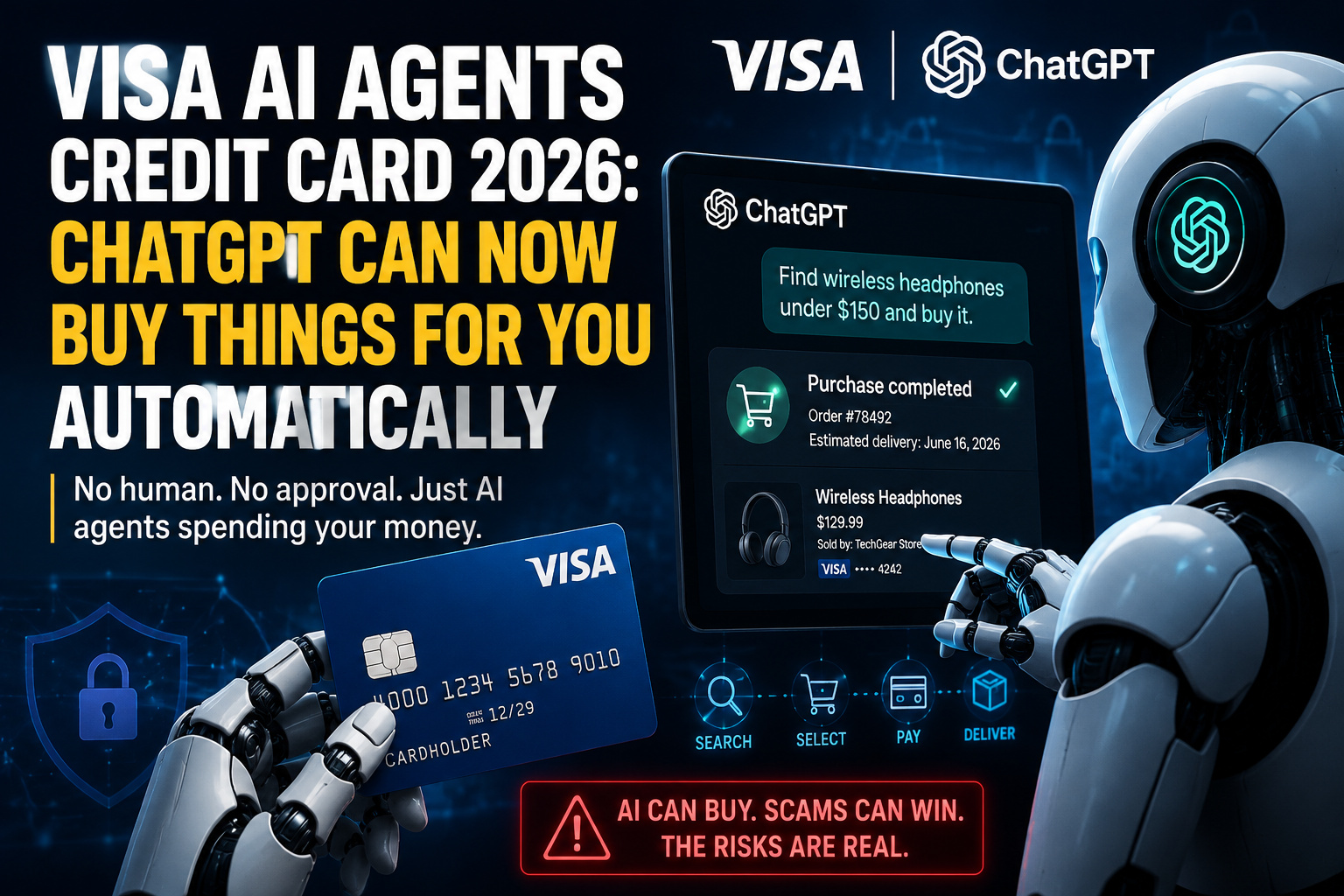
Visa announced on June 11, 2026, that its payment network will now be integrated directly into ChatGPT AI chatbot, allowing it to purchase items on your behalf with your Visa card fully and autonomously. Thanks to OpenAI integration, an AI agent within ChatGPT can now select products, vendors, and shipping details independently without human approval, making possible AI-powered shopping.
What Changed And What Did Not
This is not the first time someone has tried to get AI to handle shopping end-to-end.
OpenAI launched an Instant Checkout feature earlier this year that let you place orders directly inside the ChatGPT interface. It was discontinued in March 2026. The feature never quite landed; a few vendors actually accepted the orders, and the friction of having a human manually approve each transaction defeated the purpose.
The Visa partnership is different in one significant way. Visa is not a vendor. Visa is the payment rail that sits underneath millions of vendors. Integrating at the network level means the problem of vendor acceptance largely disappears. If a merchant takes Visa, and most do, an AI agent using your Visa credentials can now complete a transaction there.
That is a structural change, not a feature update.
How It Works in Practice
Visa’s chief product and strategy officer, Jack Forestell, walked through the mechanics in an interview with the Associated Press on Wednesday.
His example was simple: a customer asks ChatGPT for a pair of wireless headphones under $150. The AI finds options that meet the criteria, selects one, and buys it using the Visa card on file without the user taking any further action.
“I think we’re generally at a place where most people are very comfortable with the shopping aspects of it and have discovered this as a superior discovery experience,” Forestell told the AP.
Then came the honest part.
Going from an AI recommending products to one actually buying them for you, Forestell acknowledged, “requires a whole different level of trust.”
That acknowledgment is important. It signals that Visa knows what it is asking of its cardholders. Whether the trust infrastructure is actually in place to back that ask is a different question.
The Problem Nobody Wants to Say Out Loud
Here is what Visa’s press release did not lead with.
Ask Silver, a scam-detection service, recently documented that ChatGPT was actively recommending fraudulent clones of real storefronts, fake websites designed to look like legitimate retailers, built to steal money and banking details from customers who click through.
That was when humans were still in the loop. Someone still had to decide to click, enter their card details, and complete the purchase themselves.
Remove that human checkpoint. Hand the card to an AI. Tell it to buy the headphones.
The AI does not feel suspicious. It does not notice that the domain was registered three weeks ago. It does not click that the seller has no reviews, or that the shipping address routes through a reshipping service. It finds something that matches the price criteria, and it buys.
This is not a hypothetical edge case. ChatGPT recommending fraudulent storefronts was documented before autonomous purchasing existed. The combination of autonomous AI agents with credit card access is a larger version of a problem that is already real.
Forestell acknowledged the concern without quite addressing it directly. “As AI agents become active participants in the economy,” he told the AP, “Visa’s focus is to ensure transactions are trusted, secure, and seamless.”
Trusted. Secure. Seamless. In that order. Whether that ordering reflects operational reality at launch is something cardholders will find out firsthand.
The Broader Pattern AI Agents and Money
Visa is not doing this alone.
Mastercard made a similar announcement this week, signaling that both major card networks are moving toward AI agent integration simultaneously. This is not a single company experimenting. This is the payment industry collectively deciding that autonomous AI spending is coming and positioning to own the infrastructure layer when it does.
The AI companies have been pushing this direction for over a year. OpenAI, Anthropic, Google, and others have been building and marketing autonomous agent capabilities systems that can browse the web, make decisions, and take actions on a user’s behalf across digital environments. Shopping was always one of the most obvious applications.
The bottleneck was never the AI. The bottleneck was payment authorization. Visa just removed that bottleneck.
What this means for the broader AI agent economy is significant. If AI can now autonomously handle purchasing, not just recommend but actually transact, the use cases that unlock are substantial. Subscription management. Business procurement. Travel booking. Expense filing. Every workflow that currently ends with a human clicking “confirm payment” becomes a candidate for full automation.
That is a large shift in what the internet’s economy looks like at the transaction level.
What Visa Is Promising And What That Promise Covers
Visa says it will be “on top of” fraud risks from autonomous AI purchasing.
The specifics of what that means in practice have not been fully detailed publicly. What Visa has committed to, in general terms, is that its existing fraud monitoring infrastructure, which operates across billions of transactions, will apply to AI agent purchases as it does to human ones.
That infrastructure is genuinely robust. Visa’s fraud detection systems are among the most sophisticated in financial services. They flag unusual patterns, velocity anomalies, and high-risk merchant categories at scale.
But they were built to catch unusual human behavior. An AI agent browsing and buying across a wide range of merchants at unusual hours, in unusual categories, hitting merchants with no transaction history that may read as normal agentic behavior rather than fraud. The models were not trained on this scenario because this scenario did not exist until now.
There is also a consumer protection question that has not been resolved. When a human makes a fraudulent purchase by accident, falling for a scam, Visa’s chargeback protections apply. When an AI agent makes that purchase on your behalf, the liability chain is less clearly established. Did you authorize the agent? Did you authorize that specific transaction? Did you authorize purchases from vendors with no review history?
These are questions that will eventually be resolved in courts and regulations. They have not been resolved yet.
Frequently Asked Questions
What did Visa announce with ChatGPT?
On June 11, 2026, Visa announced it is integrating its payment network into ChatGPT, allowing AI agents to complete purchases autonomously on a user’s behalf using their Visa card. The user does not need to approve each transaction.
How does Visa’s AI agent shopping work?
A user sets up their Visa card with the system and gives ChatGPT a shopping instruction for example, “find wireless headphones under $150.” The AI searches for options that meet the criteria and completes the purchase, including handling payment and shipping details, without further human input.
What happened to OpenAI’s Instant Checkout?
OpenAI launched an Instant Checkout feature earlier in 2026 but discontinued it in March. Few vendors accepted orders placed through the system, and the feature required human approval of each transaction, limiting its usefulness. The Visa network integration resolves the vendor acceptance problem by operating at the payment rail level.
What are the fraud risks of AI agents using credit cards?
Security researchers have documented ChatGPT recommending fraudulent clones of real storefronts before autonomous purchasing existed. With AI agents now able to complete transactions independently, the risk is that an AI selects a fraudulent vendor without detecting the warning signs a human might notice. Visa says its fraud monitoring infrastructure will cover AI agent transactions, but the systems were not designed for this use case.
Is Visa the only card network doing this?
No. Mastercard announced a similar AI agent integration in the same week, indicating that both major card networks are moving toward autonomous AI purchasing infrastructure simultaneously.
What happens if an AI agent buys something fraudulent with my card?
This has not been fully resolved legally or by Visa’s policies. Standard chargeback protections apply to fraudulent transactions, but the liability chain when an AI agent, rather than a human, authorizes a purchase is not clearly established. Regulatory and legal frameworks for this scenario are still developing.