The White House just made AI a warfighting priority. The memo gives the Pentagon new powers, sets hard deadlines, and puts Anthropic in an uncomfortable spotlight.
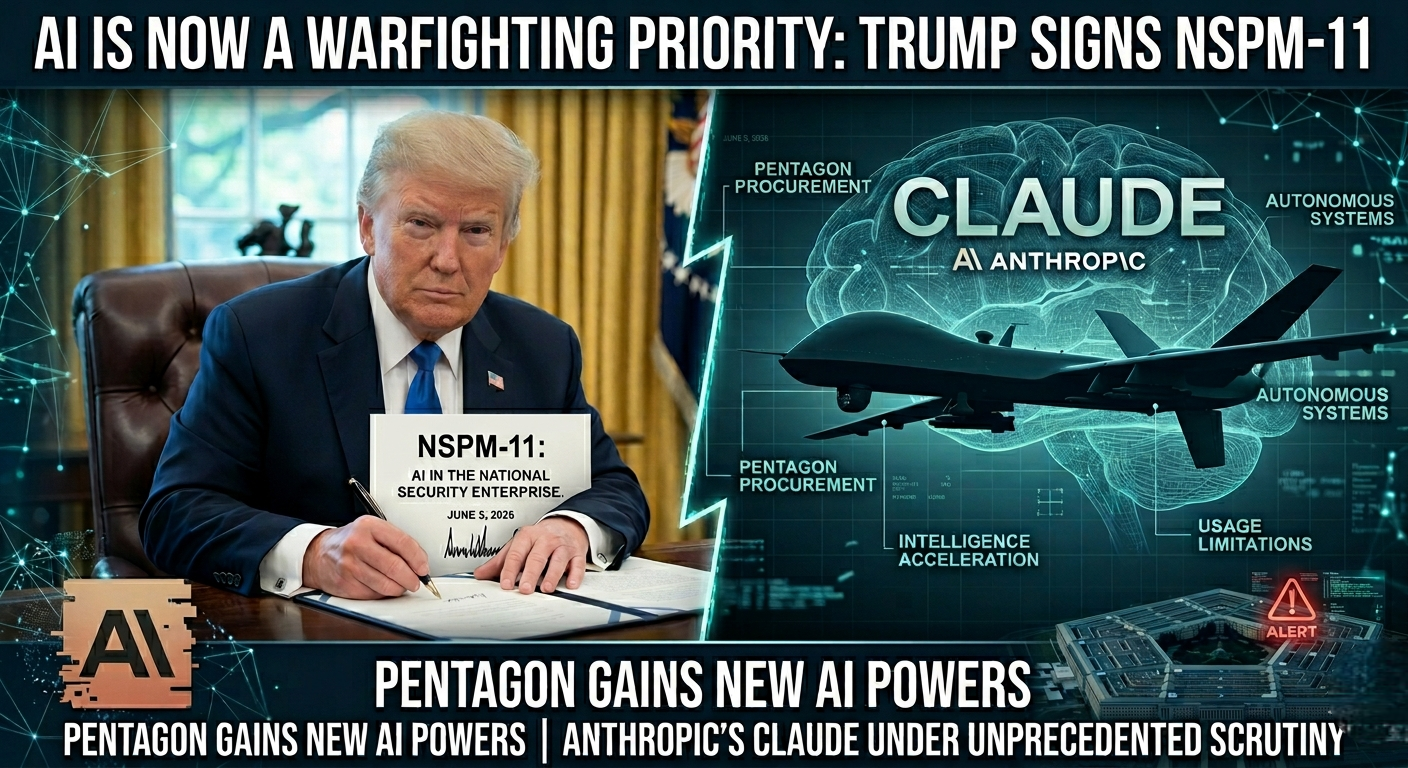
Washington has been talking about AI and national security for years. On June 5, 2026, President Donald Trump signed National Security Presidential Memorandum-11.
He Said:
“Artificial Intelligence in the National Security Enterprise.”
directing the US military and intelligence community to stop talking and start deploying. The order came out of the White House and sets hard deadlines for federal agencies, new procurement rules, and explicit authority to use AI in intelligence and warfighting.
The memo also lands on top of a fight that has been building for months, between the White House, the Pentagon, and at least one major AI company that would rather not be named in the same sentence as autonomous weapons.
What the Memo Actually Orders
NSPM-11 is not a vision statement. It has deadlines and named officials responsible for hitting them. Within 90 days by around September 3, 2026, the Assistant to the President for Science and Technology, the OMB Director, the Secretaries of War and Energy, the Director of National Intelligence, and the Director of the NSA must jointly develop a roadmap ensuring the entire national security enterprise has adequate access to advanced computing resources. That is a short window for that many agencies to agree on anything.
Within 120 days by around October 3, 2026, the Secretary of War and the Director of National Intelligence must review and update procurement processes to speed the onboarding of advanced AI models from multiple vendors. The stated goal: close the capability gap between what is commercially available and what US national security agencies actually have access to.
Defence Secretary Pete Hegseth has 90 days to update the existing directive on the autonomy of weapons systems, specifically to ensure what the memo describes as
“The deliberate adoption of AI systems that respect the chain of command.”
Trump said in the memo.
“Under my Administration, the United States can and will responsibly accelerate the use of AI across intelligence and warfighting domains in line with American values,”
The Anthropic Situation: The Story Behind the Story
The memo does not mention Anthropic by name. It does not need to. In March 2026, the Pentagon gave Anthropic a formal supply-chain risk designation, an extraordinary step, and a rebuke rarely applied to an American tech company. The reason: Anthropic had refused to lift its bans on using its Claude AI model to power autonomous weapons systems and mass domestic surveillance.
The Pentagon’s position was direct. It said it should be able to use the technology as needed, as long as it complied with US law. Anthropic’s position was equally direct: certain uses were off-limits regardless of who was asking.
Reuters has previously reported that the Pentagon had been relying on Anthropic’s technology to support military operations, including in Iran. That reliance made Anthropic’s refusal a significant operational problem rather than a policy disagreement.
Anthropic did not respond to a request for comment on the new memorandum. Trump also said on Friday he planned to host a meeting with AI executives as soon as next week. Whether Anthropic would attend, and under what terms, was not confirmed.
The tension between the White House’s acceleration agenda and Anthropic’s usage limits is the real story underneath the policy announcement. NSPM-11 is partly a response to the fact that some AI companies are drawing lines the government does not want drawn.
The Voluntary Testing Pushes Another Pressure Point
Separately from NSPM-11, the Trump administration announced earlier in the week that it would ask leading AI developers to voluntarily submit their most capable models for government cybersecurity tests before releasing them publicly.
Voluntary is the operative word there. The administration is asking, not requiring. But in a week where the Pentagon has signalled it wants more access and fewer restrictions, “voluntary” carries a particular kind of weight.
Security fears in Washington over increasingly powerful AI systems have been mounting throughout 2026. Models capable of generating working cyberweapons code, assisting in biological research, and conducting sophisticated disinformation operations at scale are no longer theoretical concerns. They exist. Some are already deployed commercially.
The testing ask is a soft pressure point for now. How long it stays voluntary depends largely on what the tests find.
The Talent Pipeline: A Detail That Matters
NSPM-11 also establishes a new AI talent reserve, a framework to bring AI expertise into the national security workforce. The memo explicitly identifies the talent gap between commercial AI development and government capability as a strategic vulnerability.
That framing is notable. The government is not just saying it wants better AI tools. It acknowledges that it does not have enough people who know how to build, evaluate, or govern them.
Closing the procurement gap and the talent gap simultaneously, within 90 to 120 days, is an ambitious timeline. Whether the agencies involved can actually deliver is a separate question from whether the memo orders them to.
Why This Week Matters
Three things happened in the same short window. Trump signed NSPM-11 on June 5, ordering AI acceleration across the military and intelligence community. Earlier in the week, his administration asked AI labs to submit their most powerful models for cybersecurity vetting. And on Friday, Trump said he was planning a meeting with AI executives the following week.
Each of these moves, taken individually, would be a noteworthy policy development. Together, in the same week, they sketch the outline of a strategy: bring AI companies closer to government, create frameworks for their technology to flow into national security applications, and apply pressure through procurement rules, risk designations, and testing asks on companies that resist.
Anthropic is the most visible company that has pushed back. It will not be the last. The line between commercial AI and national security AI, which many assumed would remain clearly drawn for years, is narrowing faster than anyone expected.
Frequently Asked Questions
What is NSPM-11?
NSPM-11 is National Security Presidential Memorandum-11, signed by President Donald Trump on June 5, 2026. Formally titled “Artificial Intelligence in the National Security Enterprise,” it directs the US military, intelligence agencies, and related departments to accelerate AI adoption in warfighting and intelligence operations.
What deadlines does NSPM-11 set?
Within 90 days, relevant agencies must jointly develop a roadmap for adequate computing access across the national security enterprise. Within 120 days, the Secretary of War and Director of National Intelligence must update procurement processes to speed AI model adoption. Defence Secretary Pete Hegseth has 90 days to update the autonomous weapons directive.
Why is Anthropic mentioned in connection with this memo?
In March 2026, the Pentagon gave Anthropic a formal supply-chain risk designation after the company refused to lift bans on its Claude AI model being used for autonomous weapons or mass surveillance. The Pentagon had previously relied on Anthropic’s technology to support military operations. NSPM-11 is partly a response to AI companies drawing usage limits that conflict with government requirements.
What is the voluntary AI testing program?
The Trump administration asked leading AI developers to voluntarily submit their most capable models for government cybersecurity testing before public release. The program is not legally mandatory. The goal is to assess security risks from increasingly powerful AI systems before they reach wide deployment.
What does “responsibly accelerate” mean in Trump’s memo?
Trump used the phrase “responsibly accelerate” to describe the administration’s approach, acknowledging risks associated with AI in military contexts while prioritising speed of adoption over precautionary delays. The phrase signals that safety considerations will not be allowed to block deployment timelines.
Is AI being used in US military operations already?
Yes. Reuters has previously reported that the Pentagon relied on Anthropic’s Claude AI to support military operations, including in Iran, before the supply-chain risk designation was applied in March 2026.