The White House is in talks with Sam Altman’s company about a government ownership deal that could hand ordinary Americans a cut of the AI boom.
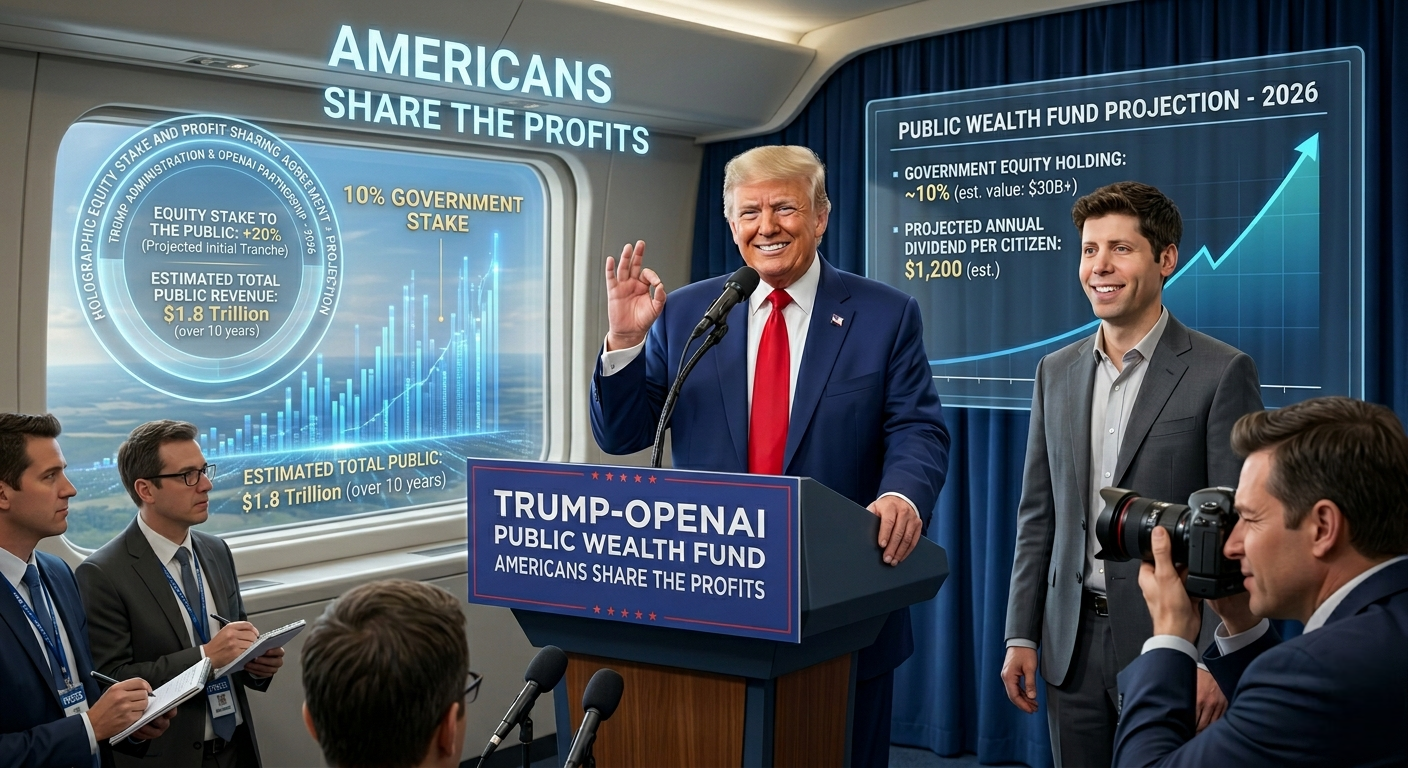
Something unusual is happening on Air Force One this week. President Donald Trump is reportedly in active discussions about the federal government taking an equity stake in OpenAI, Washington D.C. / San Francisco, disclosed on June 5–6, 2026. The goal, Trump says, is simple: make sure ordinary Americans get a share of the money being made from artificial intelligence. The mechanism being discussed is a government ownership position that could seed a public wealth fund.
Nobody has signed anything yet. But the conversations are real, and they are further along than most people expected.
What Trump Actually Said
Trump did not name OpenAI directly in his public comments. Speaking to reporters, including those traveling with him on Air Force One, he described talks with AI executives about arrangements where,
He said,
“pieces could be given to the American public, where the American public essentially becomes a partner with the companies.”
That is a notable framing from a Republican president. Government stakes in private companies are not a typical conservative policy position. But Trump has moved in this direction before. Last year, the federal government took a 10% stake in Intel, the struggling chipmaker, after extended negotiations over subsidies and strategic investment.
OpenAI, by contrast, is not struggling. The company is in the middle of restructuring from a nonprofit into a for-profit corporation and is widely expected to pursue a public offering at some point. Taking a government stake now before an IPO would be a very different kind of deal.
The Public Wealth Fund Idea
CNBC reported details that make this story genuinely interesting: some of the equity under discussion could seed a so-called Public Wealth Fund.
OpenAI itself proposed this concept in a recent policy document. The idea is straightforward enough. Proceeds from the fund would be distributed directly to American citizens, a kind of AI dividend, structured so that people who have no access to venture capital or stock markets can still benefit from what OpenAI builds.
Whether that actually happens and what form it would take are entirely unclear. These are early discussions. But the fact that OpenAI floated the concept in its own policy paper, and that the White House is apparently open to it, suggests both sides see something worth pursuing here.
Bloomberg reports that OpenAI CEO Sam Altman has been pushing the idea of a government stake in major AI companies since early 2025. That is over a year of groundwork before this week’s headlines.
Not Just OpenAI
This is not happening in a vacuum. Senator Bernie Sanders, who sits at the opposite end of the political spectrum from Trump, put forward his own version of this idea just days ago. Sanders proposed a one-time 50% tax on companies like OpenAI, Anthropic, and xAI payable in stock rather than cash. His argument: the trillions that AI could generate should not flow entirely to a handful of founders and investors.
The fact that both Trump and Sanders are landing in roughly the same place, the public should own a piece of AI, from completely different directions, says something about the political moment. David Sacks, the venture investor who served as Trump’s AI and crypto czar before stepping down in March, posted that he understood why Sanders’ proposal resonates, including with many on the right.
“He warned, though, that it risks accelerating what he called “the corporate-government fusion we’re already sliding toward.”
That tension between public benefit and government overreach is going to define this debate.
The Skeptics
Not everyone is reading this as a policy success story in the making. Dare Obasanjo, a former Microsoft product manager with a large following on Bluesky, put it bluntly:
“The groundwork is already being laid for a government bailout of OpenAI.”
That reading flips the frame entirely. Instead of the government getting a good deal on a valuable company, the question becomes whether OpenAI is seeking a powerful protector ahead of a turbulent period of regulatory pressure, compute costs, increasing competition from open-source models, and the scrutiny that comes with going public.
A government equity stake would not just be a financial arrangement. It would create a political relationship. And political relationships cut both ways.
What Happens Next
No deal has been announced. No terms have been made public. The White House and OpenAI have not confirmed a timeline.
What is clear is that the idea has moved from the realm of speculation into active negotiation. Trump has spoken publicly about it. CNBC and Bloomberg, two outlets with strong sourcing in both Washington and Silicon Valley, have both confirmed the discussions are real.
OpenAI is restructuring, eyeing a public offering, and trying to build the kind of political relationships that keep a company out of regulatory crosshairs. The Trump administration is looking for ways to frame AI as a populist project rather than a tech elite windfall.
Whether a government equity stake is the right vehicle for any of that is a genuinely open question. But the conversation is happening, and it is happening now.
Frequently Asked Questions
Q: Is the US government taking a stake in OpenAI?
Active discussions are underway, according to reporting by CNBC and Bloomberg. President Trump confirmed on June 6, 2026, that he has spoken to AI executives about deals where the American public would benefit from AI profits. No formal agreement has been announced.
Q: What is the OpenAI Public Wealth Fund?
OpenAI proposed a Public Wealth Fund in a recent policy document. The concept involves distributing proceeds from a government equity stake directly to American citizens, essentially an AI dividend designed to share profits broadly rather than concentrating them among investors.
Q: Has Trump taken equity stakes in companies before?
Yes. The Trump administration took a 10% equity stake in Intel last year as part of negotiations over chipmaker subsidies and strategic investment in US semiconductor manufacturing.
Q: What does Sam Altman think about a government stake in OpenAI?
According to Bloomberg, OpenAI CEO Sam Altman has been discussing the idea of government stakes in major AI companies since early 2025, well before this week’s public reports.
Q: What does Bernie Sanders propose for AI companies?
Senator Bernie Sanders proposed a one-time 50% tax on companies, including OpenAI, Anthropic, and xAI, payable in stock rather than cash. His goal is to give the public a direct ownership role in AI companies before their values compound further.
Q: What are critics saying about a Trump-OpenAI equity deal?
David Sacks warned of accelerating “corporate-government fusion.” Former Microsoft employee Dare Obasanjo suggested the deal could amount to laying groundwork for a government bailout of OpenAI, raising questions about whether OpenAI is seeking political protection rather than the government securing a good investment.