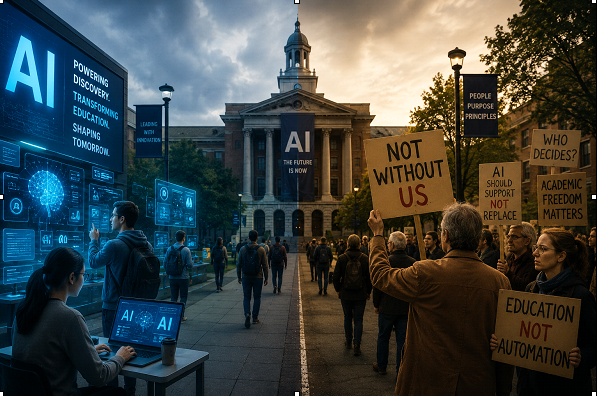
AI is one of the more disruptive and rapidly evolving technologies that is starting to reshape higher education systems. Advanced AI and technologies enable automated learning systems and grading, research assistance, and tailored education. But at one university system, the large-scale adoption of AI is beginning to show the darker side of the technology’s use. Challenges brought on by the large-scale adoption of AI can be just as disruptive as the opportunities.
Large-scale adoption of AI was an aggressive attempt at modernizing education, but it has rapidly become a concern about the future of teaching and academic integrity, and a strong debate about the control of the university.
The Promise of an AI-Powered University
The large-scale AI initiative is intended to improve the efficiency of academic operations and prepare students to enter an AI-dominated workforce.
The administrators’ plans were of a future where students always had access to AI tutoring, faculty could automate the more mundane tasks, and researchers could boost the speed of discoveries with advanced AI and data analysis.
AI has brought a disruptive technology that many industries have begun to use, including healthcare, finance, software development, marketing, and engineering, and supporters of the initiative argued that universities could not afford to ignore AI’s use.
The initiative made sense to many, especially in the competitive higher education market for student enrollment and research funding. AI adoption has become an expectation of workforce preparation and an understanding of AI tools by graduates.
Faculty Concerns Begin to Surface
As implementation expanded, resistance emerged from within the academic community.
Many professors considered AI to be a helpful innovation, but were critical of the rapid, large-scale adoption of AI in education. Some believed that the tech trends were dictating the educational methods rather than the educational methods guiding the tech trends.
Some of the biggest worries included:
- Less focus on critical thought.
- Higher reliance on AI to generate content.
- A growing concern regarding the integrity of academic work.
- Policies for the responsible use of AI are lacking.
- There is little faculty involvement in the decisions.
For educators, it was about the integration of technology. It was the preservation of the primary objective of higher education, which is to aid learning, analyzing, and solving work-related problems without assistance.
Students Find Themselves in The Middle
For students, the reactions have been very bipolar.
Many welcome AI for its ability to simplify and break down complex and difficult information, for the saving of time, providing instant feedback, and improving the quality of almost everything at your fingertips. AI even helps students write better. For students balancing class, work, and personal time, AI is a great tool.
The worry that the over-reliance on AI will damage the necessary skills of writing, critical thinking, and problem-solving is not lost on students.
Students also have trouble understanding the boundaries of acceptable behavior versus academic misconduct due to the inconsistency of policies across different departments.
For better or worse, students are adapting to a fluid system of education that is changing quickly to meet new expectations.
The Challenge of AI Governance
The most important issue goes beyond the classroom.
Universities must tackle tough governance, privacy, and accountability questions before they move on to the difficult balancing acts of the AI age.
Here are a few major concerns that are central to the debate:
Data Privacy
Students using AI systems means investigators need to know how data is collected and how long it is stored and used, if at all.
Algorithmic Bias
AI does not always produce correct or unbiased results. Educational framework safeguards must be implemented if the integrity of educational outcomes is to be preserved.
Academic Freedom
Faculty are concerned about how centralized AI policies could constrain their choice of teaching style and, therefore, compromise the integrity of their discipline.
Long-Term Costs
Although there are efficiency gains, large-scale enterprise systems mean big outlays on infrastructure, staff training, and system support.
Why This Debate Matters for Higher Education
These are all challenges faced in other university systems. Balancing traditional educational values against the pressures of innovation is a challenge for institutions worldwide. Studies indicate that amongst most already established systems of AI, many are in the initial phases of developing tools to draft responsive policy frameworks for governance.
This period of tension assists in illustrating how the deployment of AI in education is not a simple challenge of the application of technology, but a disruption in the transformation of organizational systems and structures, including teaching and learning, and more importantly, the expectations of students and the purpose and function of the institution.
The AI education raises a dilemma that systems within the AI education framework must address: Too much innovation too quickly means that what is designed is counterproductive. Balancing the use of AI in education on a sustainable rather than a disruptive basis.
Rather than seeing AI as simply a danger or a remedy, organizations can realize optimal results by concentrating on integration. This includes:
- Creating a specific AI use policy
- Faculty training/support
- Instruction of AI literacy with traditional skills
- Keeping AI use as oversight in educational policies
- Promoting transparent AI use
The universities of the future will be those that integrate strong educational design with new technologies.
Final Thoughts
The university system, which sits in the middle of all this, should serve as a focus for higher education as a whole. Adoption of artificial intelligence is not about a software purchase or a tool change. It is about design, stakeholder engagement, and envisioning the intersection of learning and technology.
Artificial Intelligence will continue to build out new models of education. Universities will have to balance this with the appropriate concerns around traditional education. The institutions that prosper will be those that recognize the opportunities of AI while retaining the core of education.
The discussions that are developing today are likely to influence how subsequent generations teach and learn to prepare for a future that is inevitably more embedded with AI technology.