Congress failed to renew it. The Senate voted 47-52 just days ago. And yet, the government’s warrantless surveillance program is almost certainly continuing until March 2027 anyway. Here is how that is possible and why it matters.
The law that permits the US government to conduct warrantless electronic surveillance sweeping through millions of Americans’ private communications is set to expire on June 12, 2026. Still, Senators voted 47-52 against renewing it on June 5. Civil libertarian Republicans and unifying Democrats united to oppose it and block its renewal; FISA Section 702 remains at the heart of the debate about how much surveillance power the government should possess and over whom. Yet its scope may extend even after its actual expiration date has come and gone; there may even be another way that its impact remains significant – possibly not actually expiration!
What Is FISA Section 702?
Start with what the law does, as the name itself doesn’t tell much. FISA stands for the c Act and was passed by Congress in 1978. Section 702 was added in 2008 in response to warrantless surveillance programs from post-9/11 that needed legal legitimacy within which to operate.
The law authorizes the National Security Agency (NSA) to collect communications of foreigners located outside the US without first seeking an individual court order for each target – for example, terrorists, state adversaries, and proliferators of weapons of mass destruction.
Communication does not discriminate by nationality. When the NSA intercepts messages sent from foreign targets, they also capture whatever else was said during that conversation, including any email exchange between an American and one of these targets. No consent was ever sought, nor was court approval granted, for the collection.
In its 2023 report on the program, the Privacy and Civil Liberties Oversight Board explained it clearly: Collection under Section 702
“inevitably sweeps up large quantities of Americans’ phone calls, texts, and emails.”
How It Actually Works: The Three Programs
Section 702 runs through three collection programs. Each works differently.
PRISM is the most well-known, largely because of the Edward Snowden disclosures in 2013. Under PRISM, the government sends directives to US technology companies Apple, Google, Meta, Microsoft, and others requiring them to turn over communications to and from specific foreign targets. The companies comply. The user never knows.
Upstream collection is broader: The NSA taps directly into the physical internet infrastructure, the cables and switches that carry internet traffic, and copies communications as they flow through. This is sometimes described as collecting communications “about” a target, not just “to or from” one.
DITU: the Data Intercept Technology Unit is the FBI’s piece of the architecture, managing the actual technical interception process.
One detail from the 2024 RISAA reauthorization deserves specific attention. Congress expanded the definition of who can be compelled to assist surveillance. Data center workers, maintenance crews, and commercial landlords who have physical access to internet infrastructure can now be ordered to help the government conduct surveillance. Newsrooms received no exemption.
The “Backdoor Search” Problem
Foreign collection is one issue. What the government does with that collection afterward is another matter.
Once communications are gathered under Section 702, the FBI, CIA, and NSA can search through them using American names, phone numbers, or email addresses without a warrant. This is called a backdoor search. The target of the original surveillance was a foreigner. The person whose name is now being run through the database is an American who was never individually targeted.
In August 2024, the Department of Justice discovered that the FBI had been quietly running a querying tool that allowed agents to access Americans’ communications without following the procedures designed to prevent abuse, including obtaining supervisory approval, recording reasons for searches, or submitting to internal audits. It took months to shut the tool down.
In March 2026, the FISA Court issued an opinion about the government’s misuse of these filtering tools. That opinion remains classified. The chair and ranking member of the Senate Intelligence Committee sent a letter to the Director of National Intelligence and the acting Attorney General in April demanding declassification. As of this writing, the opinion has not been released.
Why Congress Failed to Renew It
The Senate vote on June 5-47 to 52, failing to advance reauthorization, was not a surprise to anyone who had been watching the politics.
Seven Republicans voted no on civil liberties grounds. Among them: Rand Paul of Kentucky, Mike Lee of Utah, Josh Hawley of Missouri, and Tommy Tuberville of Alabama. Lee’s explanation was direct: “No warrant to protect Americans? No FISA.”
Every Democrat except John Fetterman of Pennsylvania voted no, not because of surveillance concerns, but in protest of Trump’s appointment of Bill Pulte as acting Director of National Intelligence. Democrats called the appointment of an unqualified loyalist to run the country’s intelligence apparatus disqualifying. They would not provide cloture votes while Pulte remained in the role.
The administration would not accept a warrant requirement. The seven civil liberties Republicans would not vote yes without one. Democrats would not vote yes at all. As of June 5, Senate Majority Leader John Thune said publicly, “Next week it gets real. A few days from now, that program goes dark.” It did not go dark. Not exactly.
The Secret That Changes Everything
Here is the part that most coverage is missing. Section 702 surveillance does not run on the calendar directly. It runs on yearlong certifications approved by the Foreign Intelligence Surveillance Court, the FISA Court. In March 2026, the Trump administration obtained a new secret certification from the FISA Court for the program.
Those certifications, and the directives issued to companies under them, are legally grandfathered. They remain valid until their own expiration date, regardless of whether the underlying statute has expired.
The March 2026 certification runs until March 2027. What this means in practice: even if Congress does nothing, even if Section 702 formally sunsets on June 12, the government’s surveillance authority under the existing certification almost certainly continues for another nine months. Liza Goitein of the Brennan Center for Justice laid this out clearly in a June 4, 2026, thread on X, explaining how surveillance will continue until March 2027 regardless of congressional action.
The Brennan Center does note one risk: some communications providers might refuse to comply with government directives if the underlying statute has expired. That concern is not a national security crisis, is the more practical worry for the intelligence community right now.
What Has Changed Since Section 702 Was Created
The surveillance architecture of 2026 is not what it was in 2008.
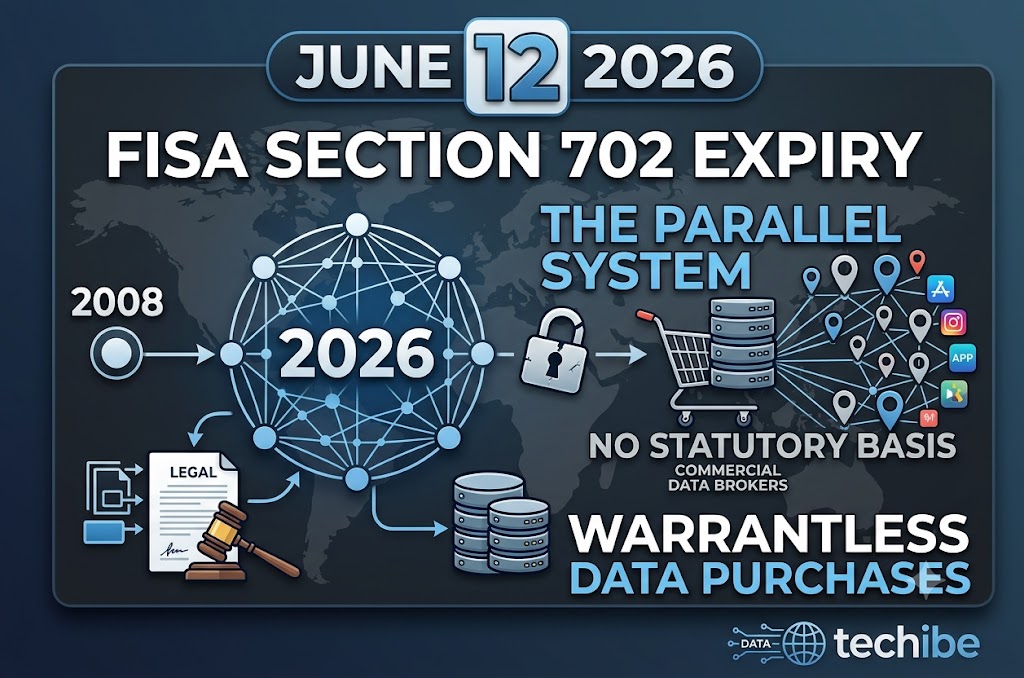
A parallel system has grown up alongside Section 702 that operates with no statutory basis at all. Federal agencies buy location history, browsing data, and movement patterns from commercial data brokers. The legal theory: purchasing data is not a constitutional search. No court has fully agreed or disagreed with that position.
This data broker loophole means that even a full expiration of Section 702 would not end the government’s ability to build detailed profiles of Americans’ movements and online behavior. It would simply shift the method. The constitutional question of whether the government can buy what it cannot legally compel has never been resolved.
Where Things Stand on June 10
Congress has until June 12. There is no deal in sight.
The House passed a three-year extension in April by a vote of 235 to 191, but attached an unrelated ban on Central Bank Digital Currency, a move designed to attract conservatives, which complicated Senate passage. Both chambers passed a 45-day clean extension in late April to allow more time for negotiations. That extension expires June 12.
As of June 10, the warrant requirement dispute remains unresolved. Democrats have not moved on Pulte. The administration has not moved on warrants. Seven Republicans have not moved on their civil liberties position.
The program will likely continue operating under the March 2026 FISA Court certification regardless of what happens on June 12. But the legal ambiguity that follows a formal statutory expiration creates problems for the intelligence community’s relationships with tech companies, for ongoing court cases challenging the program, and for the political accountability of a surveillance authority that affects millions of people who have no idea it exists.
Frequently Asked Questions
What is FISA Section 702?
FISA Section 702 is a US surveillance law enacted in 2008 that authorizes the National Security Agency to collect communications of foreign nationals located outside the United States without an individual court order. It inevitably captures large amounts of Americans’ communications in the process, since foreign targets communicate with people inside the US.
When does FISA Section 702 expire?
FISA Section 702 is scheduled to expire on June 12, 2026. The Senate voted 47-52 on June 5 to block reauthorization, leaving Congress without a path to renewal before the deadline.
Will surveillance actually stop on June 12, 2026?
Almost certainly not. In March 2026, the Trump administration obtained a secret certification from the FISA Court that runs until March 2027. That certification grandfathers existing surveillance authority regardless of whether the underlying statute expires, meaning the program likely continues operating until at least March 2027.
Why did the Senate fail to renew Section 702?
A coalition of seven civil liberties Republicans, including Rand Paul and Mike Lee, refused to vote yes without a warrant requirement for backdoor searches of Americans’ communications. Every Democrat except John Fetterman voted no in protest of Trump’s appointment of Bill Pulte as acting Director of National Intelligence. The administration refused to accept a warrant requirement.
What is a backdoor search under Section 702?
A backdoor search occurs when US intelligence agencies, particularly the FBI, search through communications collected under Section 702 using American names, phone numbers, or email addresses. Although Section 702 targets foreigners abroad, the collected data contains Americans’ communications. Searching that data by American identifiers without a warrant is what critics call the backdoor search loophole.
What is the data broker loophole in US surveillance?
Federal agencies routinely purchase location history, browsing data, and movement patterns from commercial data brokers without a warrant or court order. Their legal theory is that buying data is not a constitutional search. No court has definitively resolved this question. This loophole operates entirely outside Section 702 and would continue even if the law fully expired.