SK Hynix, SK Telecom, Naver, and Doosan all signed. The memory supply chain just got a lot more secure, and South Korea just became Nvidia’s most important partner outside the United States.
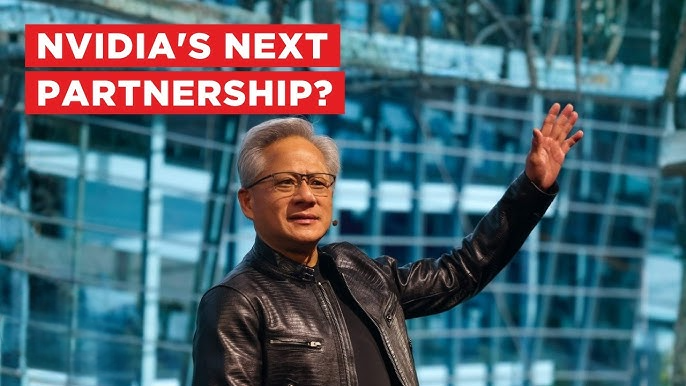
Jensen Huang did not fly to Seoul just to eat fried chicken and throw a baseball pitch, though he did both. The Nvidia CEO arrived in South Korea on June 5 and spent the weekend dining with the country’s top corporate bosses before getting down to business on Monday, June 8.
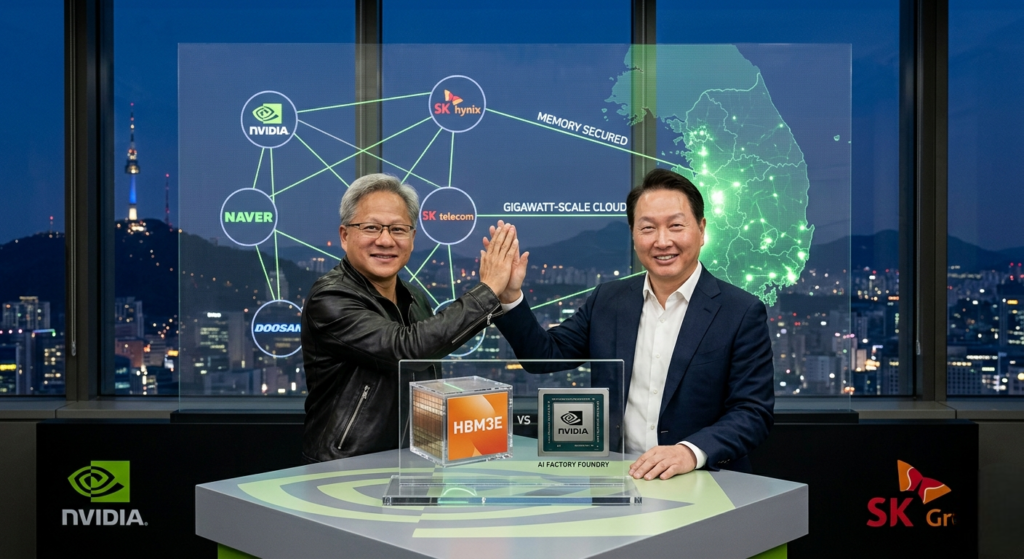
What came out of those conversations was significant. NVIDIA announced a series of deals in South Korea with SK Hynix, Naver, SK Telecom, and Doosan Group, a sweep of partnerships that touch memory chips, AI cloud infrastructure, internet services, and industrial energy. None of the parties disclosed financial terms. They did not need to. The strategic signal was loud enough on its own.
The Deal That Actually Matters SK Hynix
Of everything announced Monday, the SK Hynix partnership is the one that will define Nvidia’s next three years.
SK Hynix signed a multi-year technology partnership with Nvidia to advance next-generation memory technologies for AI factories. That sounds dry on paper. In practice, it means Nvidia has locked in its most critical supplier at exactly the moment when everyone else is scrambling for the same chips.
The deal specifically reinforces Nvidia’s access to high-bandwidth memory HBM the key component that powers advanced AI systems. HBM is not a commodity. It is the bottleneck. Every AI data center on the planet needs it, and there is not enough of it. SK Hynix and Samsung are the two companies that make it at scale.
Huang was direct about the relationship’s scale.
“SK Hynix has been Nvidia’s largest memory partner. SK Hynix will continue to be Nvidia’s largest memory partner,”
He said after meeting SK Group Chairman Chey Tae-won at the group’s Seoul headquarters.
“We already procure, and we buy from SK Hynix already billions and billions of dollars each year, and it’s going to grow substantially.”
That last line, billions growing substantially, is what the market will remember. SK Group Chairman Chey Tae-won framed it as the product of years of shared work:
“SK Hynix and Nvidia have been building toward this for years, and this partnership reflects the depth of that collaboration.”
As part of the agreement, both companies also plan to cooperate on simulation technology required for semiconductor development, a detail that has gotten less attention than it deserves. Simulation work means they are not just agreeing to buy and sell chips. They are building the next generation of chips together.
SK Telecom A Gigawatt-Scale Bet
The second major announcement involves a different kind of infrastructure entirely.
SK Telecom said it plans to build a gigawatt-scale AI cloud infrastructure platform using Nvidia technology, with its first AI data center expected to launch in 2027.
Gigawatt-scale is not a term that gets used loosely. It is the kind of power consumption associated with the largest hyperscale facilities in the world. For a telecom operator, even one of South Korea’s largest, committing to that scale is a significant strategic pivot toward becoming an AI infrastructure provider.
Naver and Doosan Round Out the Week
Internet giant Naver and conglomerate Doosan Group also signed agreements to use Nvidia technology to help build AI data centers.
Naver is South Korea’s dominant search and internet platform, the Google of Korea, in rough terms. Its AI data center ambitions have been growing for years. An Nvidia partnership gives it a direct line to the hardware that its AI services will depend on.
Doosan is different. It is an industrial conglomerate with interests in energy, heavy equipment, and manufacturing. Its involvement in AI data center infrastructure signals how far the buildout has moved beyond the traditional tech sector.
What Huang Is Actually Doing in Seoul
The fried chicken and baseball pitch made for good photos. But Huang’s South Korea trip has a sharper strategic purpose underneath the optics.
Huang is also expected to meet Samsung semiconductor chief Jun Young-hyun on Monday and executives from LG during his South Korea visit. That means Nvidia’s two largest memory chip suppliers, SK Hynix and Samsung, are both getting face time in the same week.
South Korea sits at the center of the global AI hardware supply chain in a way that is easy to underestimate. SK Hynix and rival Samsung Electronics are the world’s two largest makers of memory chips, which are key components in data centers. Every Nvidia GPU that ships into an AI data center somewhere in the world has memory inside it that almost certainly came from one of these two companies.
Securing that supply, not just for this quarter but for the next two years and beyond, is what this week was really about.
Huang said in a statement that a sustainable supply of memory is essential for building AI factories that will power the new AI-led industrial revolution.
“Advanced memory is at the core of their performance. By jointly developing next-generation memory for AI factories, we will accelerate the expansion of global AI infrastructure, from frontier model training to agentic AI and physical AI.”
One More Thing The Senate Is Watching
Not everything about Huang’s South Korea trip is celebratory. Senator Elizabeth Warren has invited Nvidia CEO Jensen Huang to testify before the Senate over the company’s China business.
The invitation landed while Huang was in Seoul closing deals. The timing was not accidental. As Nvidia deepens its ties with Asian partners and expands its global footprint, its relationship with China and the export controls that govern it remains a live political issue in Washington. Huang has not confirmed whether he will testify.
Why This Week in Seoul Changes Things
Memory is the AI industry’s most constrained resource right now. Not compute. Not software. Memory.
Every major AI model that runs inference at scale, every ChatGPT query, every Gemini API call, every enterprise AI deployment requires high-bandwidth memory to function. The more capable the model, the more memory it needs. Demand has been growing faster than the industry’s ability to supply it.
What Nvidia did this week in Seoul was lock in the supply chain before the next wave of demand hits. The multi-year structure of the SK Hynix deal is particularly deliberate; it extends beyond the current product cycle and into a period when AI infrastructure spending is widely expected to accelerate further.
South Korea just became Nvidia’s most important partner outside the United States. That is not a small thing.
Frequently Asked Questions
Q: What did Nvidia and SK Hynix agree to?
SK Hynix signed a multi-year technology partnership with Nvidia focused on developing next-generation memory chips, particularly high-bandwidth memory, for global AI data centers. The deal also includes cooperation on semiconductor simulation technology. Financial terms were not disclosed.
Q: How much does Nvidia spend with SK Hynix?
Nvidia CEO Jensen Huang said on June 8, 2026, that Nvidia already buys “billions and billions of dollars each year” worth of products from SK Hynix and expects that spending to grow substantially under the new agreement.
Q: What is SK Telecom building with Nvidia?
SK Telecom announced plans to build a gigawatt-scale AI cloud infrastructure platform using Nvidia technology. Its first AI data center under the agreement is expected to come online in 2027.
Q: Who else signed deals with Nvidia in South Korea?
Naver, South Korea’s dominant internet company, and Doosan Group, an industrial conglomerate, both signed agreements to use Nvidia technology in building AI data centers.
Q: Why is Jensen Huang visiting South Korea?
Huang’s trip, which began June 5, 2026, was aimed at securing long-term supply chain partnerships with South Korean technology leaders. South Korea is home to SK Hynix and Samsung — the world’s two largest producers of HBM memory chips critical to Nvidia’s AI hardware.
Q: Is Nvidia facing any political pressure during the Seoul trip?
Yes. Senator Elizabeth Warren invited Nvidia CEO Jensen Huang to testify before the US Senate regarding Nvidia’s China business dealings. The invitation arrived while Huang was in Seoul. He has not confirmed whether he will appear.